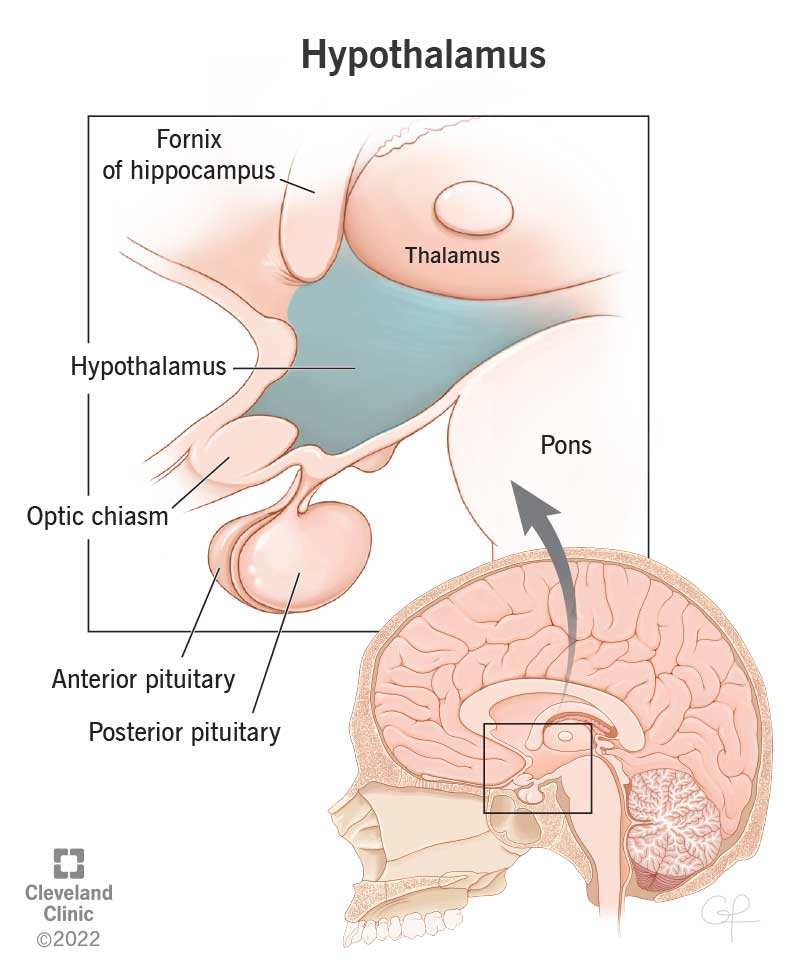
hypothalamus
Brain structureWikipedia
11
MENTIONS
10
EPISODES
9
PODCASTS
Search complete. 11 mentions across 10 episodes found for "hypothalamus".
Sep 10, 2026

Karl KruszelnickiHOST
But then in the medium to long term, you get what's called the hypothalamic axis.
Karl KruszelnickiHOST
A- look it up in Wikipedia, H-Y-P-O-T-H-A-L-A-M-I-C axis, and that can then cause long-term changes.
Karl KruszelnickiHOST
And if you don't want these long-term changes to happen, you got ac- you may...
Karl KruszelnickiHOST
I'm guessing here, if you haven't got any physical changes, you may have accidentally got conditioned, like the poor, uh, publicists who can't drink champagne anymore, and you c- the good news is you can condition yourself back again in many cases.

Jim RothmanGUEST
Fly brain has maybe, I don't know, 200,000 nerve cells.
Jim RothmanGUEST
Well, you know, that's about as much as your hypothalamus.
Jim RothmanGUEST
Hypothalamus is kind of interesting.
Jim RothmanGUEST
It's, you know, controlling your weight, okay, and a lot of other things.
Jim RothmanGUEST
So that having the complete wiring diagram of bits of the human brain that are functional and dedicated to areas of medicine and to do so as if it were an afternoon's biochemical assay could be very, very valuable.

Jennifer GarrisonGUEST
And hypothalamus is right.
Jennifer GarrisonGUEST
A neural circuit is a bunch of different parts of your brain that talk to each other to control something.
Jennifer GarrisonGUEST
Hypothalamus is like command central for all of those homeostats.
Jennifer GarrisonGUEST
And it is also a place where...
Jennifer GarrisonGUEST
it uses this kind of wifi signaling a lot.
Chris WhartonHOST
Hmm.
Jennifer GarrisonGUEST
And hypothalamus is like when a, you know, a neural circuit is a bunch of different parts of your brain that talk to each other to control something.
Jennifer GarrisonGUEST
Hypothalamus is like command central for all of those homeostats.
Jennifer GarrisonGUEST
And it is also a place where, um, it uses this kind of Wi-Fi signaling a lot.
Jennifer GarrisonGUEST
And it happens to be a hotspot where inflammation goes up with age.

Julius MarquisHOST
It's very unhappy by yourself.
Julius MarquisHOST
Hypothalamus is in a position to take information that may be reflexive like the ick, but put a cognitive interpretation on that experience.
Julius MarquisHOST
Okay.
Julius MarquisHOST
Uh, we learn to put appropriate social, societal interpretations on our sensory information.

speaker_2HOST
I might expand it once we're done covering part one and part two and go further into these topics maybe to help you in the future just in general.
speaker_2HOST
Hypothalamus manages hunger, thirst, and body temperature and controls the HPA axis for stress response.
speaker_2HOST
A lot of times you'll get questions that are connected to trauma, addiction, or regulatory disorders.
speaker_2HOST
So if a client with PTSD shows hypervigilance and poor memory, for the trauma you're seeing here what an overactive amygdala that's hypervigilance the sympathetic nervous system kicks in and impaired hippocampus integration so encoding memories could be a problem here the hp axis which we've talked about before regulated by the hypothalamus also connects stress to illness so chronic overactivation floods the body with cortisol increasing vulnerability to anxiety depression and metabolic disease and we covered this in another episode Subcortical structures, subcortical meaning underneath the cortex, deep in the brain lie the basal ganglia, the thalamus, and the brainstem.

speaker_2HOST
I might expand it once we're done covering part one and part two, and go further into these topics maybe to help you in the future just in general.
speaker_2HOST
Hypothalamus manages hunger, thirst, and body temperature, and controls the HPA axis for stress response.
speaker_2HOST
A lot of times you'll get questions that are connected to trauma, addiction, or regulatory disorders.
speaker_2HOST
So if a client with PTSD shows hypervigilance and poor memory for the trauma, you're seeing here what? An overactive amygdala, that's hypervigilance.

CarlosHOST
I might expand it once we're done covering part one and part two and go further into these topics maybe to help you in the future just in general.
CarlosHOST
Hypothalamus manages hunger, thirst, and body temperature and controls the HPA axis for stress response.
CarlosHOST
A lot of times you'll get questions that are connected to trauma, addiction, or regulatory disorders.
CarlosHOST
So if a client with PTSD shows hypervigilance and poor memory for the trauma, You're seeing here what? An overactive amygdala.

Marek DoyleGUEST
But also, yeah, is there going to be that same level of... resources registered where it matters.
Marek DoyleGUEST
Hypothalamus and the areas it works alongside, it's not going to receive the same insulin signal now.
Marek DoyleGUEST
It's going to think we've got less than we have.
Marek DoyleGUEST
More stress response required with