Hypha
8
MENTIONS
7
EPISODES
6
PODCASTS
Search complete. 8 mentions across 7 episodes found for "Hypha".
Sep 23, 2026

speaker_0HOST
It usually begins with airborne spores, which attach to the outer shell of the insect's abdomen, called the external integument.
speaker_0HOST
Hyphae then grow filamentously through the shell, dissolving it and using various enzymes including chitinases and specialized structures called appressoria to penetrate the shell.
speaker_0HOST
Once within the primary body cavity, called the hemicoel, the hyphae colonize the tissue, switching to a yeast-like structure by growing as a cluster of independent, free-flowing yeast-like cells called blastospores that use a mitotic budding strategy to multiply.
speaker_0HOST
This increases the fungus's speed of propagation, as well as helping bypass the host's immune response.
speaker_0HOST
It usually begins with airborne spores, which attach to the outer shell of the insect's abdomen, called the external integument.
speaker_0HOST
Hyphae then grow filamentously through the shell, dissolving it and using various enzymes including chitinases and specialized structures called apressoria to penetrate the shell.
speaker_0HOST
Once within the primary body cavity called the haemocol, the hyphae colonize the tissue, switching to a yeast-like structure by growing as a cluster of independent, free-flowing yeast-like cells called blastospores that use a mitotic budding strategy to multiply.
speaker_0HOST
This increases the fungus's speed of propagation, as well as helping bypass the host's immune response.

speaker_1HOST
Yes.
speaker_1HOST
Beneath the visible mold, microscopic thread-like filaments called hyphae begin to spread through the damp wood.
LernerHOST
Hyphae.
speaker_1HOST
Right?
LernerHOST
Yeah.

speaker_1HOST
Germination, right.
speaker_2HOST
Once it wakes up, it starts to send out these incredibly tiny hollow threads called hyphae.
speaker_1HOST
Hyphae.
speaker_1HOST
H-Y-P-H-A-E.
speaker_1HOST
So they look like little strings or roots.

KellyHOST
Unlike bacteria, yeasts are eukaryotic, so they do not gram stain reliably, which is an important distinction in the laboratory when differentiating fungal cells from bacterial cells.
KellyHOST
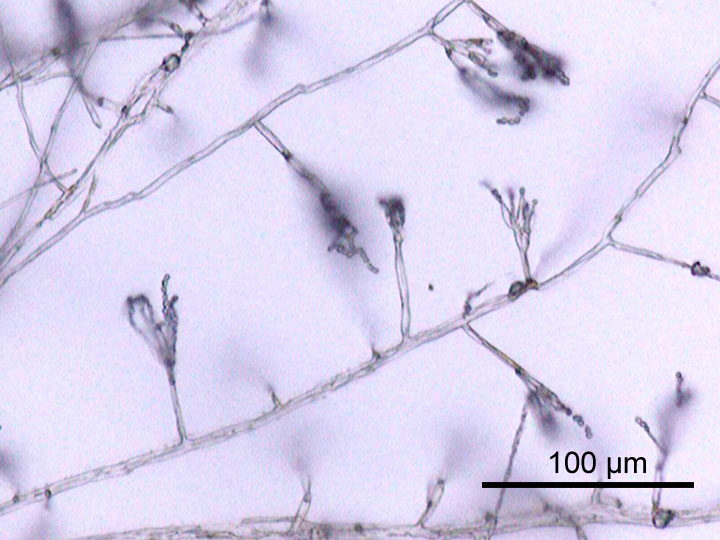
Hyphae, on the other hand, look like long threads.
KellyHOST
Bread mold is a great example.
KellyHOST
They appear fuzzy because they grow in long filaments.
KellyHOST
Hyphae can be septate, where the filaments are segmented, or non-septate, which is one long filament.
KellyHOST
Collectively, filaments form a mycelium, which maximizes surface area for nutrient absorption by the organism.
KellyHOST
Fungi are heterotrophs, just like humans.

AndreaGUEST
It has been interesting, you know, right now we have the third generation coming into the business.
AndreaGUEST
We have three children and they have all three started working at Hyphal in the last two years.
AndreaGUEST
And it's been really good for us too as a reminder that as they've gone out and started doing things, you know, learning that not everybody does know the story of the company and not everybody, you know, is aware that, oh, this was, is a family business and that these are the people that actually invented high float.
AndreaGUEST
This was their idea.

speaker_2NARRATOR
The fungal threads I'd glimpsed earlier proved, under the microscope, to be neither ordinary mycorrhiza nor any known pest.
speaker_2NARRATOR
Hyphae branched in asymmetrical, almost spiraling formations, reminiscent of neurological tissue diagrams.
speaker_2NARRATOR
I found traces of a faint chemical signature, a methylated compound used in high-level lab research, a proprietary tag, engineered.
speaker_2NARRATOR
Somewhere near I heard laughter, jagged, forced from a group of three workers.