Hypermobility spectrum disorder
31
MENTIONS
8
EPISODES
5
PODCASTS
Search complete. 31 mentions across 8 episodes found for "Hypermobility spectrum disorder".
Sep 10, 2026

Linda BluesteinHOST
Dr. Ina Stephens is Associate Director of the UVA Health EDS and Hypermobility Disorders Center, who we are so proud to partner with to bring you conversations that connect cutting-edge science with practical, compassionate care for our community.
Linda BluesteinHOST
This conversation includes so many topics, including fermented foods and MCAS and histamine, Munchausen's by proxy, medications and supplements for migraine, why diagnosis matters in children, and what to do while you're waiting to get assessed for a possible hypermobile EDS or HSD diagnosis.
Linda BluesteinHOST
This podcast is for education only, and it's not a substitute for personalized medical advice.
Linda BluesteinHOST
Stay to the end for a hypermobility hack.
8 MINS LATER
Ina StephensGUEST
I think it's mostly based on cardio as well.
Linda BluesteinHOST
Okay, no problem.
Linda BluesteinHOST
Um, the second point that I wanted to make was I was doing a literature search the other day, and I came across a study looking at nutrition in people with hypermobile EDS and HSD, and it was so interesting because they were talking about how in that group of people they were eating, um, high amounts of protein, generally speaking, um, but they were eating really low amounts of fiber.
Linda BluesteinHOST
So it's really interesting that you pointed that out as one of the things that can contribute to dysbiosis, um, because I don't think a lot of people think about that, even though when I had Lorna Ryan on the podcast, she brought that up as a factor.
Linda BluesteinHOST
And I could think of so many different directions that that could go.
Linda BluesteinHOST
And I think doing an entire episode geared towards family and friends to understand about connective tissue disorders like hypermobile EDS and HSD is a really good idea.
Linda BluesteinHOST
So if you also like this idea, I'm going to give you a little bit of information now, but I also would suggest that you go to bendybodiespodcast.com and let me know what kind of information you want your family and friends to have so that we can then create that episode for you.
Linda BluesteinHOST
So that's the first thing.
Linda BluesteinHOST
Then the second thing that I think I want to just mention is that for family and friends, one of the things that they have the most difficulty understanding is the variability from day to day.
Linda BluesteinHOST
So whether you have hypermobile EDS or HSD or MCAS or POTS, any of those conditions, it can be that you feel really great one day and then you are significantly impaired the next.
Linda BluesteinHOST
Or even just a few hours later, you can be significantly different than you were just a few hours sooner.
Linda BluesteinHOST
So a lot of family members can end up thinking that the person is exaggerating or they're not being consistent or they're not trying hard enough.

Ashton WilsonHOST
an incredible amount of time when you think of it like that.
Ashton WilsonHOST
To see the evolution of how we look at HEDS and HSD and hypermobility in general, I think that it's just credit to you for being a big part of that evolution as well.
Ashton WilsonHOST
Because you're right in saying we have more understanding now, but I think that there is still that gap in knowledge that Especially when it comes to, you know, how do we get hypermobile people strong? You know, we know that strength is a really important part as far as stabilizing joints, reducing risk of injury, reducing pain.
Ashton WilsonHOST
But where do we start? How do we do it? And that's often the question I find myself facing with people is they come in going, I've been told this.
Linda BluesteinHOST
Do, do you all think that, uh, these are separate diseases that, um, Dr. Fitzgerald, you kind of started to comment on this a little bit.
Linda BluesteinHOST
So do you think that, you know, hypermobile EDS, HSD, POTS, MCAS, ME/CFS, long COVID, you know, et cetera, are these, uh, separate diseases? Do you think that neuroinflammation is something that happens with, you know, most people with mast cell activation? How does this fit in with autonomic dysfunction and all of these other things? Do they have shared biologic pathways? What do you think is the story there?
Megan FitzgeraldGUEST
Sorry, that's a lot of questions.
Megan FitzgeraldGUEST
Um, I, I can say for, for one of them, um, MCAS, I think is, you know, neuro- neuroinflammation.

Melissa KoehlGUEST
So like once you meet that cutoff of that, that gives you the sign that gives you the official diagnosis of hypermobile EDS versus hypermobility spectrum disorder.
Melissa KoehlGUEST
But there's many experts will argue that it's kind of arbitrary because it's symptomatically like when they're treating these people in the clinic, they're the same, right? Like even though they, okay, this group has the scars and maybe their skin's a little more fragile, but these people have just as bad dysautonomia and POTS in their mast cell or in upper cervical instability.
Melissa KoehlGUEST
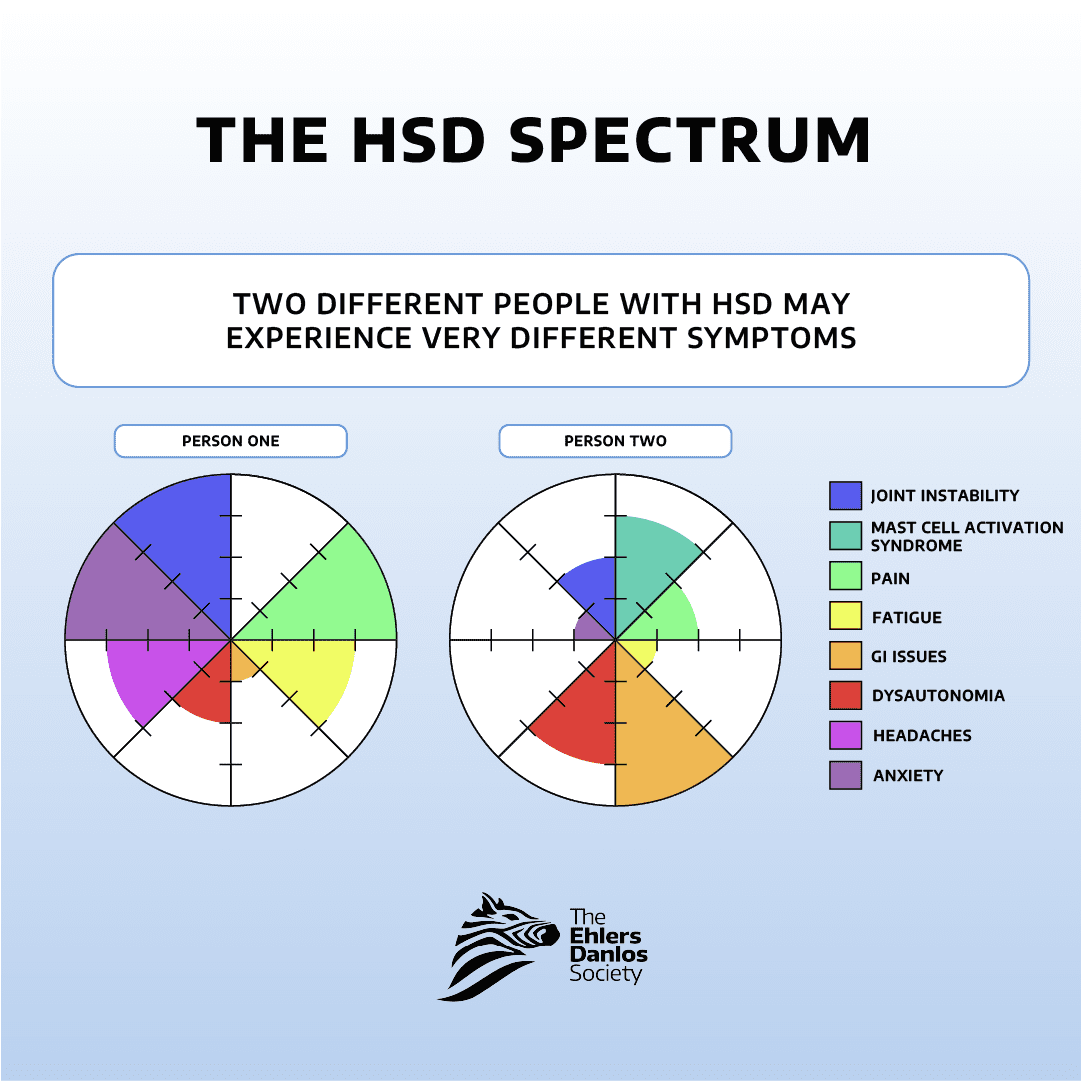
Like they can be just as severe if not where someone with HSD struggling big time whereas someone with hypermobile EDS can be like I'm actually pretty okay other than you know I do have a few joints that you know that I have some pain or I sublux here and there and I'm a little fatigued but also but generally I'm like living my life and vice versa.
Melissa KoehlGUEST
So they're both a spectrum, and we don't at this point have any really clear definition of how are they acutely different.
Melissa KoehlGUEST
It'll be interesting to see how research changes over time as they look more into the genetics of all of this on a cellular level.
Melissa KoehlGUEST
But yeah, right now, I think it's important that people understand if you have HSD or if you just have multiple joints that are hypermobile and you're having other systemic things going on in your body that aren't making sense, that there's a good chance that you have hypermobility spectrum disorder or hypermobile EDS, and both are equally as valid of a reason to explain some of this.
Donna PiperHOST
And now what is your kind of feeling and stance on getting diagnosed? Self-diagnosis versus an official diagnosis.
Donna PiperHOST
And I mean, going to the EDS website would be a good place to find maybe your provider, but I've heard different stories that it could be kind of challenging to find...

Jeannie Di BonGUEST
So everything we did had to take into account the biopsychosocial model, um, which was really, really interesting.
Jeannie Di BonGUEST
Um, so my, um, dissertation very much focused on what are the causes of, um, pain-related disability in the hypermobile EDS and HSD adolescent and adult population.
Jeannie Di BonGUEST
So, um, it was a, um, it wasn't, I didn't conduct a research study.
Jeannie Di BonGUEST
It was very much a literature, extended literature search.
29 MINS LATER
Jeannie Di BonGUEST
I mean, it's a big, big project.
Jeannie Di BonGUEST
I know one thing they are looking at, which has always been a little bit, um, I don't wanna say controversial, maybe a bit misunderstood, is this hypermobile EDS and hypermobility spectrum disorder.
Jeannie Di BonGUEST
So we had these two classifications, and if people didn't meet the full diagnostic criteria for hEDS, they were diagnosed with HSD, hypermobile uh, hypermobility spectrum disorder.
Jeannie Di BonGUEST
And then this led to this discussion that, well, is HSD a lesser diagnosis than hEDS, you know, and it's just not the case.
Kai TaylorGUEST
But then also some studies have found that 57% of endopatients meet the criteria for hypermobile spectrum disorder as well.
Kai TaylorGUEST
So for HSD, which is pretty, pretty large number as well there.
Kai TaylorGUEST
And then pelvic pain is present in 80% hypermobile EDS patients and 66% for HSD.
Kai TaylorGUEST
So we've got that really quite a large, broad data range there as well.
Kai TaylorGUEST
But I think for me, the symptom wise, it was all the like heavy periods, the pain, the cramps that were more than most, like it wasn't a bit of discomfort.
Ashton WilsonHOST
and that's I guess the biggest gap in research isn't it is this you know and we know and it's been well publicized this year that you know, it's only recently we've been studying female bodies as part of standard research.
Ashton WilsonHOST
I know, crazy, right? Yeah, like even like female mice weren't being considered in mice models because hormones would interfere with the research, which is just bizarre to think, isn't it? That we have all of these conditions that primarily affect women.
Ashton WilsonHOST
You know, the conditions are talking about, you know, HEDS, HSD, that's 80% female, 20% male.

Pete SchultzHOST
Some have experienced years of joint pain, repeated strains, headache, dizziness, fatigue, or injuries and wonder if it's all connected.
Pete SchultzHOST
Today, we'll answer questions like what exactly is Ehlers-Danlos Syndrome? What's the difference between EDS and hypermobility spectrum disorder? Why do some flexible people have no pain while others struggle with persistent symptoms? And most importantly, what does the research tell us in how to manage these conditions and still stay active? Whether you've recently been diagnosed, think you might be hypermobile, or you're a healthcare provider trying to better understand these conditions, I hope you'll all come away with a better understanding and some practical tools to help.
Pete SchultzHOST
Before we get started, a quick reminder that this podcast is for educational purposes only and should not be considered medical advice or a substitute for an evaluation by your healthcare provider.
Pete SchultzHOST
Every person is different, and treatment should always be individualized.
5 MINS LATER
Pete SchultzHOST
We're trying to rule out things like Marfan syndrome, autoimmune, other autoimmune connective tissue disorders, and other conditions that might cause joint hypermobility.
Pete SchultzHOST
Hypermobility does not automatically mean that you have EDS.
Pete SchultzHOST
Many people are naturally hypermobile, and symptomatic hypermobility does not mean you have hypermobile EDS, and people who do not meet the criteria for hypermobile EDS have something called hypermobility spectrum disorder, or HSD.
Pete SchultzHOST
So hypermobility spectrum disorder is just like it says.