hyperkalemia
15
MENTIONS
10
EPISODES
9
PODCASTS
Search complete. 15 mentions across 10 episodes found for "hyperkalemia".
Oct 17, 2026

Nick ZeltHOST
Now, this is the audio version of the past week's summaries, which this week were brought to you by our authors, Jason Lesnick, Katherine Sulkowski, Rebecca DeFabio, Joshua Belfor, Colin O'Shea, Amanda Matthews, and Clay Smith.
Nick ZeltHOST
Okay, let's talk about the first article titled, "The Diagnosis and Management of Acute Hyperkalemia" out of the BMJ.
Nick ZeltHOST
Now, hyperkalemia, we worry about this a lot.
Nick ZeltHOST
High potassium is one of the most deadly and one of the most common electrolyte disturbances, and it's definitely one that we talk about the most.

Morgan BryanNARRATOR
contributions.
Morgan BryanNARRATOR
In a contribution entitled, Hypokalemia and Hyperkalemia in Heart Failure, Risk Factor or Risk Marker? By Lars Lund and Barnas Thabor Söderberg from Karolinska Institute in Stockholm, Sweden.
Morgan BryanNARRATOR
Comment on the recently published paper entitled, Optimal Serum Potassium Concentrations in Heart Failure an Individual Patient Data Meta-Analysis by Rihoy Ono et al.
Morgan BryanNARRATOR
from the University of Glasgow in the United Kingdom Ono and colleagues reply in a separate

DHOST
Adverse effects.
DHOST
Hyperkalemia, of course, because it makes you hold on to potassium.
DHOST
We might overcorrect the problem, right? Yeah, we wanted them to hold on to potassium, but now we overcorrected it.
DHOST
Now they got hyperkalemia.
DHOST
That definitely is an adverse effect.
DHOST
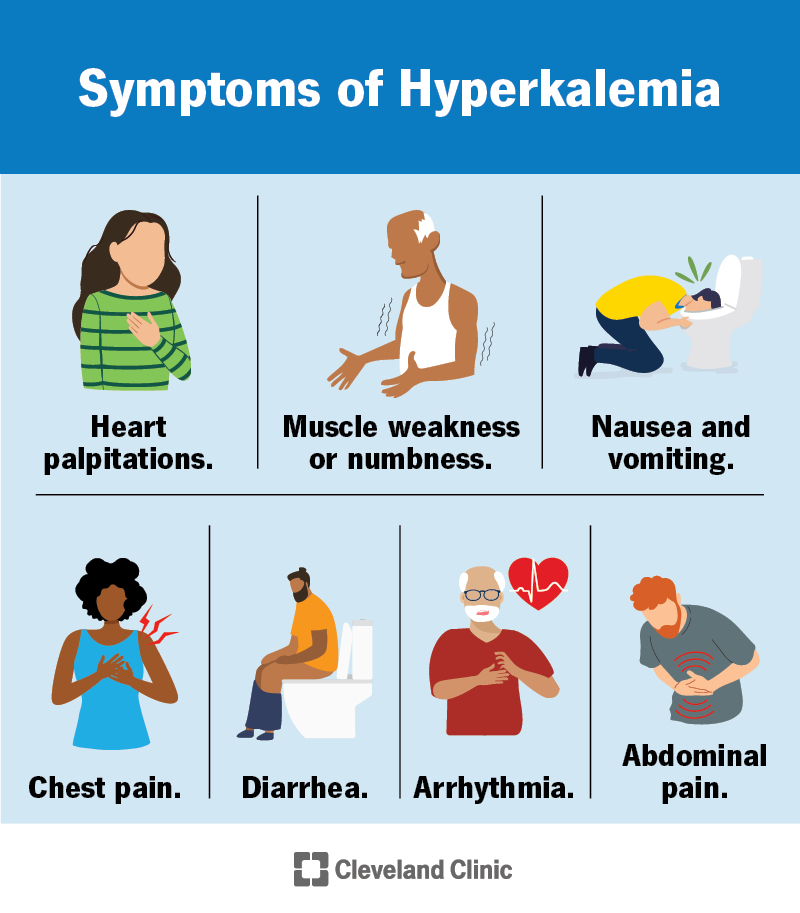
Hyperkalemia, which could cause lethargy, confusion, ataxia.
DHOST
You know ataxia, when they're walking like they're drunk? Ataxia, muscle cramps, and cardiac, page 902, cardiac arrhythmias.
DHOST
Look what I put next to it, NCLEX.

Regina CallionHOST
Correct answer here, you have to prioritize the, boom, hyperkalemia.
Regina CallionHOST
This one is the big one to watch out for.
Regina CallionHOST
Hyperkalemia is always worse [laughs] than b- Then hypokalemia, then...
Regina CallionHOST
Well, I don't wanna...
Regina CallionHOST
I can't, I guess I can't say always.

AlexHOST
You know, it can cause cardiac arrest.
AlexHOST
It is very serious if we see hyperkalemia in the emergency department.
AlexHOST
Hyperkalemia is just a fancy way of saying high potassium.
AlexHOST
But this is the most important thing.
AlexHOST
It is pretty much impossible to push your potassium into that danger zone through eating vegetables alone.

Mark EbellHOST
If you looked at a composite of heart failure, hospitalization, or cardiovascular death, which they did, that didn't differ significantly between groups.
Mark EbellHOST
Hyperkalemia was more common in the finerenone group, and NT to harm was 27, although these generally weren't serious episodes.
Mark EbellHOST
Less than 1% had serious hyperkalemia event, and there were no deaths attributed to hyperkalemia.
Mark EbellHOST
Costs about 700 bucks a month.

speaker_0HOST
The final crisis of a major burn is the profound electrolyte chaos, specifically the terrifying spike in potassium.
speaker_1HOST
Hyperkalemia.
speaker_0HOST
Let’s look at the cellular level here.
speaker_1HOST
Under normal physiological conditions, the sodium-potassium pump actively works to keep sodium outside the cell and potassium heavily concentrated inside the cell.
speaker_0HOST
And if the potassium isn’t rapidly driven back into the cells using therapies like IV insulin and glucose, what happens?
speaker_1HOST
The heart will simply stop.
speaker_1HOST
Hyperkalemia triggers lethal ventricular arrhythmias, specifically ventricular fibrillation or asystole.
speaker_0HOST
So you aren’t just treating burned skin.

Maureen OsunaHOST
The increased oxygen demand of the muscles and increased buildup of CO2 causes tachycardia.
Maureen OsunaHOST
Hyperkalemia leads to cardiac arrhythmias.
Maureen OsunaHOST
Myoglobin damages the kidneys, leading to acute renal failure.
Maureen OsunaHOST
And the hypermetabolic state causes body temperature to increase, which leads to widespread organ dysfunction and DIC.