Hunter-gatherer
18
MENTIONS
10
EPISODES
9
PODCASTS
Search complete. 18 mentions across 10 episodes found for "Hunter-gatherer".
Sep 10, 2026

Max GulhaneGUEST
So when you promote anti-fragility in a lifestyle, the ultimate anti-fragile lifestyle is similar to what we observed when those Peruvian Amazonians got witnessed in that uncontacted tribe.
Max GulhaneGUEST
Like, Hunter-gatherer culture is fundamentally anti-fragile because you don't know when your next meal is coming from.
Max GulhaneGUEST
There's intermittency of nutrient supply.
Max GulhaneGUEST
There's intermittency in many regards of exercise patterns, but it's also quite...

speaker_0NARRATOR
It's not just about discovering that seeds grow into plants.
speaker_0NARRATOR
Hunter-gatherers knew that.
speaker_0NARRATOR
They'd known it for thousands of years.
speaker_0NARRATOR
The shift to agriculture wasn't about knowledge.
1 HR 5 MINS LATER
speaker_0NARRATOR
Early farmers were working sixty, seventy, maybe eighty hours per week preparing fields, planting, weeding, protecting crops from animals and birds, harvesting, processing, storing.
speaker_0NARRATOR
Agriculture is back-breaking labor, repetitive and exhausting, and the diet got worse.
speaker_0NARRATOR
Hunter-gatherers eat an incredibly diverse diet, hundreds of different plant and animal species depending on season and availability.
speaker_0NARRATOR
Early farmers ate maybe a dozen crops, sometimes just two or three staple grains, plus whatever they could supplement through hunting and gathering.

Mike DavisSOUNDBITE_SPEAKER
Comparative research has also revealed the profound ways in which Aboriginal human societies have modified each Mediterranean ecosystem through the technology of fire.
Mike DavisSOUNDBITE_SPEAKER
Hunter-gatherer societies were once seen as having almost no control over their environments or local nature.
Mike DavisSOUNDBITE_SPEAKER
We now appreciate that groups like the native Australians and the native Californians were in fact fire farmers capable of creating, you know, enormous and long-lasting changes in their landscapes.
Mike DavisSOUNDBITE_SPEAKER
In fact, in both Australia and Southern California, it's almost impossible to know what elements or components of the original landscape at contact was not created or in some way structured by human beings and particularly by fire.

Daniel LiebermanGUEST
We evolved to know how to get our food.
Daniel LiebermanGUEST
We never evolved to choose our food.
Daniel LiebermanGUEST
Hunter-gatherers have to know a lot in order to hunt animals and find their plants and process them.
Daniel LiebermanGUEST
Farmers have to know a lot to grow their food.
Daniel LiebermanGUEST
You walk into a supermarket with 40,000 different foods, how are you supposed to decide what to choose? We were never evolved to cope with that kind of diversity and abundance.

Liam TinworthGUEST
hunter-gatherer.
Ema ChlepkovaHOST
Yeah.
Ema ChlepkovaHOST
Hunter-gatherer.
Ema ChlepkovaHOST
I gather the carbs and...
Ema ChlepkovaHOST
Hunt the Strava KOMs.

Rob DunnSOUNDBITE_SPEAKER
And what we think is that this was useful when all of our ancestors were living as hunter-gatherers, and so they just had to go f- hunt and find their food.
Lindsay PattersonHOST
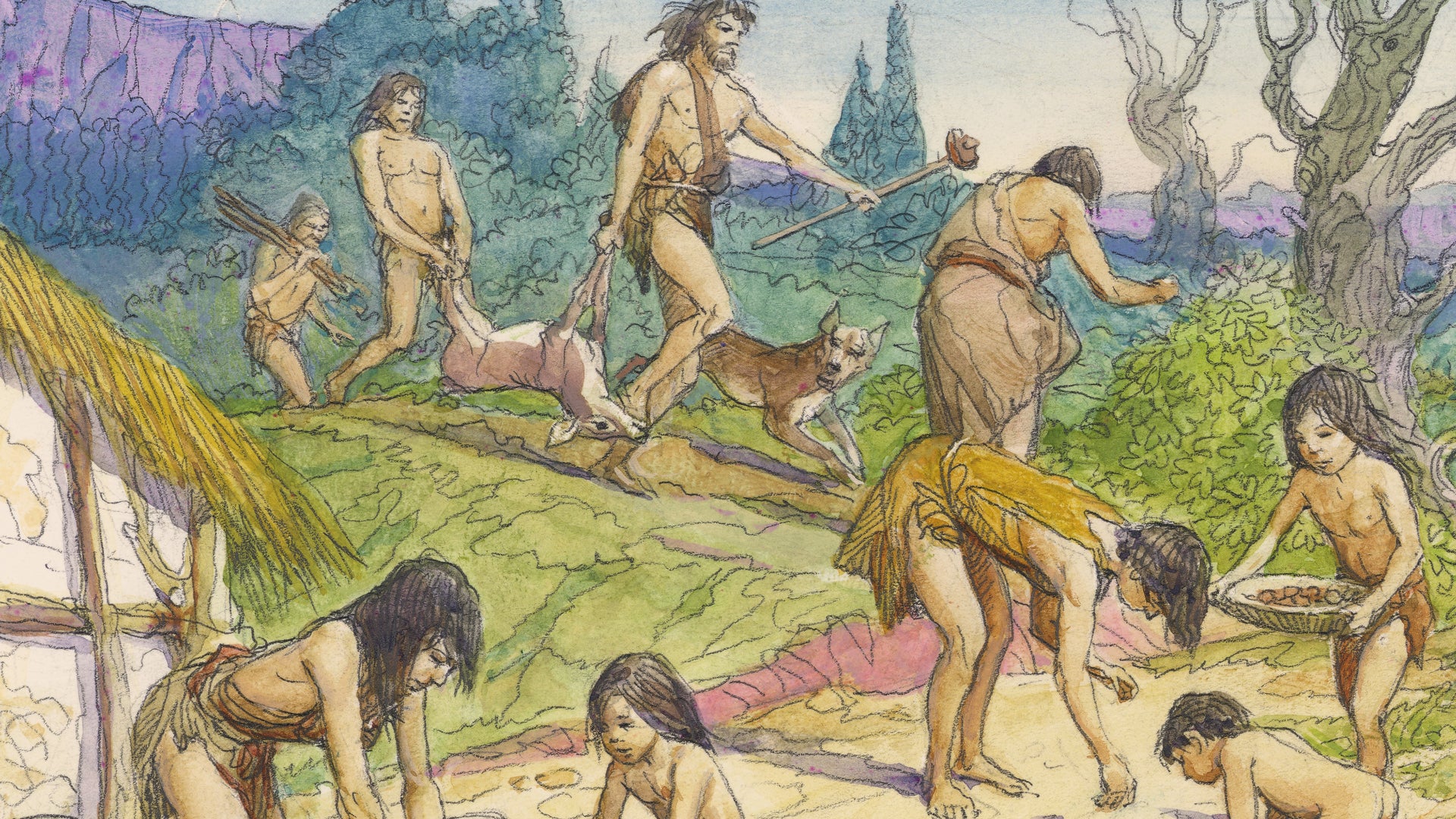
Hunter-gatherer kids also searched for food, mostly on their own.
Marshall EscamillaHOST
So you're saying they had no adult following them in the forest saying, "Eat this broccoli."
Lindsay PattersonHOST
[laughs]

Alexander CzeskiewiczGUEST
... similar to Stonehenge, but ma- much more of them, like not a single circle or st- megalithic structures, plenty of them, and they have some carvings on them even, and plenty of other place, things around them, and these are dated to at least 9600 BC, so 12,000 years ago.
Alexander CzeskiewiczGUEST
And who built them? Hunter-gatherers, this is the prevalent theory, but maybe it was some kind of advanced society.
Alexander CzeskiewiczGUEST
So I think even mainstream is pushing the dates back.
Alexander CzeskiewiczGUEST
If we find in, let's say, next few years some kind of evidence at Gunung Padang in Indonesia, it may also be another milestone.

Scott AlexanderHOST
One challenge doesn't survive.
Scott AlexanderHOST
People who are doing something extremely different from normal society can be anywhere.
Scott AlexanderHOST
Hunter-gatherers are somewhere between 6 and 8 despite their apparent poverty.
Scott AlexanderHOST
The Amish are confusing and hard to measure, with different studies finding them either above or below where their wealth level suggests.
Scott AlexanderHOST
Back to the text.
speaker_10NARRATOR
Did we lose something important when our brains shrank? Or did we simply shed unnecessary weight? The pessimists point to the correlation with agricultural decline in cognitive diversity.
speaker_10NARRATOR
Hunter-gatherers need to maintain extensive environmental knowledge, complex mental maps of vast territories, detailed understanding of hundreds of plant and animal species, Early farmers could survive knowing far less.
speaker_10NARRATOR
They cultivated a few crop species, tended a few domestic animals, lived in one location their entire lives.
speaker_10NARRATOR
The cognitive demands were different, arguably reduced in certain domains.
37 MINS LATER
speaker_10NARRATOR
Ketone metabolism produces different signaling molecules than glucose metabolism.
speaker_10NARRATOR
some of these molecules like brain derived neurotrophic factor directly stimulate neural growth and maintenance constant high glucose availability from agricultural diets might have reduced the metabolic flexibility that supported large brains then there's the lifestyle piece agriculture didn't just change what we ate it changed how we lived and those changes brought new evolutionary pressures that might have favoured smaller brains settlement meant population density for the first time humans were living in large groups hundreds or thousands of people in relatively small areas that population density created perfect conditions for infectious disease measles smallpox tuberculosis all the epidemic diseases that would eventually kill millions they emerged from agricultural settlements where humans lived in close contact with each other and with domesticated animals disease became a major evolutionary pressure surviving epidemics required robust immune systems and immune systems are expensive to maintain they consume resources energy and metabolic capacity in an environment where food quality had already declined bodies faced a choice invest limited resources in maintaining a massive energy hungry brain or invest them in immune function that might save your life during the next epidemic evolution chose survival immune systems got more sophisticated brains got smaller it's a brutal trade-off but it makes perfect sense from a natural selection perspective a slightly smaller brain is better than a corpse The reduction in physical activity probably played a role too.
speaker_10NARRATOR
Hunter-gatherers walked, ran, climbed, and engaged in constant physical activity.
speaker_10NARRATOR
That activity wasn't just exercise.

Francis FukuyamaGUEST
The earliest types of social formations are all kin-based.
Francis FukuyamaGUEST
Hunter-gatherer societies have basically very small groups of relatives, bands of 40, 50 people.
Francis FukuyamaGUEST
The first states are created that have a hierarchical and centralized form of authority.
Francis FukuyamaGUEST
But again, they are what Max Weber called patrimonial because they all arise out of the The household of the ruler and the state bureaucracy is just the cousins, sons-in-laws, you know, so forth of the ruler.