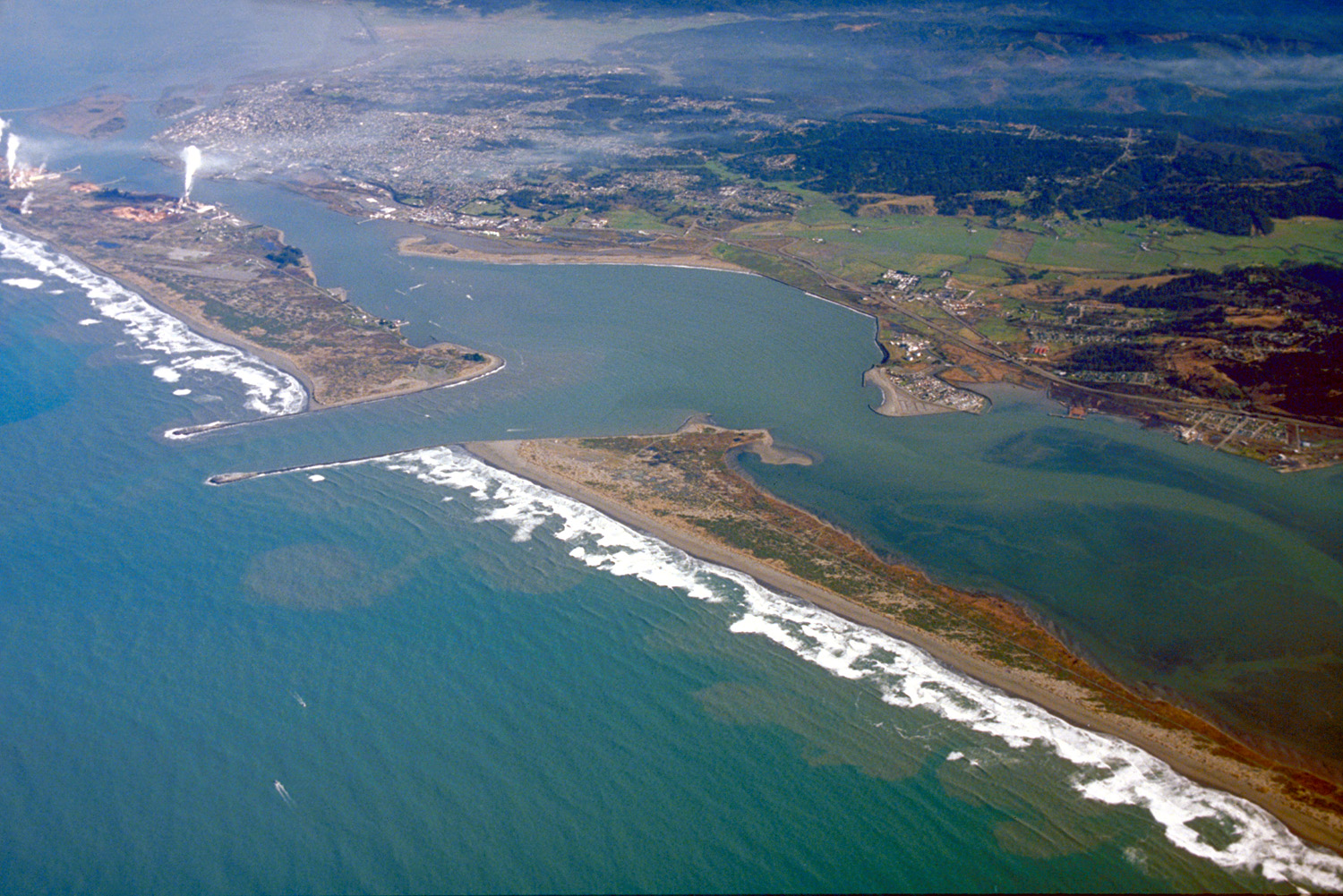
Humboldt Bay
Bay in CaliforniaWikipedia
14
MENTIONS
11
EPISODES
11
PODCASTS
Search complete. 14 mentions across 11 episodes found for "Humboldt Bay".
Oct 15, 2026

Eric RiggsGUEST
So the project is a cooperative agreement, cooperative arrangement with the United States Geological Survey or the USGS.
Eric RiggsGUEST
And this started a number of years ago as really an opportunity as Vero Networks, a fiber optic provider and internet provider, was granted a contract to help install, to go ahead and implement installation of fiber optic networks into the greater Humboldt Bay region as part of the, you know, funded partially by the state of California in the Middle Mile Initiative as an attempt to bring broadband high-speed internet connectivity to rural regions.
Eric RiggsGUEST
And so...
Eric RiggsGUEST
That was a wonderful thing, not connected to earthquakes per se, but there were a few folks that said, hey, wait a minute, there's this new technology that's been applied over the last, say, 10 to 20 years, still in development.
8 MINS LATER
Mike GreenHOST
What did you learn?
Eric RiggsGUEST
Well, that was the proof in concept that basically launched the collaborative arrangement we have today.
Eric RiggsGUEST
And that was the first installation of the cable from here down to Eureka along the east, sort of the inboard side of the Humboldt Bay Basin.
Eric RiggsGUEST
And that was an opportunity then to say, okay, if we have fiber optic lines in this region with the kinds of ground conditions that we've got, do we see seismic signal here that is comparable to the traditional seismometers? And the short answer was yes, and we're seeing different things.

Jason QuinnHOST
... at that time, I gotta think about that.
Jason QuinnHOST
I was in Humboldt Bay at the time and, and again, you just, while you're in the service you kinda hear about all that stuff that's going on.
Keith "Flip" GriffinGUEST
Right.
Jason QuinnHOST
So Freaking wild-

Lizzy Ghedi-EhrlichHOST
What's something, a lesson, a story, that you would want to leave with, you know, not just our listeners, but Americans, the, the we that we're talking about, that would maybe help them kind of make sense of some of the things that we're talking about today, about the struggle between the suppression of history versus a more, you know, holistic model that lets everything be discussed?
Kerri J. MalloyGUEST
So I grew up in Humboldt County in the California, around Humboldt Bay in the city of Eureka, and in the middle of our bay is the island formerly called Indian Island, now renamed Tuluwat, and that was the site of one of the largest massacres of the area in 1860s, and it almost brought the Wiyot people to extinction.
Kerri J. MalloyGUEST
There was no justice, as we would call it.
Kerri J. MalloyGUEST
No one was ever brought to trial.

speaker_0NARRATOR
Types of Indian Culture in California by Alfred Lewis Kroeber.
speaker_0NARRATOR
only one attempt to give a systematic account of the indians of california has been made more than twenty-five years ago stephen powers wrote his famous tribes of california which with all its defects still stands unrivaled in comprehensiveness and usefulness the one work on california which every anthropologist must cite the last few years have seen more extended research of the indians of the state the ethnological and archeological survey of california conducted by the department of anthropology of the university of california through the liberality of mrs phoebe a hurst is intended to secure and preserve for record as much information about the indians and to save for the people of the state as many of the remains and objects illustrative of the native life as possible from the time of the first settlement of california its indians have been described as both more primitive and more peaceful than the majority of the natives of north america on the whole this opinion is undoubtedly true the practical arts of life the social institutions and the ceremonies of the california indians are unusually simple and undeveloped there were no war for its own sake no confederacies of powerful tribes no communal stone pueblos no totems or potlatches the picturesqueness and dignity of other indians are lacking in general rudeness of culture the california indians are scarcely above the eskimo and whereas the lack of development of the eskimo on many sides of their nature is reasonably attributable in part to their difficult and limiting environment the indians of california inhabit a country naturally as favorable it would seem as might be if the degree of civilization attained by people depends in any large measure on their habitat as does not seem likely it might be concluded from the case of the california indians that natural advantages were an impediment rather than an incentive to progress throughout the greater part of the state the civilization of the indians is very much alike while the number of groups and of divisions corresponding to tribes and the number of languages is large and no two groups show exactly identical customs and beliefs the general type of culture is uniform the exceptions are southern california and the northwesternmost part of the state but the territory covered by these divergent cultures is comparatively small and more than two-thirds of the state including all the central part show a fundamental ethnical similarity whose distinguishing characteristics furthermore are not found outside of the state it is therefore possible to speak of typical california indians and to recognize a typical californian culture area a feature that should not be lost sight of in connection with the indians of california is the great stability of population this condition must always be given consideration in any attempt to explain the linguistic diversity existing in the state the extraneous races that have made their way far enough into the state have been completely assimilated to the condition of life of their neighbors the adabascan hoopa are almost identical in culture with the non adabascan yuruk the adabascan cato with the northernmost of the californian pomo as in other regions of america acculturation has proceeded at a more rapid rate than migration throughout the typical culture area of california the indians lived primarily on vegetable products they were of course also hunters especially of small game and wherever there was opportunity fishermen but it is probable that plant food formed as large a proportion of their subsistence as of any of the non agricultural and even some of the agricultural tribes of the continent north of mexico the staple was everywhere acorns but an abundance of other plant products consisting more largely of seeds than of berries or roots were known and eaten the dwellings of these california indians were sometimes of a tolerable size but may be described as having been huts rather than houses structures of brush or of tule were common wood was also used but consisted of sticks pieces of bark and similar materials rarely or never of split or dressed planks whatever part of the structure had any weight and was raised above the ground was either leaned against supports or rested on forking upright logs the shape of the houses was conical or domed and either thatching or a layer of earth was usually depended upon to keep out the rain almost all the tribes had assembly houses generally known as sweat houses that were larger than the dwelling houses only in the regions where the use of the sweat house was confined to sweating and sleeping and to lesser ceremonies was it smaller than the house the arts were unusually primitive basketry alone had reached a considerable development pottery was unknown except perhaps for rude attempts by some of the tribes in contact with the shoshoneans rope and string were everywhere but woven textiles nowhere made within the state felling or large cutting implements other than wedges of antlers and these had a very limited use were not employed the art of carving was exceedingly rude such objects as tubular wooden pipes and small paddles for stirring semi-liquid vegetable food were made by perhaps the majority of tribes but even these objects were not found everywhere pipes of reeds and soup stirrers of looped sticks were the only ones used by certain tribes of the sierra what carved native work there exists from california is notably deficient in ornament the scanty decorations are simple and crude of realistic representation either in two or in three dimensions there appears to be virtually none beyond the patterns on baskets and in these the conventional side in most cases far outweighs the realistic the interpretations of designs being pattern names and not symbolism picture-writing is foreign to the mind of the california indian the social organization was both simple and loose there was no trace of a gentile organization tribes can scarcely be spoken of with correctness beyond the family the only bases of organization were the village and the language the villages were often not continuously inhabited the population being inclined to shift within confined limits they were connected into groups of little definiteness whose common bond was similarity of language and sometimes frequency or cordiality of intercourse but which were without political coherence in most cases these larger groups were without names the village communities almost always were named from localities generally the systematic classification of the divisions of any larger body of indians is difficult on account of the lack of organization in population and social life the village was the approximate equivalent of a localized clan but being the largest political unit it corresponded in a measure to a tribe in so simple a condition of society difference of rank naturally found but little scope the influence of chiefs was comparatively small and distinct classes as of a nobility or of slaves were unknown there was however little communistic tendency accompanying the simplicity of social organization for individual property rights were developed and what organization of society there was was largely on the basis of property the ceremonies of california are characterized as compared with those of the indians of the rest of america by a very slight development of the extreme ritualism that is so characteristic of the american indians and by an almost entire absence of symbolism of any kind fetishism is also unusual among the pomo and yucats and perhaps other groups fetishes are used to some extent as has been observed by stephen powers but usually in connection with individual shamanistic efforts rather than with communal or tribal ceremonies the most important ceremonies of the maidu of the northern sierra nevada have been said by dixon to be an annual mourning ceremony and the observances of a secret society the tribal mourning ceremonial variously known as burning cry or dance of the dead seems to be found in some form among all the divisions of the main part of the state excepting the pomo and yuki as well as among all the tribes of southern california but in the northwesternmost region of the state only faint reminiscences of it occur something corresponding to a secret society is also found in the greater part of the state although in many very different forms to some of which the strict organization of a society can scarcely be said to belong it seems however that there is everywhere either some ceremony conducted by a special group of men or an initiation of children or young men the dance costumes consist primarily of feathers they are not complex and often without delicacy but sometimes striking mythological characters are at times represented the disguise of such characters consists of feathers and paint masks not being used restrictive beliefs in regard to all phases of life especially birth death names and sexual matters are very strongly developed in california and have led to a long series of prescribed usages and prohibitions which play as large a part in the life of the people as analogous restrictions do among the tribes of the north pacific coast and northern atabascans and the eskimo and decidedly more than among the tribes of the mississippi valley or those of the agricultural southwest generally speaking the characteristics of culture that have been enumerated pertain to all the indians between point conception and cape mendicino and between this stretch of coast and the sierra nevada extending from north to south from mount shasta to the tehachapi range in the northwestern part of the state is found another type of culture the territory of which is very much more limited this culture centers about the lower klamath river and extends to the south as far as lower eel river the indians showing this culture most conspicuously are the carrock the yurok and the athabascan only these three tribes practice the so-called white deerskin dance the wesheks of humboldt bay the adabaskan tribes of redwood creek and more southern streams the adabaskan toluwa of smith river on the coast to the north and the shimerico of trinity river to the southeast all show more or less the same culture considerable traces of the same type of civilization are also found among the shasta on the east and among the atabascans along the lower eel river in southernmost humboldt county But so many typical elements of the Northwestern culture are lacking among these last two groups, and they present so many resemblances on the one hand to the Indians of Oregon, Pitt River, and the Sacramento Valley, and on the other to the Yuki and Pomo tribes of Mendocino County, that they may more properly be included in the larger central group.
speaker_0NARRATOR
to the north the limits of the northwestern ethnical province seem to have been formed by the siskiyou range except along the coast where the type of culture perhaps undergoes a more gradual transition through the various athabascan tribes of southern oregon in some of their characteristics the indians of this northwestern region of california resemble the tribes on the pacific coast between the columbia river and alaska in some respects however they are typically californian and in still other ways they have reached considerable specialization The subsistence of the Indians of northwestern California is less predominantly vegetable than in the remainder of the state.
speaker_0NARRATOR
Salmon constitutes perhaps as great a staple as acorns, and along the coast much dependence is placed upon seafood.

Dave SchlomHOST
Named by white settlers for the lampreys they saw there, this magnificent wild and scenic river system has its headwaters just north of the San Francisco Bay Area.
Dave SchlomHOST
It wends its way through redwood forests and magnificent coastal mountains before reaching its destination in the Pacific, just south of Humboldt Bay.
Dave SchlomHOST
Later on in the show, we'll learn about this and other fisheries in the state when we profile the newly reborn periodical, California Fly Fisher.
Dave SchlomHOST
We'll be speaking with publisher Tracy Diaz and editor-at-large George Revell.

Amy BakerHOST
Yeah.
Amy BakerHOST
Alwyn Johnson and his son George head to Humboldt Bay Beach to fish in the surf.
Amy BakerHOST
June, on this part of the California coast, it's not sunshine and glistening sand.
Amy BakerHOST
It's the heavy murk of marine fog rolling in off the ocean and trapping in just cold, damp air along the beach and dunes.
13 MINS LATER
VanessaHOST
So we're not worried about anything yet.
Amy BakerHOST
No, everything is going completely normal at this point.
Amy BakerHOST
Around 7 a.m. the next morning, there's this man, his name is Ralph Hudson, and he was down by Humboldt Bay as well with his son.
Amy BakerHOST
They're in the area vacationing and they'd wandered down to the beach that morning when they came across a Ford car idling nearby.

Daniel SwainGUEST
So this year we're almost, it's almost like looking 10, 20, 30 years in the future in terms of sea level rise this winter alone.
Daniel SwainGUEST
And this very strong El Niño event will probably also increase the likelihood of large, battering waves along the coast, of pretty strong storms that could push winds into places like San Francisco Bay and Humboldt Bay and further elevate the water levels.
Daniel SwainGUEST
So significant coastal flooding, especially during the astronomical high tides, especially during king tides-
Kat ManalacHOST
Mm-hmm
1 more episode mentions Humboldt Bay.
Create an account to see the whole feed, search across every transcript, and follow the entities you care about.