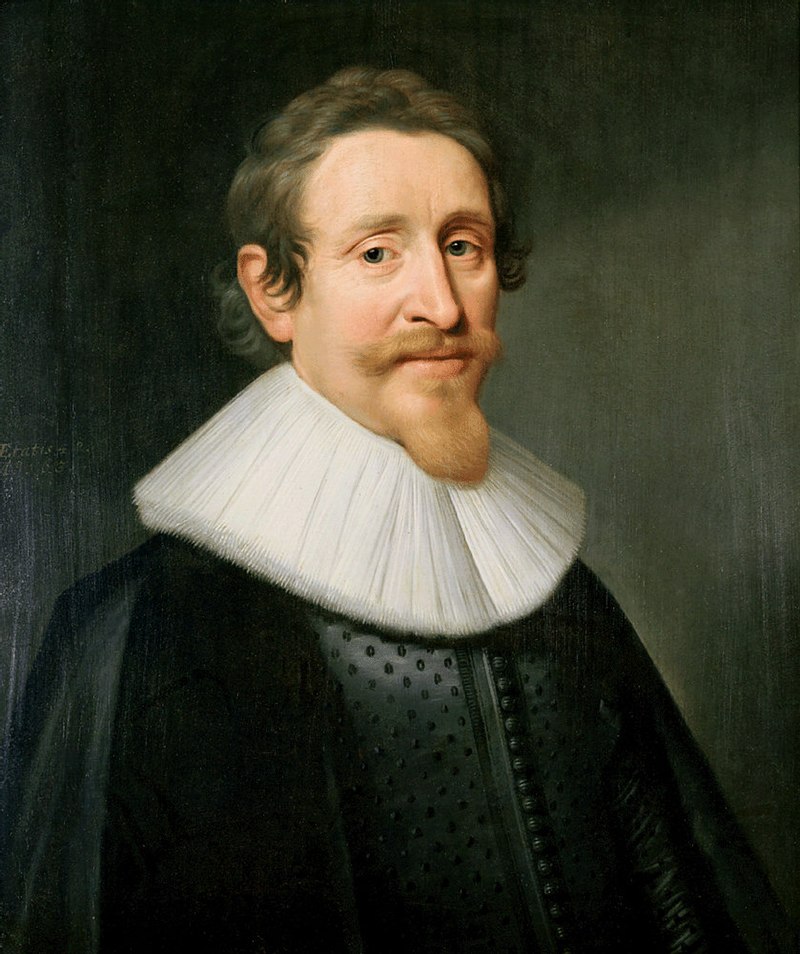
Hugo Grotius
Dutch diplomatWikipedia
117
MENTIONS
34
EPISODES
27
PODCASTS
Search complete. 117 mentions across 34 episodes found for "Hugo Grotius".
Oct 26, 2026

John Samuel HarphamGUEST
And as a matter of fact, you might say that one of the defining features of the early modern period in the history of political thought, the history of English political thought in particular, is that it was a period that rejected the kinds of natural inequality associated with Aristotle's theory of slavery.
Sam Tchorek-BentallHOST
Okay, so if we look at people like Gentile, Grotius, Hobbes, Locke, Pufendorf, they all had different conceptions of slavery and different ideas of how slavery originated and how it functioned.
Sam Tchorek-BentallHOST
But for you, they all belong to the same Roman law tradition.
John Samuel HarphamGUEST
And I'm very glad that you put it that way because this is the aim of the first couple chapters of the book.
40 MINS LATER
John Samuel HarphamGUEST
I don't think any of my advisors would have imagined when I started graduate school that I would spend years of my life digging into the legends of Prester John.
John Samuel HarphamGUEST
I don't think that was on anybody's agenda.
John Samuel HarphamGUEST
after I started to write about theories of slavery in Hobbes and Grotius, but it emerged in part because the figure of Prester John has to be understood if we are to understand early modern English perceptions, indeed European perceptions, of Africa.
John Samuel HarphamGUEST
It emerged out of a probably falsified letter that started to circulate in Europe, I believe in the 13th century, attesting to the existence of a vast Christian empire below or south of the Holy Land, below Egypt, in an inland region of Ethiopia, where to that point, very few European travelers had ever visited.

Peter AdamsonHOST
He said that Lutherans and Mennonites could be grudgingly tolerated if they kept quiet, but that Jews were beyond the pale and should be excluded entirely.
Peter AdamsonHOST
Even Hugo Grotius, who, as we'll be seeing, was the most important thinker of the Dutch Republic, apart from Spinoza, said that there should be firm restrictions on worship amongst Jews.
Peter AdamsonHOST
In light of such unfriendly attitudes, Jonathan Israel has suggested that Spinoza must have meant it ironically when he wrote of the rare happiness of living in the Netherlands, where everyone's judgment is free and unshackled, where each may worship God as his conscience dictates, and where freedom is esteemed above all things dear and precious.
Peter AdamsonHOST
A man like Spinoza would have criticized religious freedom in the Netherlands only insofar as it remained limited.
7 MINS LATER
Peter AdamsonHOST
Arminianism became politically relevant when their cause was taken up by Oldenbarnevelt.
Peter AdamsonHOST
He and his allies were called Remonstrants after a document they put before the states of Holland in 1610, a so-called Remonstrance.
Peter AdamsonHOST
Political tensions within the northern provinces became increasingly entangled with religious disputes, as Republicans like Grotius threw their lot in with the Remonstrants, and conservatives
Peter AdamsonHOST
like

Jeff KellickHOST
Otis named Locke, Vettel, and Harrington in 1764.
Jeff KellickHOST
Hamilton in 1765 told his loyalist opponent to study Grotius, Pufendorf, Locke, Montesquieu, and Berlemonchi.
Jeff KellickHOST
Those jurists, Grotius, Pufendorf, Berlemonchi, Vettel, show up in these lists far more often than they show up in the popular memory of the revolution.
Jeff KellickHOST
John Wise's defense of the New England churches, which Calvin Coolidge would one day say had been declared a textbook of liberty for the revolutionary fathers, appears on none of these lists.
Jeff KellickHOST
Locke's place is the clearest of all because the parallel can be heard in the words themselves.
Jeff KellickHOST
Adam's shelf is documented in his own hand.
Jeff KellickHOST
At 20, keeping school in Worcester, he wrote in his diary that he was reading Hutchinson's Introduction to Moral Philosophy.
Jeff KellickHOST
At 25, taking stock as a young lawyer, he admitted that he had never read any part of the best authors, Pufendorf and Grotius.

speaker_2NARRATOR
The taste for wine, which was then characteristic of their nation, they had not forgotten.
speaker_2NARRATOR
At the table of the elector of Brandenburg, much mirth was caused by the gravity of the statesmen of Holland, who, sober themselves, confuted out of Grotius and Puffendorf the nonsense stuttered by the tipsy nobles of the empire.
speaker_2NARRATOR
One of those nobles swallowed so many bumpers that he tumbled into the turf fire, and was not pulled out till his fine velvet suit had been burned.
speaker_2NARRATOR
In the midst of all this revelry, business was not neglected.

David BennerHOST
And if you don't believe that resupplying the port within a major metropolis, one of the only metropolises of that kind, we're talking relatively speaking, would be a war crime against what was called the law of nations.
David BennerHOST
And if you don't believe me on that, read what Emmer de Vettel and Hugo Grotius wrote about that.
David BennerHOST
As you made the reference to the current day, I'm sorry, the United States would not allow a Chinese vessel to come into a port unnoticed or a Russian naval ship
Carl JonesGUEST
to come in.

Thomas777GUEST
So I'm speaking more of the human... tragedy around it and the scope and scale of severity of destruction.
Pete QuiñonesHOST
Carl Schmitt penned what is arguably the most significant scholarly treatment of the origin and praxis of a law of nations and the conceptual basis of world order at planetary scale since Grotius' De jure belli ac pacis, if I pronounce that incorrectly, I apologize, the law of war and peace.
Pete QuiñonesHOST
"...of all the aspects of Schmitt's magnum opus, ambitiously titled Nomos of the Earth, that warrant a serious analysis in the present epoch, none is more relevant to the current global power political paradigm than Schmitt's description of the ontological nuances of the political domain." a discrete sphere of human activity unto itself, according to Schmitt, and concomitantly the processes and essential features of discovery, appropriation, and conquest, and ultimately assimilation of territorial spaces into extant political cultures and the structures that sustain them.
Pete QuiñonesHOST
Can you explain that paragraph and what you're expressing there in terms that someone as dumb as I am can understand?
10 MINS LATER
Thomas777GUEST
Although it's more readable and you know, less esoteric.
Thomas777GUEST
You know, you don't, business cycles isn't going to make a whole lot of sense to you if you don't have a rudimentary understanding of pretty complex economic theory.
Thomas777GUEST
And almost to the earth, it'd help if you've read stuff like Grotius and Hobbes, obviously.
Thomas777GUEST
But, you know, conceptually, it's not outside the bounds of what somebody who's not a student of political theory or the law will understand.

ThomasGUEST
You know, you don't, business cycles isn't going to make a whole lot of sense to you if you don't have a rudimentary understanding of pretty complex economic theory.
ThomasGUEST
And almost to the earth, it'd help if you've read stuff like Grotius and Hobbes, obviously.
ThomasGUEST
But, you know, conceptually, it's not outside the bounds of what somebody who's not a student of political theory or the law will understand.
ThomasGUEST
But it's an immense book, and its subject matter is vast.

Alecia SimmondsHOST
And in
Leigh BoucherHOST
fact also have father figures from the 15th century like Grotius who we name as their origin points.
Leigh BoucherHOST
Like we could just do the same thing
Alecia SimmondsHOST
here.
Jeff KellickHOST
His great work on the law of nature and of nations appeared in 1672 and came out in English in 1703.
Jeff KellickHOST
It built on Hugo Grotius, the Dutch jurist this series met in the Merchant Republic, who argued for a natural law binding on nations as on men knowable by reason.
Jeff KellickHOST
Pufendorf took up that tradition and carried it forward.
Jeff KellickHOST
His work belongs to the natural law tradition Grotius shaped and to the intellectual world in which Locke wrote.
Jeff KellickHOST
So Wise began where the tradition begins.
Jeff KellickHOST
He would consider man, he wrote, in a state of natural being as a freeborn subject under the crown of heaven and owing homage to none but God himself.
Jeff KellickHOST
That vocabulary was not foreign to Boston.
Jeff KellickHOST
In October of 1758, John Adams, a young man trying to be admitted to the Boston bar, went to see one of the city's leading lawyers, Jeremiah Gridley.

George BogdenHOST
You know, all these kind of jumble of events to establish what the actual path might be.
George BogdenHOST
And I mean, the only, the only kind of theorist that I've heard articulate this in a serious way, you know, is Hugo Grotius.
George BogdenHOST
Um-
Richard FontaineGUEST
[chuckles]
George BogdenHOST
but I don't think that's part of the conversation.
George BogdenHOST
So, uh, but anyway, I certainly take your point about how it's developing and-
Richard FontaineGUEST
I, I admire your, um, invocation of Hugo Grotius, which even in this, uh, erudite, uh, audience that I know you have, is probably not a household name.
Richard FontaineGUEST
But, uh, you as a, at least, um, a-
24 more episodes mention Hugo Grotius.
Create an account to see the whole feed, search across every transcript, and follow the entities you care about.