Hubble's law
11
MENTIONS
8
EPISODES
5
PODCASTS
Search complete. 11 mentions across 8 episodes found for "Hubble's law".
Oct 12, 2026

Philip MannheimGUEST
Einstein introduced the cosmological constant in the 1920s, so this problem is also 100 years old.
Philip MannheimGUEST
Now, if you take the current era Hubble parameter, the value of it, and you calculate a quantity called omega lambda, which just involves this lambda, the cosmological constant, Newton's constant, the velocity of light, and the Hubble parameter that we measure, the amount-- that quantity is the amount by which the cosmological constant will gravitate today in the standard dark energy, cold dark matter cosmology.
Philip MannheimGUEST
Lambda, uh, uh, dark energy, CDM, cold dark matter.
Philip MannheimGUEST
Now, all estimates of this number put it at order at least 10 to the 60 if it's a TeV scale coming from the weak interaction, or 10 to the 120 if it's the Planck scale, H bar C over GN to the half coming from quantum gravity.
25 MINS LATER
Philip MannheimGUEST
So we can never measure face on galaxies.
Philip MannheimGUEST
But what we can do is we can look at a galaxy which is edge on, because an edge on galaxy, one side will be coming towards us, and the other side would be going away from us.
Philip MannheimGUEST
And the sum of the two velocities is the overall flow of the galaxy, which we now call the Hubble flow, and the difference is the rotation velocity.
Philip MannheimGUEST
Now, this picture is actually a picture of the Milky Way as seen by somebody on Andromeda.

speaker_0HOST
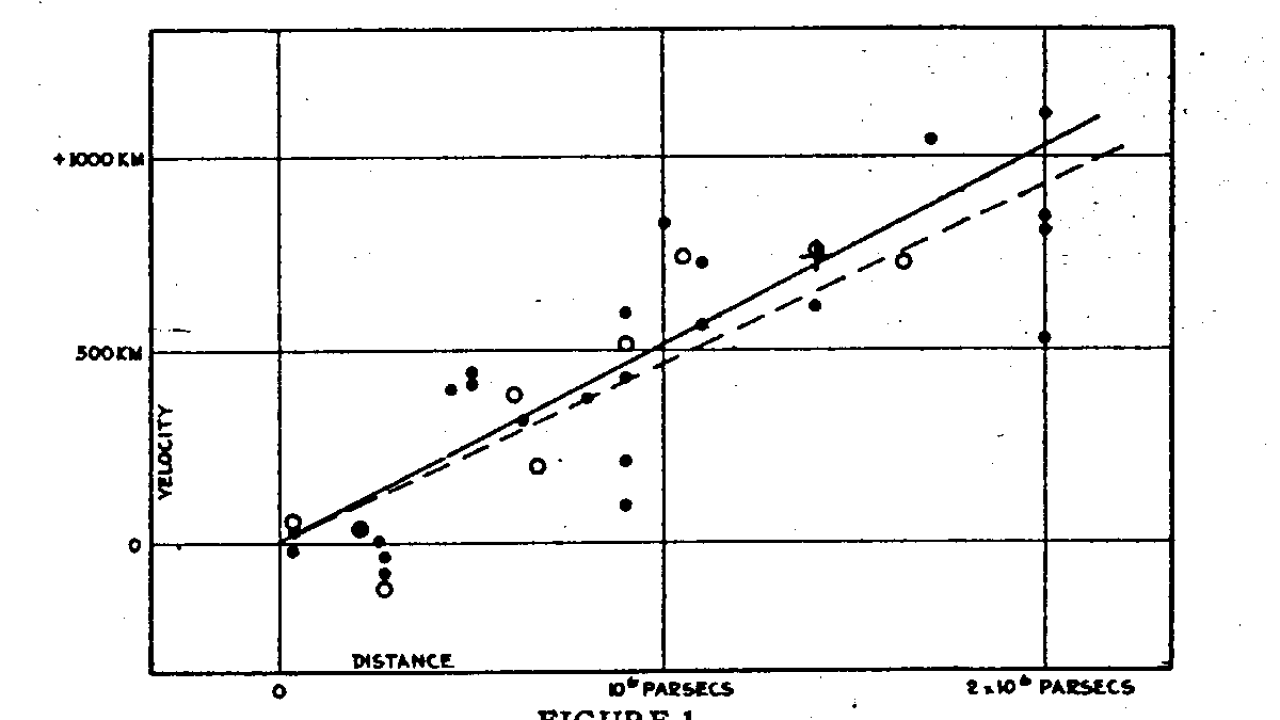
The further the galaxy is away, the faster it recedes and the greater its redshift.
speaker_0HOST
This relationship is known as Hubble's law, and the rate of expansion is called the Hubble constant.
speaker_0HOST
Run the expansion backward in time and everything converges to a single moment, The Big Bang.
speaker_0HOST
Measuring distances accurately took decades of work built on the star brightness standard candles discovered by Henrietta Swan Leavitt.

Charles BailynHOST
And you can plot this by using, by doing galaxy surveys, And the problem with a galaxy survey is, how do you know where it is in the third dimension? How do you know how far away it is? So, you have position in the sky that tells you two of the coordinates of a galaxy, and then you measure its redshift.
Charles BailynHOST
And you use the redshift in order to make a guess at how far away it is, just from using the Hubble Law.
Charles BailynHOST
So, instead of trying to determine the distance in order to measure the value of the Hubble constant, you assume a value of the Hubble constant that you take from somewhere.
Charles BailynHOST
And then, if you measure, then you can, and once you've assumed the value of the Hubble constant, you can use redshift to tell you what the distance is supposed to be.
Charles BailynHOST
We measured their velocity.
Charles BailynHOST
We got Hubble's Law.
Charles BailynHOST
Therefore, the Universe is expanding.
Charles BailynHOST
And as we were doing that, we had the idea that the redshift is telling you something about velocity.
Charles BailynHOST
But the further away it is, the faster it's moving away, right? And that's just a consequence of the fact that you have taken this, uh, uh, uh, this geometry and expanded it.
Charles BailynHOST
And so wherever you sit in an expanding, uh, uh, in an expanding geometry, every object you see will be moving directly away from you, and the further away it is, the faster it will be moving, which is Hubble's law.
Charles BailynHOST
So, uh...
Charles BailynHOST
Oh, uh, and one other thing about this, this nice, uh, analogy here.

Dave HahnNARRATOR
A Catholic priest named Georges Lemaître first postulated that the universe was expanding in 1927.
Dave HahnNARRATOR
In 1929, Edwin Hubble published his findings with better data, and we've been calling the discovery Hubble's Law, while also naming a space telescope after Hubble.
Dave HahnNARRATOR
That is until 2018 when the IAU renamed it the Hubble-Lima-Trey Law.
Dave HahnNARRATOR
Perhaps more infamously was when James Watson, Francis Crick, and Maurice Wilkins received the Nobel Prize in 1962 for their contribution to the discovery of the double helix structure of DNA in when their work was based on the previous work of Rosalind Franklin, whom they knew, attended lectures of, and had seen her research.
Charles BailynHOST
We know that the Universe is expanding, and that we know Hubble already figured that out.
Charles BailynHOST
We know this from the Hubble from the Hubble Law and from other, just in general, from the study of standard candles at relatively low redshift.
Charles BailynHOST
So, distances out to, I don't know, Z of less than 0.2 or so.
Charles BailynHOST
You can't tell the difference between an accelerating or a decelerating Universe.
1 more episode mentions Hubble's law.
Create an account to see the whole feed, search across every transcript, and follow the entities you care about.