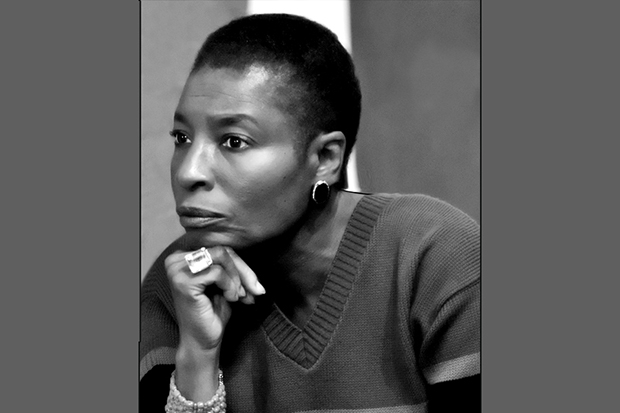
Hortense Spillers
American literary criticWikipedia
8
MENTIONS
4
EPISODES
4
PODCASTS
Search complete. 8 mentions across 4 episodes found for "Hortense Spillers".
Oct 11, 2026

Gail LewisGUEST
Well, it's interesting, 'cause when we... you posed that question to us as something to, to think about, I thought, "Oh, okay." So I could say, "Oh, well, I'm influenced by these bodies of, of theoretical works," you know, maybe some artistic works.
Gail LewisGUEST
So I could say Audre Lorde, and June Jordan, and Hortense Spillers, and Stuart Hall, you know, Sylvia Wynter, and that's all correct.
Gail LewisGUEST
Um, we've already referenced Glissant.
Gail LewisGUEST
So, you know, they're all correct, and they all offer something around kind of world senses, not just visions, but senses in all those ways in which we can kind of engage the world, and engage our sense of ourselves in the world, and our changing sense of our changing self in the world.

Sheree MackHOST
Hey, guy.
Sheree MackHOST
And then also, I know being ungendered from Hortense Spillers, and I think she mentions it in, oh, I can't remember, the Mama something, Mamas and Papas something essay.
Sheree MackHOST
Um, and then she was using it in the sense of they took the Africans across the Atlantic Ocean to enslave them in the Caribbean and the Americas, and in that process, the- they might have left Africa as men and women, uh, or male and female, and we're just doing the binaries here.
Sheree MackHOST
But then in that process, by the time they got to the other, the New World, they were ungendered in the sense of, like, females weren't protected, females weren't looking as, like, or the women weren't look as fragile or couldn't, you know, couldn't do this or couldn't do that.

Joan IlacquaHOST
In A Black Queer History of the United States, authors C. Riley Snorton and Darius Bost explain, "Literally and figuratively, racial slavery altered the condition with which gender was represented, perceived, and lived by radically defining Black personhood as property and as according to an individual's capacity to reproduce capital.
Joan IlacquaHOST
The brutality of slavery lessened gendered distinctions between captives, as all enslaved people were measured according to the value they could produce for their enslavers." They cite Black feminist literary scholar Hortense Spillers, who coined the term ungendering in 1987 as a way of further dehumanizing enslaved people and Black people broadly.
Joan IlacquaHOST
Early American laws and norms condemning same-sex activity make it difficult to find narratives of people transgressing gender or sexuality norms without significant power and privilege.
Joan IlacquaHOST
When we discuss sexuality and gender in light of racial slavery, at this time the archives are pretty quiet.
Joan IlacquaHOST
During this time period, gender and sexuality are, are policed by colonialist and early American law, by Christian morality, and by societal norms that are dedicated to white supremacy and to the subjugation of people of color.
Joan IlacquaHOST
These are people who are un-personed in a way, or ungendered.
Joan IlacquaHOST
And I believe, okay, ungendered is Hortense Spillers.
Arielle GrayGUEST
I was just about to bring her up.

John DrabinskiHOST
...
John DrabinskiHOST
Hortense Spillers and Angela Davis.
Logan ShanksGUEST
Hortense Spillers, Pauli Murray, Angela Davis, as you just said, Anita Hill, um, Pat Hill Collins, who was at UMD.
John DrabinskiHOST
Yeah.
John DrabinskiHOST
Yes, here in Baltimore.
32 MINS LATER
Logan ShanksGUEST
Like, we're, we're, we're now becoming anti-intellectual and, and we're allowing them to change the narrative of our own intellectual genealogies, and we feel-- and now we feel that we're sc- we're scared to be corrective and just, and, and just offering the archive and being like, "Actually, it was a legal forum.
Logan ShanksGUEST
[scoffs] Actually, it's a, it-it's a legal framework that developed in, in, in these particular ways by Black legal practitioners and lawyer." [scoffs] Like, I think that the fact that that's not, that even, you know, people who are maybe lay to Black studies, they're, like, repeating the same sentiments the Moynihan Report, you know, kinda intramurally in, you know, Black gender wars that we might see on Twitter and Instagram interpersonally.
Logan ShanksGUEST
Like, when I'm like, "Oh, well, you know, Angela Davis, Hortense Spillers," you know, it wa- they, they've already been corrective and prescriptive in that.