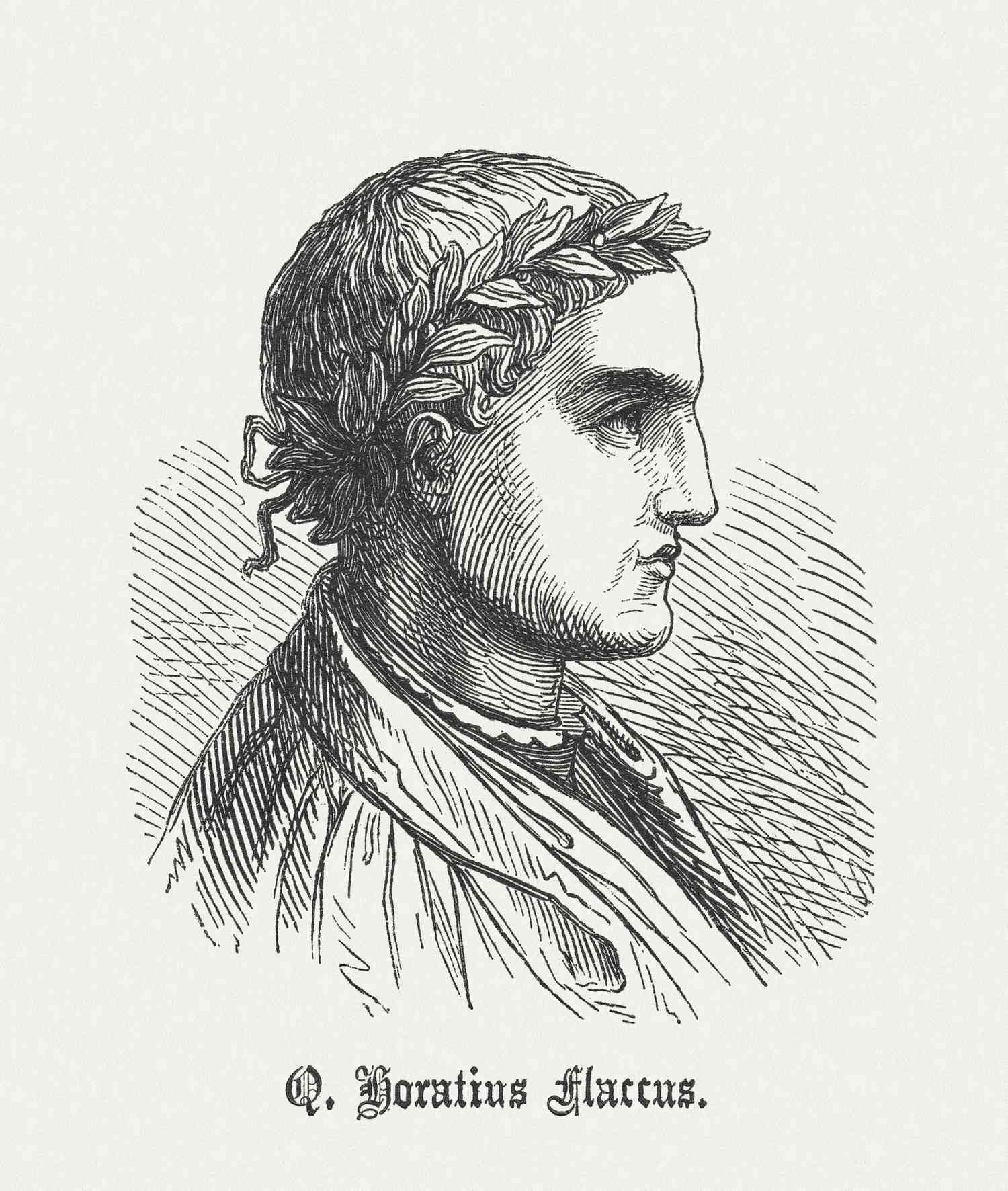
Horace
Roman poetWikipedia
160
MENTIONS
59
EPISODES
55
PODCASTS
Search complete. 160 mentions across 59 episodes found for "Horace".
Sep 16, 2026

Emily WilsonGUEST
I mean, the line from Horace that we already discussed, it's about this aspiration towards high culture and towards the range of different cultural representations that the Romans could gain and reinvent by borrowing so many different literary genres from the Greeks.
Emily WilsonGUEST
Yeah.
Claire CatenaccioMODERATOR
So the Romans borrowed not only genres and stories from the Greeks, but also poetic forms.
Claire CatenaccioMODERATOR
And one of the things I think that sets you apart as a translator is your rigorous attention to form, especially to keeping a regular meter even while using accessible language.
Claire CatenaccioMODERATOR
So can you talk a little about how you think formal features like meter and rhythm affect the way that an audience connects to a work?
Emily WilsonGUEST
Yeah, great question.
Emily WilsonGUEST
I mean, that's, again, one of the big themes of the book, but it's also one of my big stump things as a translator is that I very much wanted to try to provide 21st century readers of Homer and tragedy with translations that use traditional meter because the regular musicality and rhythmicality of the originals seem to me so much part of the experience that they're designed not just for performance out loud, they need to be speakable in some way or other, but speakable not in a casual, I'm just chatting to you kind of way, but in a way where even if you're not thinking about meter on some subliminal level, you're going to hear the difference between something read out loud that has a beat versus something that doesn't.
Emily WilsonGUEST
And again, I very much admire plenty of existing translations that don't use meter, but I also felt there were lots of those out there already, and there's something that I can add to what's available to a... to an English reader who may not have access to the original by thinking about how mito isn't just about, in a way, an embodied experience of these musical qualities of language, but it's also about the semantics of poetic form, that if you use a traditional form, you cue the reader or listener into, this sounds rhythmically, metrically like the rhythms of poetry from 100 or 200 years ago.

Maggie SmithHOST
It offers a poet's perspective on what poetry is and how it should be written and what it might do for the reader.
Maggie SmithHOST
The term Ars Poetica comes from a poem written by Horace, an ancient Roman poet, in 19 BC.
Maggie SmithHOST
Horace's poem is 476 lines long, written in the form of a letter.
Maggie SmithHOST
In this poem, Horace advises young poets on the art of writing poetry.
Maggie SmithHOST
His writing advice includes maxims on word choice, tone, meter, and characterization in dramatic poems.
Maggie SmithHOST
He also advises poets to show restraint and to avoid over-writing.
Maggie SmithHOST
And like Horace's Ars Poetica, much of the advice I've gotten has come to me in the form of letters.
Maggie SmithHOST
In one letter, the late poet Stanley Plumly wrote, "You seem to be suffering from second book-itis.

Alex ZubinHOST
Above all, we look for stories that will stay with you.
Alex ZubinHOST
The Roman poet Horace explained in his masterful Ars Poetica that the purpose of stories, and of any literary work more broadly, is to entertain, to educate, or to do both.
Alex ZubinHOST
So we hope that Biome stories can take you to far-off worlds or let you see this world in a new light, giving you the chance to step away from the everyday.
Alex ZubinHOST
As a show that can only share a few stories each season, this also means we have to turn away a lot of stories.

Martin GeesonNARRATOR
And indeed, that is the fittest and most proper hour wherein to write these high matters and deep sciences.
Martin GeesonNARRATOR
As Homer knew very well, the paragon of all philologs, and Ennius, the father of the Latin poets, as Horace calls him.
Martin GeesonNARRATOR
Although a certain sneaking jobbernol alleged that his verses smelled more of the wine than the oil.
Martin GeesonNARRATOR
So saith a turlupin or new start-up grub of my books.

Mark HarringtonNARRATOR
The action is first in the world of the gods, then in that of the heroes, and lastly in that of men.
Mark HarringtonNARRATOR
It is the time-honored division of Pindarzode and Horace's.
Mark HarringtonNARRATOR
tina theon tine heroa tina dandra chela desomen but these divisions shade into one another and each contains matter that belongs elsewhere pyrrhus and thisbe is a love story of the hellenistic age but it is told by the daughters of minnius in the mythical days of pentheus of thebes still it might have been familiar before the flood who cares it does not disturb the reader's sense of the descending sweep of time the moment he may feel that he is floating about in a timeless realm of myth the poet with a magic touch attaches the myth to history as when apollo flying away after his victory over pan sees laomedon far beneath him building the walls of troy we know where we are and what is coming the trojan war is not far away when it comes ovid takes care not to enter the lists against either homer or virgil he tells what metamorphoses he can at the beginning and narrates the death of achilles at the end the intervening stretch of time must be wiped out with an amusing sort of illusion he manages to slide o'er full nine years and leave the growth untried of that wide gap he assembles the heroes at a feast the after-dinner talk is restricted to deeds of war for of what else could great achilles tell or others tell with great achilles there Nestor finally has the floor, and while Nestor talks, centuries can slip by.
Mark HarringtonNARRATOR
When he has finished, the war is done.
Mark HarringtonNARRATOR
The next episode marks the appearance of Greece as Rome unites with her own religion, the worship of Asclepius.
Mark HarringtonNARRATOR
The previous stories symbolize remote antiquity.
Mark HarringtonNARRATOR
This one brings us to the third century, the time in Horace's profound epigram when captive Greece took its rude victor captive.
Mark HarringtonNARRATOR
This is a turning point in the history of Rome.

Ron AltmanNARRATOR
Ego nec studium sine divite vina Nec rude quid prosit video ingenium Alterius sic altera poesit Opem res et conjuret amice.
Ron AltmanNARRATOR
Horace, De Arte Poetica.
Ron AltmanNARRATOR
Thus made English: Concerning poets there has been contest Whether they're made by art or nature best But if I may presume in this affair Among the rest my judgment to declare No art without a genius will avail And parts without the help of art will fail But both ingredients jointly must unite Or verse will never shine with a transcendent light.
Ron AltmanNARRATOR
Oldham.
1 HR 58 MINS LATER
Jennifer PainterNARRATOR
Nec semper feriet quodcunque minabitur arcus.
Jennifer PainterNARRATOR
Verum ubi plura nitent in caminae, non ego possis offendor maculis quas aut incuria fudit aut humana parco cavit natura.
Jennifer PainterNARRATOR
Horace, The Art Poet.
Jennifer PainterNARRATOR
Thus Englished: Be not too rigidly censorious.
David WalesNARRATOR
These two years have been devoted not so much to actual writing as to the research demanded by a task to which practically no limits can be set and to the reading of innumerable authors.
David WalesNARRATOR
Further, following the precept of Horace, who in his Art of Poetry deprecates hasty publication and urges the would-be author to withhold his work till nine long years have passed away, I propose to give them time in order that the ardor of creation might cool, and that I might revise them with all the consideration of a dispassionate reader.
David WalesNARRATOR
But if there is such a demand for their publication as you assert, why then let us spread our canvas to the gale and offer up a fervent prayer to heaven as we put out to sea.
David WalesNARRATOR
But remember, I rely on your loyal care to see that they reach the public in as correct a form as possible.
1 HR 25 MINS LATER
David WalesNARRATOR
I must now be understood to use verbum in its most general sense.
David WalesNARRATOR
It has, of course, two meanings.
David WalesNARRATOR
The one covers all the parts of which language is composed, as in the line of Horace, Once supply the thought, and words will follow swift as soon as sought.
David WalesNARRATOR
The other restricts it to a part of speech such as lego and scribo.

Conor HanrattyHOST
But the five-act structure is, in fact, a rather arbitrary pronouncement.
Conor HanrattyHOST
It comes to us from a single Roman poet writing a letter to a friend about how to write good poetry.
Conor HanrattyHOST
That poet was Horace.
Conor HanrattyHOST
Quintus Horatius Flaccus, his full Latin name, lived from 65 to 8 BCE.
Conor HanrattyHOST
He was a poet, a satirist, and the son of a freedman, a man who had been enslaved but was granted his freedom.
Conor HanrattyHOST
He fought on the losing side at the Battle of Philippi, which could have ended his life and certainly ended any political ambitions he had.
Conor HanrattyHOST
Instead, he became one of the most influential literary critics in history.
Conor HanrattyHOST
Their structures are very different and they were codified to an extent, but the number five doesn't really figure.

Christine RuckerNARRATOR
Even in his address to Coy Mistress, he is too witty to be a passionate lover.
Christine RuckerNARRATOR
In struggling against the fashions of his age, Marvell was confirmed by his love of classical literature, Horace being his favorite poet.
Christine RuckerNARRATOR
He never lost entirely the sense of form and proper restraint in expression, as the metaphysical school had done.
Christine RuckerNARRATOR
The ancient writers bade him, as they had bidden another great poet at Cambridge, disdain, quote, all those new-fangled toys and trimming slight, which take our late fantastics with delight, and cull those richest robes and gazed attire which deepest spirits and choicest wits require, end quote.
3 HRS 46 MINS LATER
Thomas CopelandNARRATOR
Yet then with foot as stumbling as his tongue Pressed for his place among the learned throng.
Thomas CopelandNARRATOR
But Ben, who knew not neither foe nor friend, Sworn enemy to all that do pretend, Rose more than ever he was seen severe, Shook his gray locks, and his own bays did tear At this intrusion.
Thomas CopelandNARRATOR
Then with laurel wand, The awful sign of his supreme command, At whose dread whisk Virgil himself does quake, And Horace patiently its stroke doth take, As he crowds in, he whipped him o'er the pate, Like Pembroke at the masque.
Thomas CopelandNARRATOR
Note.

Phil BensonNARRATOR
Satire always claimed to be of Roman birth.
Phil BensonNARRATOR
Certainly in the hands of Horace it became an instrument of urbane and ironical castigation, and in the hands of Juvenal a weapon of invective which the genius of the Roman state might seem to have shaped for itself, and which every modern polity, as it reached the civic maturity and the urban corruption of Rome, has sought to wield.
Phil BensonNARRATOR
But even its derivative poetical forms acquired in the Roman world a metropolitan flavor.
Phil BensonNARRATOR
The blithe, open-air pastoral of Theocritus, full of the blazed perfume of the Sicilian noontide, became the Virgilian eclogue, with its literary shepherds and its uncertain scenery, touched with the sentiment of a poet inured, like Theocritus, to court and city, but far more inwardly mastered by their spell.
2 HRS 56 MINS LATER
Phil BensonNARRATOR
She has for him a history, and the joy and pathos of history, and he forgets that she is a mechanical term.
Phil BensonNARRATOR
To say that he puts the nevermore of romantic sentimentality in the place of the dispassionate give-and-take of mechanics would do wrong to the immense virility which animates every line of this athlete among poets.
Phil BensonNARRATOR
Of the cheap melancholy of discontent he knows as little as of the cheap satisfaction of complacency, or of that literary melancholy where the sigh of Horace or Ronsard or Herrick over the passing of roses and all other beautiful things covers a sly diplomatic appeal to the human rosebud to be gathered while still there is time.
Phil BensonNARRATOR
No, the melancholy of Lucretius is like that of Durer's Melencolia, the sadness of strong intellect and far-reaching vision as it contemplates the setting of the sun of time and the ebbing of the tides of mortality; or like Wordsworth's mournful music of dissolution, only to be heard by an ear emancipated from vulgar joys and fears; or like the melancholy of Keats, the veiled goddess who hath her shrine in the very temple of delight, the amare aliquid, in Lucretius' own yet more pregnant words, which lurks in the very sweetness of the flower.
49 more episodes mention Horace.
Create an account to see the whole feed, search across every transcript, and follow the entities you care about.