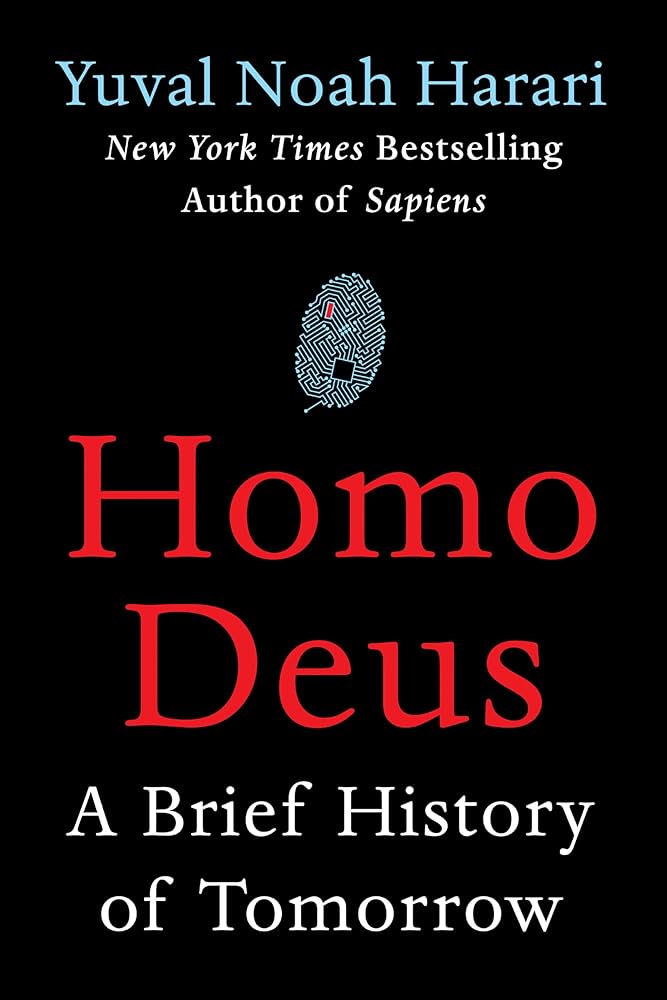
Homo Deus
Book by Yuval Noah HarariWikipedia
25
MENTIONS
11
EPISODES
11
PODCASTS
Search complete. 25 mentions across 11 episodes found for "Homo Deus".
Sep 29, 2026

Troy CaseyGUEST
Yuval Harari, who works for the World Economic Forum, Klaus Schwab's little minion boy.
Troy CaseyGUEST
He wrote a book called Homo Deus, and it's all in there.
Troy CaseyGUEST
They want to merge us into the machines.
Troy CaseyGUEST
Elon Musk has the Neuralink.

Corey BuseGUEST
Great book.
Corey BuseGUEST
Homo Deus, I think, is his follow-up book, which was great too.
Corey BuseGUEST
That's more about future human experience.
Corey BuseGUEST
The Dawn of Everything, I think, was another one.

C.R. WileyGUEST
The guy has sold millions of books.
C.R. WileyGUEST
His book, Homo Deus, has sold 30 million copies.
C.R. WileyGUEST
Oh, wow.
C.R. WileyGUEST
So this is not like some marginal dude.

Mihaela UlieruHOST
But the question is, you know, can you tell us, first of all, what is this Deus Narans? What's the future with it or its future look like?
Mark FrazierGUEST
This came out of conversations with Yasuhiko shortly after Harari published his book called Homo Deus.
Mark FrazierGUEST
And so Harari was pointing out that humans had been very branchy.
Mark FrazierGUEST
before Homo sapiens came on the scene.
45 MINS LATER
Mihaela UlieruHOST
And I remember her first time, yes, I heard her say, something about what will come after us.
Mihaela UlieruHOST
And I was like, whoa, I never thought of that.
Mihaela UlieruHOST
What will come after us? And now we say, although I was, I mean, also then and my career was in AI, but I didn't look at it like, what will come after us? But now, of course, AI changes the homo Deus evolutionary game and humanity becomes an ancestor to these new forms of intelligences beyond us.
Mihaela UlieruHOST
So my question is, what's your take on this? What do you most want from those future beings? Or what should we...

Connor BeatonHOST
There's an attempt to erode this part of, of our experience as human beings.
Connor BeatonHOST
And in a book years ago that came out, I don't even know when it came out, but Yuval Harari wrote this great book called Homo Deus, which means human gods.
Connor BeatonHOST
And in the book, he talked about that the wars of the future were not going to be hot wars necessarily.
Connor BeatonHOST
They weren't going to be the traditional World War II style, go to battle, rally the troops, go in and shoot guns and drop bombs.

So Many Insane Plays Episode 126: 2025 Year in Review
Sep 24 · 14 Mentions
#125 FRStephen MenendianHOST
So bear with me for just 30 seconds on this.
Stephen MenendianHOST
In Yuval Harari's book, Homo Deus, Yuval Harari, for those of you who don't know, is a historian and philosopher, Israeli historian.
Stephen MenendianHOST
And he's written several interesting books.
Stephen MenendianHOST
One is called Sapiens, The History of Humankind, and then another is called Homo Deus.
Stephen MenendianHOST
At the end of Homo Deus, he describes two possible religions of the future.
10 MINS LATER
Stephen MenendianHOST
And then finally, this is especially perhaps the most relevant announcement.
Stephen MenendianHOST
Not relevant in a timely sense, but in somewhat.
Stephen MenendianHOST
I have been getting a lot of inquiries about the Gush book because even before the professor...

speaker_0NARRATOR
Now, I'm really not about to debate capitalism versus other economic models in the world, because, well, I don't want to start a war.
speaker_0NARRATOR
In his book about the future of human civilization, Homo Deus, historian Yuval Noah Harari notes that, Although we experience occasional economic crises and international wars, in the long run, capitalism has not only managed to prevail, but also to overcome famine, plague, and war.
speaker_0NARRATOR
In fact, in modern times, we have experienced so much economic growth that today more people die of eating too much than eating not enough.
speaker_0NARRATOR
It turns out we have a little too much stuff sometimes, and that too much stuff isn't produced out of nothing.

James RobsonGUEST
it's fine.
James RobsonGUEST
So there's a concept in one of Yuval Noah Harari's books, Homo Deus.
James RobsonGUEST
Okay.
James RobsonGUEST
It's towards the end of the book, and it just really spoke to me because it's about data-ism.

Jamie AndrewsGUEST
And, and I think with The Rational Optimist, you started to see the same kind of things, that he was being drawn into the world of science, the world of, you know.
Jamie AndrewsGUEST
And now when I read back The Rational Optimist, I don't really see it very different to, uh, um, Yuval, uh, Harari's, uh, you know, Homo Deus.
Jamie AndrewsGUEST
I think that-
James DelingpoleHOST
Yeah

Jamie AndrewsGUEST
And I think with The Rational Optimist, you started to see the same kind of things, that he was being drawn into the world of science, the world of, you know...
Jamie AndrewsGUEST
And now when I read back The Rational Optimist, I don't really see it very different to Noval Harari's, you know, Homo Deus.
Jamie AndrewsGUEST
I think that...
Jamie AndrewsGUEST
Really, The Rational Optimist actually is almost like the foreword to that.
1 more episode mentions Homo Deus.
Create an account to see the whole feed, search across every transcript, and follow the entities you care about.