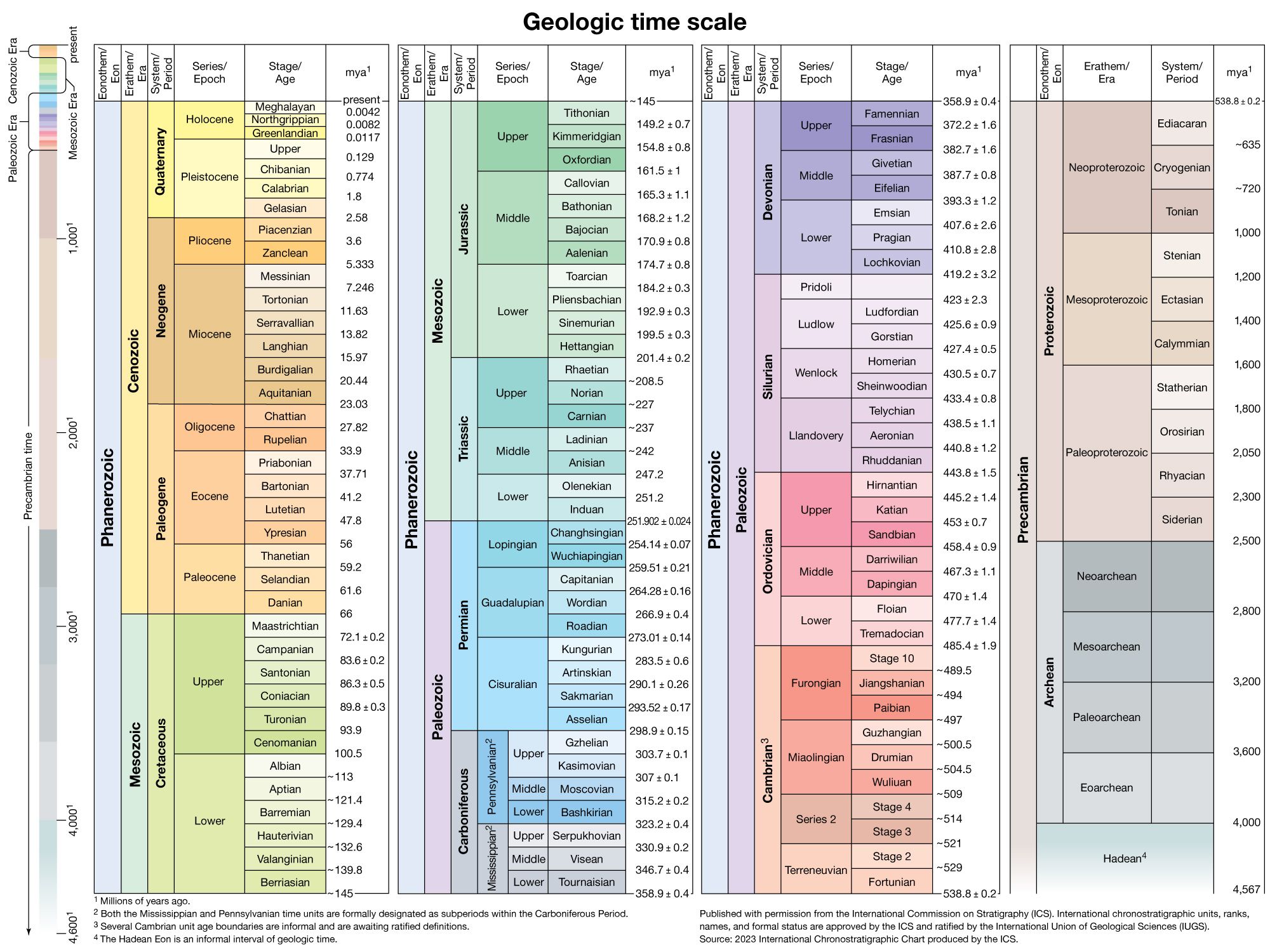
Holocene
Geologic periodWikipedia
112
MENTIONS
28
EPISODES
20
PODCASTS
Search complete. 112 mentions across 28 episodes found for "Holocene".
Sep 24, 2026

speaker_0NARRATOR
Push that back 10,000 years and you land around 13,000 BCE.
speaker_0NARRATOR
In other words, deep in the Late Ice Age, before the Holocene.
speaker_0NARRATOR
At a time when large parts of the world were still locked in glacial conditions and global sea levels were over 100 metres lower than today, right away that claim is doing two things at once.
speaker_0NARRATOR
It's not just saying, these rocks are old, of course they're old.
10 MINS LATER
speaker_0NARRATOR
They're based on global averages.
speaker_0NARRATOR
But that's already enough to answer a basic question.
speaker_0NARRATOR
Could people have physically stood on those rocks during the Late Ice Age and early Holocene? Yes, not just could.
speaker_0NARRATOR
They almost certainly did at some point.

Russ AllenHOST
It's just amazing.
Kyle AllenHOST
Okay, so the name of this paper is Climate-Controlled Holocene Occupation in the Sahara, Motor of Africa's Evolution.
Kyle AllenHOST
2006 in science.
Kyle AllenHOST
Very interesting.
Kyle AllenHOST
Let me see.
Kyle AllenHOST
Okay.
Kyle AllenHOST
So climate controlled Holocene occupation in the Sahara, motor of Africa's evolution.
Kyle AllenHOST
by Rudolf Cooper and Stefan Kruppelin.

Graham HancockGUEST
And we've ended what geologists call the Pleistocene.
Graham HancockGUEST
And we've entered the Holocene, which is our current geological epoch.
Graham HancockGUEST
And that punctuation mark is taken, has been taken for a very long time by archaeologists.
Graham HancockGUEST
After that is supposed to be when civilization, the first traces of civilization begin to be seen and grow.

Kathryn BatesHOST
Culturally, which is also super interesting, is that revenge is motivated from being mistreated or social norms being compromised.
Kathryn BatesHOST
So this theory comes from the Holocene Era, which is the age of humans from around 12,000 years ago.
Kathryn BatesHOST
At that time, societies were mostly strangers, so social norms like not murdering people in the community were really important to, like, develop and to maintain.
Kathryn BatesHOST
So the idea is that people think revenge maintains the status quo, so it's like keeping the law and order, taking it into your own hands.

Dipesh ChakrabartyGUEST
So, I mean, I don't remember the exact, the geological timetable in exact detail, but those are the basic concepts that stratigraphers, the means stratigraphers created.
Dipesh ChakrabartyGUEST
So the two immediately relevant names of two epochs that we have to remember is the Holocene which literally means in etymologically recent times.
Dipesh ChakrabartyGUEST
And it is that itself is an epoch.
Dipesh ChakrabartyGUEST
And epochs can last for 10 million years, by the way.
Dipesh ChakrabartyGUEST
And the ape family might be 6-7 million years.
Dipesh ChakrabartyGUEST
But an epoch can be 10-20 million years.
Dipesh ChakrabartyGUEST
In that context, the Holocene, the recent times, describe a period of recent warming of the planet at the end of the last ice age.
Dipesh ChakrabartyGUEST
which happened roughly 11,700 years ago or something like that, roughly 12,000 years ago, when the planet warmed and made it possible for humans to conduct agriculture.
speaker_0NARRATOR
The alternative claim says, somewhere in that enormous stretch of time between rock formation and fourth dynasty architecture, there was a human moment, a window when conditions at Giza were very different from today, when rain was heavier, the Sahara was greener, and somebody with stone tools and organised labour was already reworking that bedrock.
speaker_0NARRATOR
That's why you almost always hear the same time windows, early Holocene and late Pleistocene.
speaker_0NARRATOR
The early Holocene is the period roughly between 11,500 and 7,000 years ago, after the last ice age ended, but before the Sahara dried out.
speaker_0NARRATOR
North Africa was going through what's sometimes called the African Humid Period.
speaker_0NARRATOR
Lakes, rivers, grasslands, people hunting, herding and gathering in landscapes that are now pure desert.
19 MINS LATER
speaker_0NARRATOR
They then connect this to what we know about North African climate history.
speaker_0NARRATOR
Because the climatic premise behind the whole argument is simple but dramatic, the modern hyper-arid Sahara is a relatively recent thing, geologically speaking.
speaker_0NARRATOR
For much of the late Pleistocene and early Holocene, large parts of North Africa went through green Sahara phases.
speaker_1NARRATOR
If you were an ancient community looking for prime real estate ten thousand years ago, the mouth of a major river system draining onto a wide, gently sloping coastal plain would have been about as good as it gets.
speaker_1NARRATOR
So when researchers started asking if there were ever a submerged settlement from the early Holocene hiding somewhere off the Indian coast, where would it most likely be? The Gulf of Khambhat checked almost every box.
speaker_1NARRATOR
Shallow shelf, ancient exposed coastline, major river outflow, and a documented history of dramatic sea level rise in exactly the right time window.
speaker_1NARRATOR
On paper, it's close to the perfect location for something like this to exist.
speaker_1NARRATOR
And this is where the story exploded from interesting sonar anomaly into full-blown international news.
speaker_1NARRATOR
Because some of that material reportedly came back with radiocarbon dates suggesting an age of around nine thousand five hundred years.
speaker_1NARRATOR
If accurate, that would place these artifacts firmly in the early Holocene, thousands of years before Sumer, thousands of years before the first cities of Mesopotamia that we're taught mark the dawn of urban civilization.
speaker_1NARRATOR
You can imagine what happened next.
speaker_5NARRATOR
Not over decades, but you could see it shift if you lived your whole life there.
speaker_5NARRATOR
This was the early Holocene, the warming period after the Ice Age, and everything was in flux.
speaker_5NARRATOR
Year by year the ice sheets to the north were melting, releasing unimaginable volumes of fresh water into the ocean.
speaker_5NARRATOR
But that water hadn't reached Dogland yet.
15 MINS LATER
speaker_5NARRATOR
It wasn't just a land bridge.
speaker_5NARRATOR
It was one of the most productive hunting grounds in human history.
speaker_5NARRATOR
A landscape caught in transition between two worlds, the dying ice age and the rising warmth of the Holocene.
speaker_5NARRATOR
And that transition created something extraordinary, a biological paradise where cold adapted mega fauna still clung to survival while warm weather species were moving in to claim their territory.

speaker_2NARRATOR
What 17,000 years of sealed, darkness preserved, 15 years of public access began to destroy.
speaker_2NARRATOR
The cave survived every climate event of the Holocene.
speaker_2NARRATOR
It survived the retreat of the glaciers.
speaker_2NARRATOR
It survived the flooding of river valleys and the transformation of tundra into forest.
31 MINS LATER
speaker_2NARRATOR
And the Atlantic and Pacific Oceans were still connected through what is now Central America.
speaker_2NARRATOR
The world was a different planet, different continents, different climates, different species, different oceans.
speaker_2NARRATOR
And through all of that change, through every rearrangement of geography and biology and climate that transformed the Miocene world into the Holocene world, The organisms in Moval Cave continue to live in their dark, toxic, sealed environment, evolving only against each other, oblivious to the transformations occurring on the surface above them.
speaker_2NARRATOR
The cave was a window into what life looks like when it is completely divorced from the conditions that sustain life everywhere else.
speaker_11NARRATOR
but then these experiments would stop the settlements would be abandoned people would return to full nomadic hunter-gatherer lifestyles this wasn't failure this was adaptation they tried agriculture the climate betrayed them and they were smart enough to recognize that mobility was safer than commitment to fixed farming the hunter-gatherer lifestyle meanwhile was actually working remarkably well this is something we need to understand clearly our modern bias assumes that agriculture was an obvious upgrade from hunting and gathering that civilization represents progress and anything before it was primitive misery But the archaeological and anthropological evidence tells a very different story.
speaker_11NARRATOR
Hunter-gatherers during the Pleistocene, and even into the early Holocene, worked fewer hours than agricultural peoples.
speaker_11NARRATOR
Studies of modern hunter-gatherer societies show they typically work about 15 to 20 hours per week to meet all their food needs.
speaker_11NARRATOR
The rest of the time is leisure.
1 HR 12 MINS LATER
speaker_11NARRATOR
One year the rains wouldn't come.
speaker_11NARRATOR
The next year they'd come too much and flood everything.
speaker_11NARRATOR
the wild animals you depended on would migrate away and not return your permanent village would become a death trap so humans stayed mobile not because they were primitive but because mobility was the only rational survival strategy in an unstable world then around eleven thousand seven hundred years ago everything changed the last ice age ended and earth entered what geologists call the holocene epoch but this wasn't just another climate shift The Holocene was different.
speaker_11NARRATOR
It was stable.
18 more episodes mention Holocene.
Create an account to see the whole feed, search across every transcript, and follow the entities you care about.