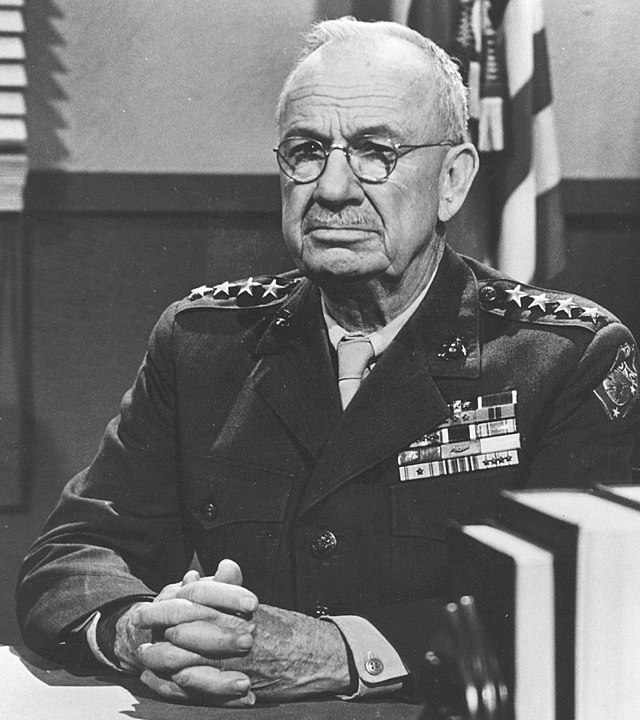
Holland Smith
GeneralWikipedia
6
MENTIONS
6
EPISODES
5
PODCASTS
Search complete. 6 mentions across 6 episodes found for "Holland Smith".
Oct 24, 2026

KevinSNARRATOR
Defense battalions, parachute battalions, raider battalions, barrage balloon detachments, and many others.
KevinSNARRATOR
since there was no prospect of increasing the corps beyond five hundred thousand men the only way to add combat divisions was to delete other organizations another factor was the changing nature of the pacific war in the desperate early days of nineteen forty two there was a potential need for commando type units that could strike deep in enemy territory and keep the japanese off balance while the united states caught its breath however there had been only one such operation and it had not been a complete success the development of the amphibian tractor and improved fire support also had removed the need for the light assault units envisioned by holland smith at the beginning of the war since then the raiders generally had performed the same missions as any infantry battalion sometimes this meant that their training and talent were wasted as happened on bougainville and pavuvoo
speaker_0ADVERTISER
in other
KevinSNARRATOR
cases the quick but lightly armed raiders suffered because they lacked the fire power of a line outfit The failure on Byroko could be partially traced to that fact.

Tom GulleyHOST
How about three days?" And this decision was heavily resented among the Marines in the landing force, and there's other reasons for that we'll talk about later.
Tom GulleyHOST
After the war, Lieutenant General Howland M. "Howlin' Mad" Smith, commander of the expeditionary troops, which consisted of Schmidt's Fifth Amphibious Corps, bitterly complained that a frequent lack of supporting naval gunfire had cost Marine lives throughout the Allied island-hopping campaign.
Tom GulleyHOST
And do you know why they called him Howlin' Mad Smith? Anybody? Apparently, he was howlin' mad.
Tom GulleyHOST
Apparently.

Aaron BennettNARRATOR
For much of the month, the 2nd Raider Regiment served as Corps Reserve, but these highly trained assault troops spent most of their time on working parties at the airfield or carrying supplies to the front lines.
Aaron BennettNARRATOR
on twenty one december the raiders reinforced by the first parachute battalion and a battalion of the one hundred forty fifth infantry assumed the position formerly occupied by the third marines the regiment remained there until eleven january when an army outfit relieved it the raiders boarded transports the next day and sailed to guadalcanal the raider legacy while the second raider regiment had been fighting on bougainville the raiders who had participated in the new georgia campaign had been recuperating and training in the rear both the first and fourth battalions enjoyed a month of leave in new zealand after which they returned to their base camps in new caledonia just after christmas nineteen forty three colonel liversedge detached and passed command of the first raider regiment to lieutenant-colonel samuel d puller the youngest brother of chesty puller the regiment embarked on twenty one january and arrived at guadalcanal three days later in short order the second raider regiment disbanded and folded into the first with shapley taking command of the combined unit and puller becoming the executive officer bougainville however was the last combat action for any raider unit events had conspired to sound the death-knell of the raiders the main factor was the unprecedented expansion of the corps in late nineteen forty three there were four divisions with another two on the drawing boards even though there were now nearly half a million marines there never seemed to be enough men to create the new battalions needed for the fifth and sixth divisions in addition to the usual drains like training and transients the corps had committed large numbers to specialty units defense battalions parachute battalions raider battalions barrage balloon detachments and many others since there was no prospect of increasing the corps beyond five hundred thousand men the only way to add combat divisions was to delete other organizations another factor was the changing nature of the pacific war in the desperate early days of nineteen forty two there was a potential need for commando type units that could strike deep in enemy territory and keep the japanese off balance while the united states caught its breath however there had been only one such operation and it had not been a complete success the development of the amphibian tractor and improved fire support also had removed the need for the light assault units envisioned by holland smith at the beginning of the war since then the raiders generally had performed the same missions as any infantry battalion sometimes this meant that their training and talent were wasted as happened on bougainville and pavuvoo in other cases the quick but lightly armed raiders suffered because they lacked the fire power of a line outfit The failure on Byroko could be partially traced to that fact.
Aaron BennettNARRATOR
With many large-scale amphibious assaults to come against well-defended islands, there was no foreseeable requirement for the particular strengths of the raiders.
Aaron BennettNARRATOR
Finally, there was institutional opposition to the existence of an elite force within the already elite corps.
Aaron BennettNARRATOR
Admiral Connolly, who had commanded the invasion forces at Roi and Namur in the Marshalls, would head the Southern Attack Force, Task Force 53, assigned to Guam.
Aaron BennettNARRATOR
Marine Major General, later Lieutenant General, Holland M. Smith, the Expeditionary Troops commander for the Marianas, would be responsible for the northern troops and landing force at Saipan and Tinian, essentially the Marine 5 Amphibious Corps, VAC.
Aaron BennettNARRATOR
Major General Roy S. Geiger, an aviator who had conducted the Bougainville operation, was to command the southern troops and landing force, the 3 Amphibious Corps at Guam.
Aaron BennettNARRATOR
D-Day for the invasion of Saipan had been set for 15 June.

Aaron BennettNARRATOR
However, there had been only one such operation and it had not been a complete success.
Aaron BennettNARRATOR
The development of the amphibian tractor and improved fire support also had removed the need for the light assault units envisioned by Holland Smith at the beginning of the war.
Aaron BennettNARRATOR
Since then the Raiders generally had performed the same missions as any infantry battalion.
Aaron BennettNARRATOR
Sometimes this meant that their training and talent were wasted, as happened on Bougainville and Pavuvu.