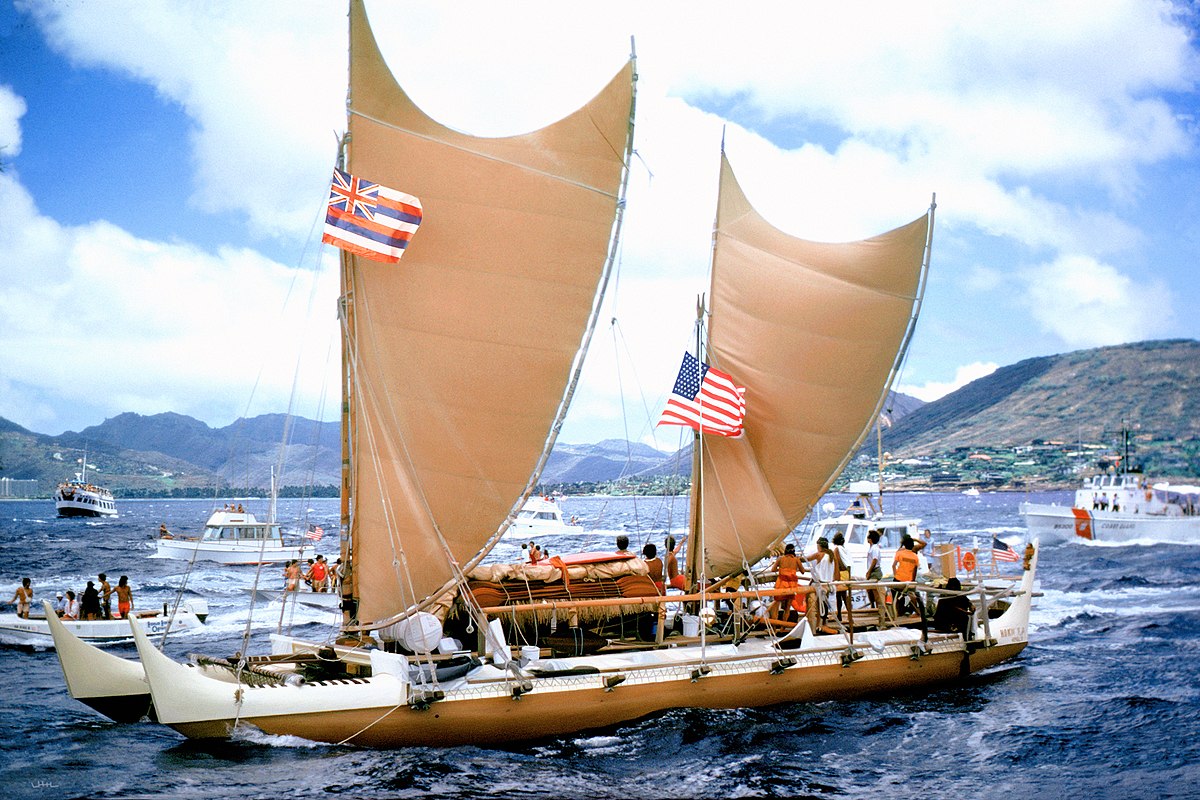
Hōkūleʻa
Double-Hull CanoeWikipedia
16
MENTIONS
9
EPISODES
8
PODCASTS
Search complete. 16 mentions across 9 episodes found for "Hōkūleʻa".
Sep 24, 2026

Mark EllisGUEST
Yep, our navigation system was taught to us by a man named Mau Piailug, who came from the island of Satawal in Micronesia.
Mark EllisGUEST
He was Hōkūleʻa's first navigator, and he taught us the art of traditional non-instrument navigation.
Mark EllisGUEST
Nothing electronic at all.
Kristen KimHOST
Can you give us an example of what non-instrument navigation actually looks like?

Charlie ParkerGUEST
But talking about Polynesian navigation, someone who I have the utmost respect for and, um, and definitely is someone who inspires me is a gentleman called Nainoa Thompson.
Charlie ParkerGUEST
And Nainoa Thompson is famed for having actually sailed across the Pacific in a canoe called the Hokule'a, and this took place back in, uh, 1980.
Charlie ParkerGUEST
It was from Hawaii to Tahiti, and this hadn't been done for over 600 years.
Charlie ParkerGUEST
And this Nainoa Thompson was, was, um, captain of this canoe and was the navigator on this canoe called Hokule'a, but it was the product of a movement in the '70s that was founded by the Polynesian Voyaging Society.
Charlie ParkerGUEST
And the Polynesian Voyaging Society set out to identify how did these islands become populated, and they did believe that they came from, you know, the, the west of here, and they set out to prove this hypothesis.
Charlie ParkerGUEST
There were others that said the islands were settled from the east, from the east, from South America, for example.
Charlie ParkerGUEST
He held the secrets or held, had the knowledge of this celestial navigation, and he may have been the last one to carry this knowledge.
Charlie ParkerGUEST
So Nainoa Thompson studied with him for years, for decades to, to learn what was needed to be able to do this.

Mark CarpenterGUEST
in January 1976.
Mark CarpenterGUEST
Uh, a movement, uh, that came amid the Hawaiian Renaissance and the swell of that, what was happening with Hokule'a as well, and the occupying of Kaho'olawe when the US military was bombing the island following, uh, World War II-
Kainoa CarlsonHOST
Wow
Mark CarpenterGUEST
... and commencing the training exercises there for decades.

Jim MurrayHOST
I, I don't know what the hell I was watching.
Jim MurrayHOST
It, it felt like there was some sort of missive into the, to Son of Hokulea's ear to say, "Make this one close.
Jim MurrayHOST
Let's let the Vikings back into this." Now, that's not to let your team off the hook, because if I was you, I'd be saying, "Fire LaFleur today." Uh, that, that guy's a moron.
Jim MurrayHOST
Taking points off the board to let the Vikings back into the game and give them momentum.

Indranil ChakrabortyHOST
They formed the Polynesian Voyaging Society.
Indranil ChakrabortyHOST
They built a traditional double-hulled canoe, named her Hokulea, which in Hawaiian means the friendly star.
Indranil ChakrabortyHOST
And they set an objective, sail from Hawaii to Tahiti using nothing but the old techniques.
Indranil ChakrabortyHOST
But they had one problem.

Kimberly-Rose WolterHOST
Somebody was saying like, it's so interesting to hear her point of view.
Kimberly-Rose WolterHOST
And because I think even if you know about Hokule'a, you don't know all the
speaker_1UNKNOWN
details of it.
Kimberly-Rose WolterHOST
You know what I mean? And certainly like hearing about it from someone who was on the boat is like something I had never heard.

Leslie TagordaGUEST
But in indigenous traditions, so many of the traditions stayed together in this form of cosmology.
Leslie TagordaGUEST
Now, back to the Hokulea, the ship.
Leslie TagordaGUEST
Nobody had the wisdom anymore of how to navigate by the stars.
Leslie TagordaGUEST
But there was somebody in the islands of Micronesia who heard what these Hawaiians were doing.
17 MINS LATER
Leslie TagordaGUEST
Seriously, I hear your values of reciprocity coming through.
Leslie TagordaGUEST
And the antidote to extraction is reciprocity, right? It's like, how can I hype others? How can I share my power? How can I build power between folks? And to me when we're not only like reclaiming leadership we're redefining leadership in this new world and to redefine leadership means that we're creating things that are like where we're all equals where there's equity meaning that there's not just somebody at the top who's just sucking up from everybody else right that's the extraction part and so how do we become more reciprocal and And I hope that, you know, like I've loved this conversation so far.
Leslie TagordaGUEST
And I hope if you've been listening that you've learned something new that your worldview has widened, that maybe you'd never heard about the Hokulea before or that you haven't heard about like the plights of like the Hawaiian monarchy and the Native Hawaiian people.
Leslie TagordaGUEST
And how by reading authors that don't look like you, that don't come from your own culture, you broaden your horizons, you learn new perspectives, you learn new facts.
Kainoa CarlsonHOST
Yes.
Paula AkanaGUEST
And we did Hokulea.
Paula AkanaGUEST
This, um, this Sunday we, we celebrate the Queen.
Paula AkanaGUEST
Um, and we just have all kinds of hula and mele that are going on, and groups.

Julian WilcoxHOST
It's 51 years since the waka Hōkūlea undertook its first journey from Hawai'i to Tahiti, and in the process, helped reinvigorate traditional navigation across Temōranui Akiwa
speaker_7CORRESPONDENT
AkiwaThe journey continues today to train the next generation of navigators, and I sat down with the captain of Hōkūleʻa, the legendary Bruce Blakenfield.
Bruce BlankenfeldGUEST
[upbeat music] We're here with the waʻa because we're on this multi-year journey of Moananuiākea.
Bruce BlankenfeldGUEST
So we're here right now to take care of the waʻa, to make sure they're in good shape for when they leave next month on a little sail, and they are, uh, all the systems are functioning.
Bruce BlankenfeldGUEST
And, uh, get them in a position with their knowledge and their understanding of this, that they're ahead of us where we were, where we started.
speaker_7CORRESPONDENT
But you've been in this a long time, though.
Bruce BlankenfeldGUEST
I started on Hōkūleʻa r- uh, in 1977.
speaker_7CORRESPONDENT
'77.