Hispania
41
MENTIONS
17
EPISODES
12
PODCASTS
Search complete. 41 mentions across 17 episodes found for "Hispania".
Sep 15, 2026

Paul McGannHOST
In the three-way split, at least in its initial format, Antony will take the Cisalpine Gaul he so covets.
Paul McGannHOST
Lepidus is thrown southern Gaul and Hispania.
Paul McGannHOST
Octavian will get North Africa, in addition to overseeing things on the home front.
Paul McGannHOST
It's the foundation of what is known as the Second Triumvirate.

Juan NaulaNARRATOR
Indeed, it had only increased as the emperor became ever more tyrannical and cruel in the following years.
Juan NaulaNARRATOR
Rebellions grew, especially in Gaul and in Hispania under the governorship of Galba, and this increasing pressure led to the head of the Praetorian Guard abandoning Nero and declaring for Galba, and the rest of the emperor's guards then followed suit.
Juan NaulaNARRATOR
Fleeing the city, Nero learned that he had been declared a public enemy by the Senate and on the 9th of June he either took his own life or ordered his personal assistant to kill him.
Juan NaulaNARRATOR
Tacitus wrote that Nero's death was celebrated by the Roman upper classes but was somewhat lamented by the lower classes who had often gained from the emperor's excesses.
Juan NaulaNARRATOR
Over the previous century, the Roman Republic had experienced a very paradoxical set of events.
Juan NaulaNARRATOR
On the one hand, the Republic had expanded at breathtaking speed, conquering huge swathes of territory across the eastern Mediterranean and north into Gaul, while also solidifying its control over regions such as the Iberian Peninsula and North Africa.
Juan NaulaNARRATOR
But this rampant growth was matched by a speedy breakdown of the Republic's politics, as numerous Roman generals effectively became too powerful for the institutions of the Republic to control.
Juan NaulaNARRATOR
Several civil wars had occurred as rival generals and politicians sought preeminence at Rome.
21 MINS LATER
Juan NaulaNARRATOR
In two AD, one of the most significant figures in the line of succession died.
Juan NaulaNARRATOR
This was Lucius, the second son of Julia and Marcus Agrippa.
Juan NaulaNARRATOR
That year, Lucius had been appointed by Augustus to undertake a military command suppressing a local revolt in Hispania.
Juan NaulaNARRATOR
On his way to Iberia, he took ill in Southern Gaul and died within days.

RolyHOST
So, as we discussed in past episodes...
RolyHOST
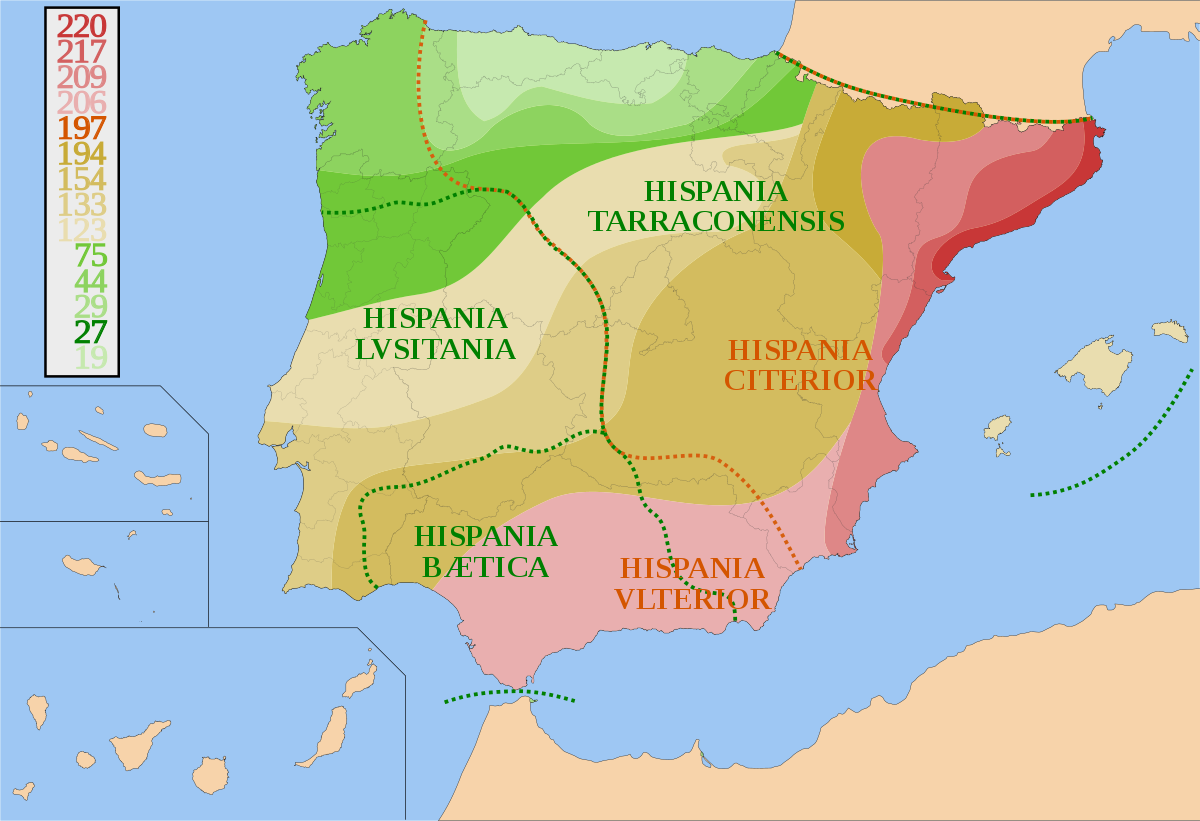
After the Second Punic War, Carthage is completely expelled from Hispania and essentially left to a mix of Roman control and local native rule.
RolyHOST
The Romans quickly realized that the peninsula was an economic goldmine and determined to subdue the entire peninsula and exploit its wealth of gold and silver.
RolyHOST
The natives, as you would imagine, did not likely consent to Roman rule, so they fought back.
9 MINS LATER
RolyHOST
murdered and was avenged and his avengers all fought each other, we all know one man was left standing, Octavian, known to us today as Augustus.
RolyHOST
With the Civil War settled, Augustus determined to settle the rest of the empire.
RolyHOST
He prosecuted a brutal bloody Tenia war against the Cantabria and Asturias, who were the last two independent Celtic tribes in Hispania, essentially sent 50,000 Roman soldiers to completely subjugate these tribes.
RolyHOST
When the fighting was through, the Romans either enslaved or executed most fighting men age of the tribes and resettled the survivors from their mountain forts into valleys.

Hannah CornwellGUEST
One of them has a carnox, which is the sort of dragon-like war trumpet associated with Celtic and Gallic peoples.
Hannah CornwellGUEST
And so they've been variously interpreted as Gallia and Hispania or potentially Dalmatia.
Hannah CornwellGUEST
However we choose to interpret them, I think thinking about them as provinces that Augustus has pacified and brought to peace is the way to think about this.
Hannah CornwellGUEST
So surrounding the central scene, we have the heavenly bodies, solar movement, Mother Earth, the support of Apollo and Diana linking into the Lude secularis, and we have the provinces that Augustus has brought to peace.
Paul McGannHOST
She will find it hard to say no a second time.
Paul McGannHOST
For in a follow-up mission to crush the last pockets of resistance, Caesar must now venture to Spain, Hispania.
Paul McGannHOST
There, Pompey's two sons, Gnaeus and Sextus, have holed up, hoping to raise an army to retake Rome.
Paul McGannHOST
This time, the 16-year-old Octavian gets permission.
Paul McGannHOST
They do so at a frightening pace.
Paul McGannHOST
According to Suetonius, they reach the Spanish border in just 24 days.
Paul McGannHOST
The Hispania campaign is notable for one of Caesar's most savage victories, the Battle of Munda, fought in modern-day Andalusia.
Paul McGannHOST
But Octavian will be nowhere near the action.

speaker_2NARRATOR
Carthage was a Phoenician colony that had been founded on the northeastern coast of what is now Tunisia by settlers from Tyre in the Levant back in the 9th century BC.
speaker_2NARRATOR
It subsequently emerged as one of the great trading and naval powers of the western Mediterranean securing control over large parts of North Africa, southern Hispania and the Balearic Islands in the 6th, 5th and 4th centuries BC.
speaker_2NARRATOR
It had also set its sights on conquering wealthy Sicily.
speaker_2NARRATOR
The Carthaginians had succeeded in doing so to some extent, claiming the western half of the island in the 4th century BC, but Syracuse, particularly during the long reign of Agathocles, had offered strong resistance to the Carthaginians and remained the pre-eminent power in the west of the island.
8 MINS LATER
speaker_2NARRATOR
Diodorus claims that while he was in Egypt, Archimedes invented a device for drawing water out of rivers and other bodies of water now commonly known as the Archimedes screw.
speaker_2NARRATOR
The device consists of a spiral thread wrapped around a pole, which when inserted into a tube, allows the user to lift water by turning a handle.
speaker_2NARRATOR
According to Diodorus, The Archimedes screw was used in silver mines in Hispania, the ancient name for Spain, to remove water from underground streams to the surface to create a dry environment and facilitate mining operations.
speaker_2NARRATOR
A version of the device continues to be used in the Nile Delta to this day for irrigation purposes.

Karl DahlGUEST
Um, the, the Romans directed, um, all kinds of Visigothic groups, the Suebis, the, um...
Karl DahlGUEST
And brought them in as foederati to, to govern Hispania, right? Um, and also to get them out of the areas where they were causing trouble.
Karl DahlGUEST
Um, so by kind of the, the collapse of, um, you know, the Western Roman Empire, um, there, there were, uh, there was a Suebian r- region, there was the Basque region in the north, there was a big Visigothic region that, uh, there was a huge sweep of, like, the central part of the country from east, uh, from west to east.
Karl DahlGUEST
And then down in the southern areas, which was, like, Cadiz and Malaga and Cartagena and out into the, um, Balearic Islands, um, that remained, um, part of the east...
7 more episodes mention Hispania.
Create an account to see the whole feed, search across every transcript, and follow the entities you care about.