Higher Education Act of 1965
37
MENTIONS
24
EPISODES
23
PODCASTS
Search complete. 37 mentions across 24 episodes found for "Higher Education Act of 1965".
Sep 27, 2026

Shabbos KestenbaumGUEST
As it pertains to just like the foreign funding, because that's, I think, the issue.
Shabbos KestenbaumGUEST
Under Section, I think it's 114 or 112 of the Higher Education Act, the Department of Education, please fact check me, go on the Department of Education website right now, they outlined, they documented for all people to see where institutions of higher learning in the United States are receiving their money from.
Shabbos KestenbaumGUEST
And we know that Qatar alone, which has a population of less than 300,000 Qataris, most of the people living there are migrants or slave laborers, they have spent more than $6 billion, with a B, to institutions of higher learning in the United States.
Shabbos KestenbaumGUEST
And the response often is, well, they're just doing that because they have Qatari satellites of these campuses, which number one, why are there American satellite campuses in Doha? And number two, that isn't even true.

Ryan MaruyamaHOST
And the price remained high, and then therefore they had to close.
Hannah MaruyamaHOST
Well, the more money gets cut off from a federal level, again, I will again, I'll take this as my weekly spot to say the only way to fix academia in the United States is to abolish the Higher Education Act and take all of the government money out of it.
Hannah MaruyamaHOST
Because if people want to see costs come down to a manageable level where, you know, boomers would say, oh, I can just work at McDonald's and I'd be able to pay tuition.
Hannah MaruyamaHOST
Yeah, that's because they were doing it before 1965, before the government was subsidizing the loans.
6 MINS LATER
Hannah MaruyamaHOST
The obvious answer is no, because more people started buying college degrees.
Hannah MaruyamaHOST
Colleges invented more worthless programs.
Hannah MaruyamaHOST
Again, tuition has been doubling every nine years since the Higher Education Act passed in 1965.
Hannah MaruyamaHOST
I do not see why more people are not ringing alarm bells about this, because this, this is a small number.

Lucas JonesHOST
NIL is continuing to incentivize foreign students to come to America and capitalize on our system.
Lucas JonesHOST
Saving sports should start and end with American athletes." So in short, the Team USA Act would amend the Higher Education Act of 1965 to require colleges and universities participating in Title IV federal student aid programs to limit international student athlete participation to no more than 20% of each varsity team's roster.
Lucas JonesHOST
That's an important note.
Lucas JonesHOST
It would aim to strengthen the American Olympic development pipeline.

Hannah MaruyamaGUEST
And they got greedy as this is what usually and predictably happens when the government writes blank checks for things and then messes up the incentive structure of an institution or a system.
Hannah MaruyamaGUEST
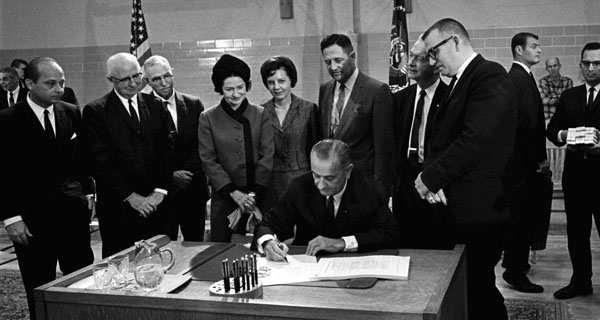
So in 1965, they signed the Higher Education Act.
Hannah MaruyamaGUEST
What the Higher Education Act did was it allowed the government to subsidize student loans.
Hannah MaruyamaGUEST
And that is where it all started going downhill.
Hannah MaruyamaGUEST
So by 1976, the default rate on the loans had gone from 2% to 9% in 11 years.
Hannah MaruyamaGUEST
Yes, and that seemed to me to be a very intentional choice because I think the mid-1980s was the last time that degrees had positive ROI for the majority of people going.
Hannah MaruyamaGUEST
Because at that point, the system was running on fumes.
Hannah MaruyamaGUEST
Another thing that caused a lot of people to go get degrees when they didn't need them and then caused colleges to sell more and create more programs was in the early 1970s, about five years after the Higher Education Act passed and the government was like, here, we'll back these loans.

Robert FarringtonHOST
The bill is called the Young Farmers Success Act, was introduced by Republican Glenn Thompson, Ann Jo Courtney, who's a Democrat, Monica de la Cruz, Republican, Nikki Budzinski, Democrat, and referred to the House Committee on Education and Workforce.
Robert FarringtonHOST
The text of the bill amends the Higher Education Act to treat full-time work as an, quote, employee or manager of a qualified farm or ranch as a public service job, Duh! A qualified operation is one with at least $35,000 in gross revenue from agricultural product sales in 26, indexed to inflation in later years.
Robert FarringtonHOST
Borrowers would still need 120 qualifying payments, of course, the same rule that applies to everybody else in the category.
Robert FarringtonHOST
So, here's why it matters.
Robert FarringtonHOST
The co-sponsor count is the near-term signal.
Robert FarringtonHOST
It's still well short of what it needs to be.
Robert FarringtonHOST
The other path is attachment to a larger vehicle, either a farm bill or a higher education act reauthorization.
Robert FarringtonHOST
Borrowers already working toward forgiveness should keep certifying employment on the current rules rather than counting on a change and just sitting on your hands.

Tom NettingGUEST
So those are kind of the biggies.
Tom NettingGUEST
And as we look at the prior OB3 regulatory packages, the most recent set of regulations and negotiated rulemaking was the AIM Committee, Accreditation, Innovation, and Modernization, a complete, complete reworking of the portions of the Higher Education Act, subpart H, of the Higher Education Act relating to accrediting agencies and their roles and responsibilities as part of the triad, and this administration's efforts to bring forth new regulations in those areas.
Tom NettingGUEST
Those regulations are not final yet.
Tom NettingGUEST
They are currently in the notice of proposed rulemaking NPRM phase.

Zak PaineHOST
Both Duke and UND are research institutions that have received significant taxpayer support for the development of critical and emerging technologies.
Zak PaineHOST
Pursuant to Section 117 of the Higher Education Act of 1965, post-secondary institutions receiving federal financial assistance must disclose foreign source gifts and contracts with a value of $250,000 or more annually.
Zak PaineHOST
So these investigations follow yesterday's House Foreign Affairs subcommittee hearing that examined the covert maligned influence operations involving China and Cuba.
Zak PaineHOST
So I think all of this is connected and we're seeing a whole of government effort to look into a variety of different sectors within the United States that have effectively been operating at the behest of a variety of different foreign influence.
Zak PaineHOST
Those efforts are critical to U.S. national security interests and have also drawn significant investment and involvement to UND by Chinese aviation companies known to also have close ties to China's military.
Zak PaineHOST
To verify their compliance with the law and accuracy of their disclosures, the agency's investigation requires that they produce, again, certain records within 30 days, all of the same types of records that I mentioned for Duke.
Zak PaineHOST
Now, what is Section 117 of the Higher Education Act of 1965? It mandates that federally funded institutions disclose all of those gifts over $250,000.
Zak PaineHOST
It's intended to protect national security and academic integrity by curbing undue foreign influence in higher education.

Sarah CusterHOST
But just for people who may not be following it as closely as you and I are, how would you explain the government's plans to overhaul accreditation in simple terms?
Maria ToyodaGUEST
Yeah, well, you know, the Higher Education Act hasn't been reauthorized since, I think, 2008.
Maria ToyodaGUEST
And in the absence of that reauthorization, you know, there's just kind of been a vacuum in a lot of ways where there hasn't been a lot of progress or adjustment or innovation made.
Maria ToyodaGUEST
So I think this was a real, you know, I'll be honest, I think it's a real push to disrupt education.
5 MINS LATER
Maria ToyodaGUEST
So when you're talking about, for instance, you know, these provisions around First Amendment rights or research conduct or misconduct, or you're even talking about this cost-benefit analysis and so forth, it isn't clear from the preamble that these apply to agencies or they apply to institutions.
Maria ToyodaGUEST
So I'll just give a quick overview of why this matters.
Maria ToyodaGUEST
So the Higher Education Act sets out about 10 different things that accreditors must look at as part of their standards.
Maria ToyodaGUEST
And then it has other language that says, you know, it's not up to the government to prescribe the substance of what.

Douglas Wayne RickettsHOST
Higher education outcomes data should be similarly risk-adjusted to more carefully isolate the impact of educational quality versus socioeconomic status and other factors on college outcomes.
Douglas Wayne RickettsHOST
Reform the Negotiated Rulemaking Process at ED The U.S. Department of Education is required by statute to engage in negotiated rulemaking prior to promulgating new regulations under Subchapter 1 of the Elementary and Secondary Education Act, as well as Subchapters 2, Teacher Quality Enhancements, and 4 of the Higher Education Act of 1964, Student Assistance.
Douglas Wayne RickettsHOST
The purpose of negotiated rulemaking is to engage a committee of stakeholders early in the drafting of proposed regulations to ensure that the regulation can be implemented as written, to understand any potential unintended consequences and to seek suggestions from stakeholders on alternative solutions.
Douglas Wayne RickettsHOST
The goal is for the negotiators to reach a consensus, thus smoothing the way to promulgate a new rule.

Debra ShushanGUEST
You know, if I say I'm sorry, you know, we don't we don't facilitate, you know, study abroad with Ariel University.
Debra ShushanGUEST
My university could get sued and we potentially could lose our eligibility for any federal funding under Title VI of the Higher Education Act, according to this bill.
speaker_3UNKNOWN
Yeah, First Amendment
Wajeeh LionHOST
doing very well.
14 more episodes mention Higher Education Act of 1965.
Create an account to see the whole feed, search across every transcript, and follow the entities you care about.