Hidden Markov model
31
MENTIONS
11
EPISODES
5
PODCASTS
Search complete. 31 mentions across 11 episodes found for "Hidden Markov model".
Nov 21, 2026

Sanjeev KhudanpurGUEST
And third, Let's just allow captions which are actually seen.
Sanjeev KhudanpurGUEST
In other words, if I've never seen a car, road, and building together, it's not allowed as a possible path through my HMMs.
Sanjeev KhudanpurGUEST
Only paths which I've actually seen in training are allowed.
Sanjeev KhudanpurGUEST
This doesn't mean that my captions coming out will only be captions in the training.
7 MINS LATER
Sanjeev KhudanpurGUEST
So we have 13 individual video sources in our entire collection.
Sanjeev KhudanpurGUEST
And so we went ahead and did this HMM training.
Sanjeev KhudanpurGUEST
So what we did is we built up the HMMs first for everything, like all the images of all the sources for all the concepts.
Sanjeev KhudanpurGUEST
And then we chopped up the data into the 13 individual subsets, one from each source, and re-estimated the HMM parameters on each subset.
Fernando PereiraGUEST
many of you will notice immediately, that's not tractable in general, because there are exponentially many y's.
Fernando PereiraGUEST
So what we're going to do is that we're going to do exactly the same thing that people do for HMMs and probabilistic contextual grammars, which is to impose some kind of a Markov assumption into this inference problem.
Fernando PereiraGUEST
So what we're going to do is think about this feature function as a sum of feature functions that look basically at all, can look at all of the input x, but only a little piece of y.
Fernando PereiraGUEST
So a bounded piece of the output structure Y.
Mark JohnsonGUEST
I'll talk about that at the end.
Mark JohnsonGUEST
So here's another example that might look a bit more familiar to people familiar with HMMs.
Mark JohnsonGUEST
It's dependency parsing where we're just trying to recover these, these head dependent relationships.
Mark JohnsonGUEST
We don't have internal structure.

Grant BelgardHOST
You decide what counts as a seizure phenotype in a fly, and how do you measure it?
Lawrence ReiterGUEST
So you would understand this concept, right? We don't decide, right? We use hidden Markov modeling and we let the video just tell us, right? What's immobilization? What's walking? What's uncoordinated movement? And then we compare to the control group and look at statistically at effect sizes for drug treatment, right? So in most cases, good science, you don't decide, right? You just, you let the statistics and the animal decide for you.
Grant BelgardHOST
How would you
Lawrence ReiterGUEST
work out

Percy LiangHOST
So in case H is small, we can just do it kind of brute force.
Percy LiangHOST
If H is HMM, we can use, if the Bayesian network is HMM, we can use forward-backward.
Percy LiangHOST
In general, we can skip sampling, et cetera.
Percy LiangHOST
So now what do we have? We have these weights for every H.
12 MINS LATER
Percy LiangHOST
So now you hide the substitution table, and then you hand someone the ciphertext, or you put it in a book and bury it for someone to discover later.
Percy LiangHOST
So now the question is when someone receives a ciphertext, is given the ciphertext, can they recover the plaintext? Importantly, the plaintext is obviously unknown, but also the substitution table is also unknown.
Percy LiangHOST
So this is a very challenging problem, but let's see how we can use Bayesian networks, in particular HMM, to try to address this.
Percy LiangHOST
So remember the process of using an HMM, you have to think about what is the generative story of how this data arose.
Percy LiangHOST
then the trajectories are OK.
Percy LiangHOST
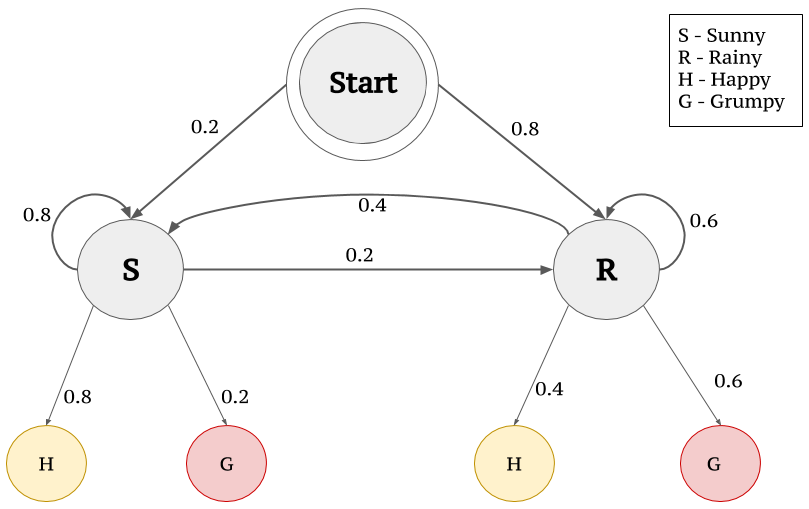
So this program specifies what is called a Markov model, which is a special case of a Bayesian network where we have a chain.
Percy LiangHOST
Each variable is only dependent on the previous
Percy LiangHOST
variable.
Percy LiangHOST
With this
Percy LiangHOST
Markov model, we can ask particular questions.
Percy LiangHOST
For example, what are the possible trajectories given the evidence X10 equals A2? So here, I'm going to condition on X10 equals A2.
Percy LiangHOST
And if I run this, then I'm sampling from all the program traces.
Percy LiangHOST
So we saw many ways of doing this, including manually by exhaustive enumeration, We can convert Bayesian networks into Markov networks and do Gibbs sampling.
Percy LiangHOST
And then for HMMs, we have specialized techniques such as the forward-backward algorithm and particle filtering.
Percy LiangHOST
So inference assumes that all these local conditional distributions are known.
Percy LiangHOST
But the big question is, where do all of these come from? So all of these numbers are called the parameters of the Bayesian network, the red question marks.
Percy LiangHOST
0.61 and 0.3. All right, so
Percy LiangHOST
to summarize, we've presented the forward-backward algorithm for probabilistic inference in HMMs, in particular answering smoothing questions.
Percy LiangHOST
So the key idea behind the forward background algorithm is this lattice representations, which allows us to compactly represent paths as assignments and the weights of each assignment to be the product of the edge weights.
Percy LiangHOST
That allows us to define a dynamic program, which computes the forward and backward messages in an efficient way.
Percy LiangHOST
We're actually going to reduce the problem in Bayesian networks to the same problem of probabilistic inference in Markov networks, allowing to leverage the stuff that we talked about when we talked about Markov networks.
Percy LiangHOST
Then we're going to specialize to hidden Markov models, HMMs, an important special case of Bayesian networks.
Percy LiangHOST
We're going to show that the forward-backward algorithm can leverage the chain structure of an HMM allowing you to do exact probabilistic inference efficiently, then
speaker_0ADVERTISER
Hey, Spotify listeners.
1 more episode mentions Hidden Markov model.
Create an account to see the whole feed, search across every transcript, and follow the entities you care about.