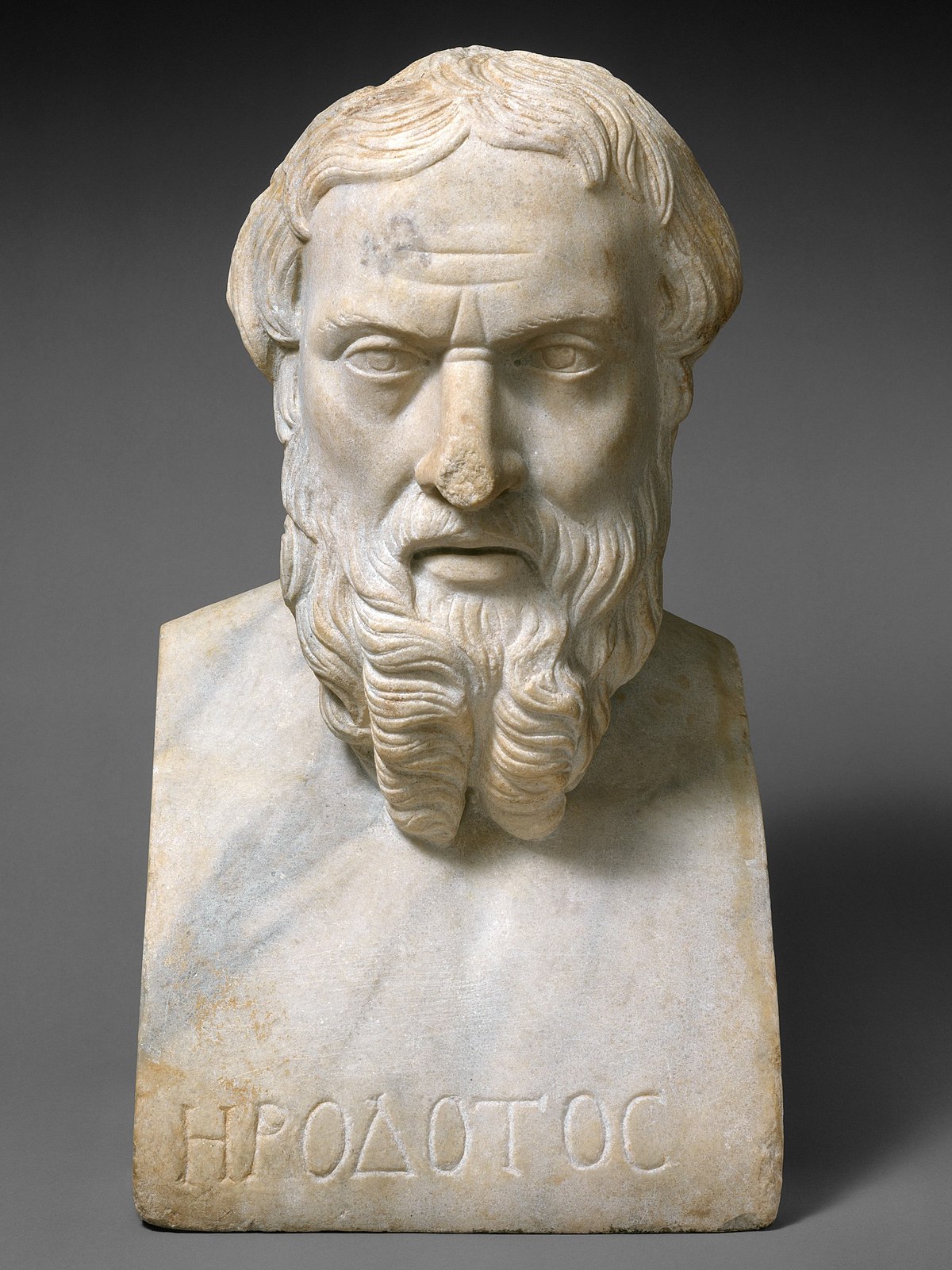
Herodotus

Herodotus

Historian and geographerWikipedia

Search complete. 1762 mentions across 525 episodes found for "Herodotus".

Sep 11, 2026

Noel BadrianNARRATOR
83:36
footnote the cloak or mantle as described by thady is of high antiquity spenser in his view of the state of ireland proves that it is not as some have imagined peculiarly derived from the scythians but that most nations of the world anciently used the mantle for the jews used it as you may read of elias's mantle c The Chaldees also used it, as you may read in Diodorus.
Noel BadrianNARRATOR
84:09
The Egyptians likewise used it, as you may read in Herodotus.
Noel BadrianNARRATOR
84:13
and may be gathered by the description of Berenice in the Greek commentary upon Callimachus.
Noel BadrianNARRATOR
84:20
The Greeks also used it anciently, as appeared by Venus' mantle lined with stars, although afterwards they changed the form thereof into their cloaks, called palae, as some of the Irish also use.
Larry WilsonNARRATOR
3:14
It may be said that Greek myths, especially as handled by the poet who wove them into his deepest criticisms of life, are misleadingly, if not profanely, entitled fairy tales.
Larry WilsonNARRATOR
3:26
But I would plead that nothing in Greek literature, except the stories of Herodotus, is so steeped in the true fairy atmosphere as are the myths of Pindar.
Larry WilsonNARRATOR
3:35
I need not speak of Aeschylus, the creatures of whose titanic imagination belong to a universe of their own, but consider, for example, the poet of the Odyssey.
Larry WilsonNARRATOR
3:45
His wonder world, though real, lies far away.
Bill MosleyNARRATOR
9:40
And I should spend my time to little purpose if I should pretend to teach the Greeks that which they know better than I already.
Bill MosleyNARRATOR
9:49
What a great disagreement there is between Hellenicus and Acusilaus about their genealogies, in how many cases Acusilaus corrects Hesiod, or after what manner Ephorus demonstrates Hellenicus to have told lies in the greatest part of his history, as does Timaeus in like manner as to Ephorus, and the succeeding writers do to Timaeus, and all the later writers do to Herodotus.
Bill MosleyNARRATOR
10:21
Nor could Timaeus agree with Antiochus and Philistius, or with Callias about the Sicilian history, no more than do the several writers of the Atheidae follow one another about the Athenian affairs, nor do the historians the like that wrote the Argolics about the affairs of the Argives.
Bill MosleyNARRATOR
10:45
And now what need I say any more about particular cities and smaller places, while in the most approved writers of the expedition of the Persians, and of the actions which were therein performed, there are so great differences.

20 MINS LATER

MarianneNARRATOR
31:21
The Thracians were also known to them by the nearness of their countries, and the Scythians by the means of those that sailed to Pontus.
MarianneNARRATOR
31:30
For it was so in general that all maritime nations, and those that inhabited near the eastern or western seas, became most known to those that were desirous to be writers.
MarianneNARRATOR
31:42
But such as had their habitations further from the sea were for the most part unknown to them, which things appear to have happened as to Europe also, where the city of Rome, that hath this long time been possessed of so much power, and hath performed such great actions in war, is yet never mentioned by Herodotus, nor by Thucydides, nor by any of their contemporaries.
MarianneNARRATOR
32:08
And it was very late, and with great difficulty, that the Romans became known to the Greeks.
speaker_3NARRATOR
3:10
Of the first kind, the mention of one or two distinguished names will furnish a definite type.
speaker_3NARRATOR
3:16
To this category belong Herodotus, Thucydides, and other historians of the same order, whose descriptions are for the most part limited to deeds, events, and states of society which they had before their eyes and whose spirit they shared.
speaker_3NARRATOR
3:36
They simply transferred what was passing in the world around them to the realm of representative intellect.
speaker_3NARRATOR
3:43
An external phenomenon is thus translated into an internal conception.
speaker_3NARRATOR
5:27
Such original historians, then, change the events, the deeds, and the states of society with which they are conversant into an object for the conceptive faculty.
speaker_3NARRATOR
5:41
The narratives they leave us cannot, therefore, be very comprehensive in their range.
speaker_3NARRATOR
5:47
Herodotus, Thucydides, Guicciardini may be taken as fair samples of the class in this respect.
speaker_3NARRATOR
5:56
What is present and living in their environment is their proper material.
ExpatriateNARRATOR
52:17
Here loom up the mountains of the moon.
ExpatriateNARRATOR
52:20
Here begins the deserta incognita of Herodotus.
ExpatriateNARRATOR
52:24
What was the chimera of infinity, or the notion of the primum mobile? Out of what did man create God? Then Josephine wondered if indeed she were the centre of creation, if it were not from her point lopsided, and there followed common speculations.
ExpatriateNARRATOR
52:40
Do ghosts exist, she thought? And there came back to her the memory of the ghost of a man who had been killed in France, which she once saw above the ripe cornfields by an August sea.
MaryHOST
22:37
Like if you see like a human face in a tree, they call that pareidolia.
MaryHOST
22:40
Herodotus.
MaryHOST
22:40
And I get it.
MaryHOST
22:41
There's that verse in Isaiah 27.1. And it says, And in that day, that means the day of the Lord or judgment day.
Jillian MosleyNARRATOR
37:37
But what I've found is willful ignorance on a scale that's caused me to question this key part of my own identity.
Jillian MosleyNARRATOR
37:51
First referenced by Herodotus in the 5th century BC, Palestine came to include what's now Israel.
Jillian MosleyNARRATOR
38:06
But one British Jew I encountered was adamant that a place called Palestine never existed.
Jillian MosleyNARRATOR
38:19
And although Israel Medad, a settler, admits that there was an Arab majority in this country when General Allenby arrived, one Israeli I spoke to thought these numbers were made up.
speaker_5NARRATOR
28:25
And their history has a story they told about a king.
speaker_5NARRATOR
28:29
Cleomenes of Sparta, Cleoem Ones, spent time among Scythian envoys, learned to drink his wine unmixed as they did, and, according to Herodotus, went mad.
speaker_5NARRATOR
28:44
The Spartans said so themselves.
speaker_5NARRATOR
28:47
When they wanted to describe a man drinking without water, they had a verb for it, to do it Scythian style.
Michael R. JacobsNARRATOR
12:21
It was not until the mid-first millennium BCE that more explicit histories were written.
Michael R. JacobsNARRATOR
12:28
For example, Hecateus, Thucydides, Herodotus.
Michael R. JacobsNARRATOR
12:33
Methodological concerns and caveats.
Michael R. JacobsNARRATOR
12:36
A few points about research issues.
GregHOST
39:25
Look, I know I'm jumping around between books quite a bit.
GregHOST
39:28
I'm also still reading the histories by Herodotus.
GregHOST
39:31
I may have gotten a certain diagnosis lately that I'm just like leaning full into, you know, just being like, well, doctor said it.
GregHOST
39:40
So I'm just going to like, I guess.

515 more episodes mention Herodotus.

Create an account to see the whole feed, search across every transcript, and follow the entities you care about.

We value your privacy

We use cookies to understand how you use our platform and to improve your experience. Click “Accept All” to consent, or “Decline non-essential” to opt out of non-essential cookies. Read our Privacy Policy.