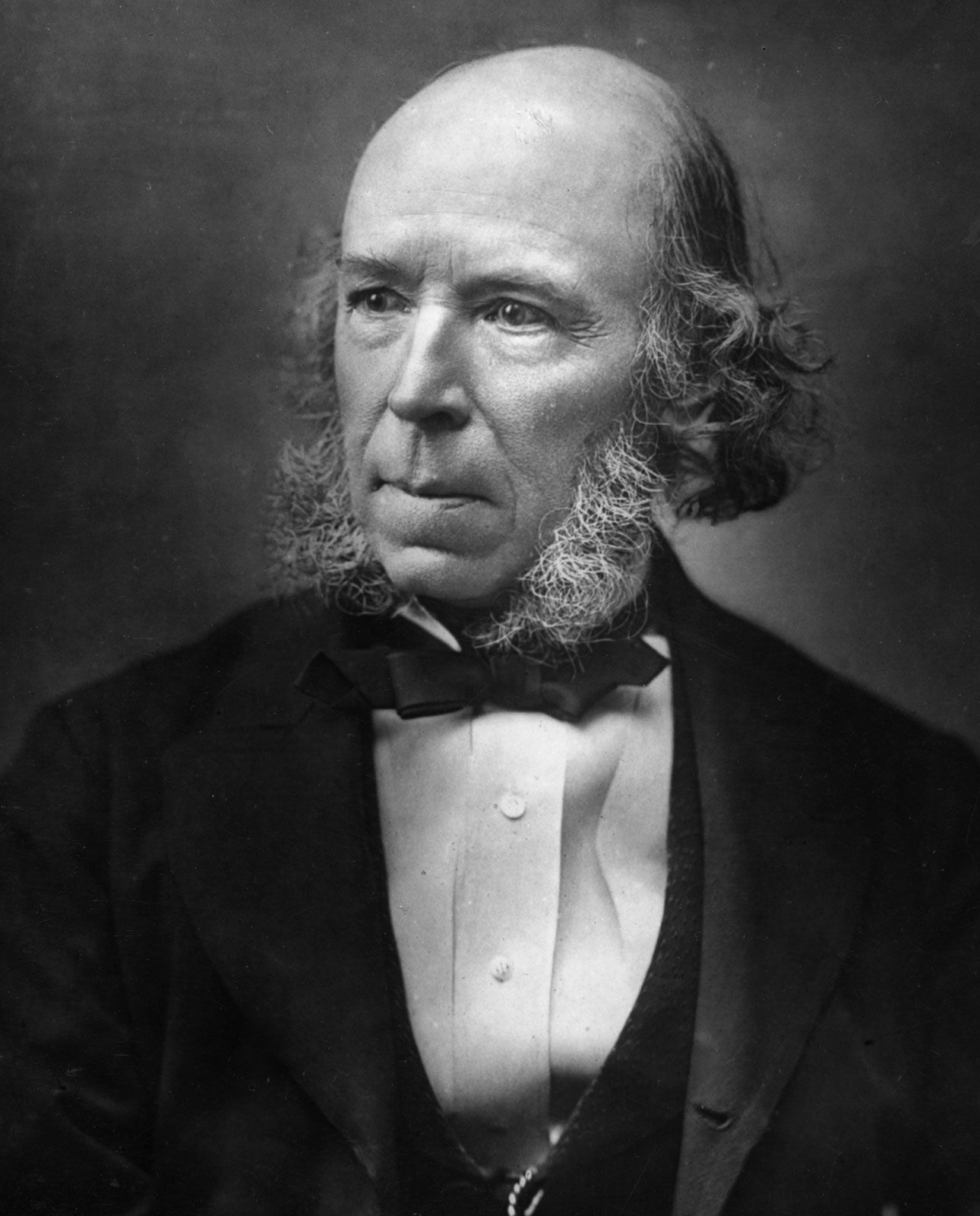
Herbert Spencer
English philosopher and psychologistWikipedia
267
MENTIONS
72
EPISODES
62
PODCASTS
Search complete. 267 mentions across 72 episodes found for "Herbert Spencer".
Nov 3, 2026

Gordon McCormickHOST
So this was a nominally scientific think tank that Thomas Huxley was assigned to oversee.
Gordon McCormickHOST
It was an appendage of the Royal Society that was itself created out of the Rosicrucian Invisible College about almost two centuries earlier in what was it 1660 yeah a little over two centuries earlier and uh featured there are some of the the leading members of this group you had joseph dalton hooker matthew arnold uh william spotswoods george busk john tyndall a physicist herbert spencer the founder that Herbert Spencer is the founder of social Darwinism, Sir John Lubbock, Thomas Archer Hearst, Franklin Edward.
Gordon McCormickHOST
You had the followers of the Lyell School as well of geology, but you had basically leading figures assigned from the Royal College who were experts at their particular field of whether hydrodynamics, astronomy uh anthropology you name it geology biology and they were all brought together with the assignment to try to take control of what was known then as of continental science and try to bring all of science as we know it under a singular control mechanism that would have common characteristics such as, but not limited to, the denial of any creative leaps, ontologically creative leaps, that would break the system of approved thinking, basically, which was known as logical, deductive, and inductive thinking, or also known as a posteriori and a priori logical analysis, the type of logic That starts with blind assumptions, blind obedience to certain axioms, certain laws, certain generalities that we assume are true.
Gordon McCormickHOST
We cannot know are true, but we assume are true.
13 MINS LATER
Gordon McCormickHOST
But accepting in the case of man itself, hardly anyone is so ignorant as to allow his worst animals to breathe.
Gordon McCormickHOST
So Darwin is, even though people say he wasn't a eugenicist, he wasn't he didn't come up with the term social Darwinism.
Gordon McCormickHOST
That was Herbert Spencer.
Gordon McCormickHOST
He's he's innocent of the of the application of his theories to human organization.

Beth ThomasNARRATOR
true reality according to him is not motion itself but the force which is its cause force and existence became for him identical terms to work and to exist were the same that force is the true reality leibniz expressed in the language of his time by saying force is a substance and all substance is force a proposition which would not be repudiated by modern science and upon this statement his philosophy is built But it was not force in general, or some universal force, that was regarded by him as the final reality.
Beth ThomasNARRATOR
Leibniz was not a forerunner of Herbert Spencer.
Beth ThomasNARRATOR
Reality for him consisted in individual centers of force, a multitude of individual and independent beings, each with its own idiosyncrasy, and following its own lines.
Beth ThomasNARRATOR
Existence was, in fact, for him, individual.
1 HR 36 MINS LATER
Beth ThomasNARRATOR
Its first principles were published in 1862.
Beth ThomasNARRATOR
But it was not until 1896 that the gigantic enterprise was complete.
Beth ThomasNARRATOR
Spencer was inspired neither by hostility to religion in general, nor to Christianity in particular.
Beth ThomasNARRATOR
The motive of his work was a more honorable one.

Kirk ZieglerNARRATOR
Much of current agnostic speculation on the existence of the first cause is little better than veiled materialism, the terminology alone being different.
Kirk ZieglerNARRATOR
Even so great a thinker as Mr. Herbert Spencer speaks of the unknowable occasionally in terms that demonstrate the lethal influence of materialistic thought, which, like the deadly sirocco, has withered and blighted all current ontological speculation.
Kirk ZieglerNARRATOR
For instance, when he terms the first cause, the unknowable, a power manifesting through phenomena and an infinite eternal energy, it is clear that he has grasped solely the physical aspect of the mystery of being, the energies of cosmic substance only.
Kirk ZieglerNARRATOR
The co-eternal aspect of the one reality, cosmic ideation, is absolutely omitted from consideration, and as to its noumenon, it seems non-existent in the mind of the great thinker.

speaker_5NARRATOR
We think of Descartes nowadays as the metaphysician who said cogito ergo sum, separated mind from matter as two contrasted substances, and gave a renovated proof of God s existence.
speaker_5NARRATOR
But his contemporaries thought of him much more as we think of Herbert Spencer in our day, as a great cosmic evolutionist, who explained by the redistribution of matter and motion, and the laws of impact, the rotation of the heavens, the circulation of the blood, the refraction of light, apparatus of vision and of nervous action, the passings of the soul, and the connection of the mind and body.
speaker_5NARRATOR
Descartes died in 1650.
speaker_6ADVERTISER
No purchase
24 MINS LATER
speaker_1ADVERTISER
visit crown coins.com sign up in seconds enter code crown and get a free lucky wheel bonus you may win up to 10 000 sweeps coins
speaker_2ADVERTISER
crown coins.com that's c-r-o-w-n coins.com no purchase needed code valid for new users only void were prohibited by law 18 plus terms and conditions apply crown
speaker_5NARRATOR
but few of them result from a misuse of terms in stating them things for example are or are not composed of one stuff they either have or have not a single origin they either are or are not completely predetermined etc such alternatives may indeed be impossible of decision but until this is conclusively proved of them they confront us legitimately and some one must take charge of them and keep account of the solutions that are proposed even if he does not himself add new ones the opinions of the learned regarding them must in short be classified and responsibly discussed for instance how many opinions are possible as to the origin of the world Spencer says that the world must have been either eternal or self-created, or created by an outside power.
speaker_5NARRATOR
So for him, there are only three.

speaker_10NARRATOR
But what are you sure is stationary? Nothing on earth, surely, for the earth compared with the fixed stars is spinning around at the rate of about a thousand miles an hour, and rushing around the sun at the rate of nearly seventy thousand miles an hour.
speaker_10NARRATOR
But are we sure the stars are fixed, since we have nothing else to compare them with? You may remember Herbert Spencer's illustration of the sea-captain who was walking west on the deck of a ship sailing east at the same rate.
speaker_10NARRATOR
Is he moving or not? If you are in the same boat, you say he is.
speaker_10NARRATOR
If you are on the shore, when the ship is passing, you say he is standing still and marking time.

Paul MussonHOST
The night watchman state, which we talked about before, is one in which government is only responsible for, or mainly responsible for, peace, justice, law and order, and protecting citizens from aggression, violence, theft, and fraud.
Paul MussonHOST
In the 19th century, Herbert Spencer said that in assuming any office beside its essential one, the state begins to lose the power of fulfilling its essential one.
Paul MussonHOST
And yeah, me talking now, we're seeing this in Europe in the form of riots, gang violence, threats to freedom of speech, and years of underinvestment in national defense.
Paul MussonHOST
And on that cheery note, that is it for Political Economy, post number 391.

Andrea FioreNARRATOR
The latter merely teaches that the nature of the universe is mental, while modern science has taught that it is material, or of late, that it is energy in the last analysis.
Andrea FioreNARRATOR
The Hermetic teachings have no fault to find with Herbert Spencer's basic principle which postulates the existence of an infinite and eternal energy from which all things proceed in fact the hermetics recognize in spenser's philosophy the highest outside statement of the workings of the natural laws that have ever been promulgated and they believe spenser to have been a reincarnation of an ancient philosopher who dwelt in ancient egypt thousands of years ago and who later incarnated as heraclitus the grecian philosopher who lived b c five hundred and they regard his statement of the infinite and eternal energy as directly in the line of the hermetic teachings always with the addition of their own doctrine that his energy is the energy of the mind of the all with the master-key of the hermetic philosophy the student of spenser will be able to unlock many doors of the inner philosophical conceptions of the great english philosopher whose work shows the results of the preparation of his previous incarnations his teachings regarding evolution and rhythm are in almost perfect agreement with the hermetic teachings regarding the principle of rhythm so the student of hermetics need not lay aside any of his cherished scientific views regarding the universe all he is asked to do is to grasp the underlying principle of the all is mind and the universe is mental held in the mind of the all he will find that the other six of the seven principles will fit into his scientific knowledge and will serve to bring out obscure points and to throw light in dark corners this is not to be wondered at when we realize the influence of the hermetic thought of the early philosophers of greece upon whose foundations of thought the theories of modern science largely rest the acceptance of the first hermetic principle mentalism is the only great point of difference between modern science and hermetic students
speaker_1ADVERTISER
winning never sounded so good what would you do if you won big at crown coins casino real people win real prizes every single day
MichaelSOUNDBITE_SPEAKER
hi this is michael from dallas and i won 40k and finally renovated my home

Michelle FryeNARRATOR
He knew nothing of the habits of this beggar, knew not the use that would be made of this money, although he had every reason to suspect that it would be spent improperly.
Michelle FryeNARRATOR
This man professed to be a disciple of Herbert Spencer, yet the quarter dollar given that night will probably work more injury then all the money will do good which its thoughtless donor will ever be able to give in true charity he only gratified his own feelings saved himself from annoyance and this was probably one of the most selfish and very worst actions of his life for in all respects he is most worthy in bestowing charity the main consideration should be to help those who will help themselves to provide part of the means by which those who desire to improve may do so to give those who desire to rise the aids by which they may rise to assist but rarely or never to do all neither the individual nor the race is improved by almsgiving those worthy of assistance except in rare cases seldom require assistance the really valuable men of the race never do except in case of accident or sudden change every one has of course cases of individuals brought to his own knowledge where temporary assistance can do genuine good and these he will not overlook but the amount which can be wisely given by the individual for individuals is necessarily limited by his lack of knowledge of the circumstances connected with each he is the only true reformer who is as careful and as anxious not to aid the unworthy as he is to aid the worthy and perhaps even more so for in almsgiving more injury is probably done by rewarding vice than by relieving virtue the rich man is thus almost restricted to following the examples of peter cooper enoch pratt of baltimore mr pratt of brooklyn senator stanford and others who know that the best means of benefiting the community is to place within its reach the ladders upon which the aspiring can rise free libraries parks and means of recreation by which men are helped in body and mind works of art certain to give pleasure and improve the public taste and public institutions of various kinds which will improve the general condition of the people in this manner returning their surplus wealth to the mass of their fellows in the forms best calculated to do them lasting good thus is the problem of rich and poor to be solved the laws of accumulation will be left free the laws of distribution free individualism will continue but the millionaire will be but a trustee for the poor entrusted for a season with a great part of the increased wealth of the community but administering it for the community far better than it could or would have done for itself the best minds will thus have reached a stage in the development of the race in which it is clearly seen that there is no mode of disposing of surplus wealth creditable to thoughtful and earnest men into whose hands it flows save by using it year by year for the general good this day already dawns men may die without incurring the pity of their fellows still sharers in great business enterprises from which their capital cannot be or has not been withdrawn and which is left chiefly at death for public uses yet the day is not far distant when the man who dies leaving behind him millions of available wealth which was free for him to administer during life will pass away unwept unhonoured and unsung no matter to what uses he leaves the dross which he cannot take with him of such as these the public verdict will then be the man who dies thus rich dies disgraced Such, in my opinion, is the true gospel concerning wealth, obedience to which is destined some day to solve the problem of the rich and the poor and to bring peace on earth among men goodwill.
Michelle FryeNARRATOR
End of Part 1 The Problem with the Administration of Wealth The Gospel of Wealth by Andrew Carnegie.
Michelle FryeNARRATOR
This LibriVox recording is in the public domain.

John TrevithickNARRATOR
Of quite serious forecasts and inductions of things to come, the number is very small indeed.
John TrevithickNARRATOR
A suggestion or so of Mr. Herbert Spencer's, Mr. Kidd's Social Evolution, some hints from Mr. Archdall Reid, some political forecasts, German for the most part, Hartmann's Earth in the Twentieth Century, for example, some incidental forecasts by Professor Langley, Century Magazine, December 1884, for example, and such isolated computations as Professor Crooks's Wheat Warning and the various estimates of our coal supply make almost a complete bibliography.
John TrevithickNARRATOR
Of fiction, of course, there is abundance.
John TrevithickNARRATOR
Stories of the Year 2000 and Battles of Dorking and the like.
speaker_4NARRATOR
Of course I'm talking here of very positively marked men, men of radical idiosyncrasy who have set their stamp and likeness on philosophy and figure in its history.
speaker_4NARRATOR
Plato, Locke, Hegel, Spencer are such temperamental thinkers.
speaker_4NARRATOR
Most of us have, of course, no very definite intellectual temperament.
speaker_4NARRATOR
We are a mixture of opposite ingredients, each one present very moderately.
11 MINS LATER
speaker_4NARRATOR
If you look to the quarter where facts are most considered, you find the whole tough-minded program in operation and the conflict between science and religion in full blast.
speaker_4NARRATOR
Either it is the Rocky Mountain tough of a heckle with his materialistic monism, his ether god, and his jest at our god as a gaseous vertebrate.
speaker_4NARRATOR
Or it is Spencer treating the world's history as a redistribution of matter and motion solely and bowing religion politely out at the front door.
speaker_4NARRATOR
She may indeed continue to exist, but she must never show her face inside the temple.
62 more episodes mention Herbert Spencer.
Create an account to see the whole feed, search across every transcript, and follow the entities you care about.