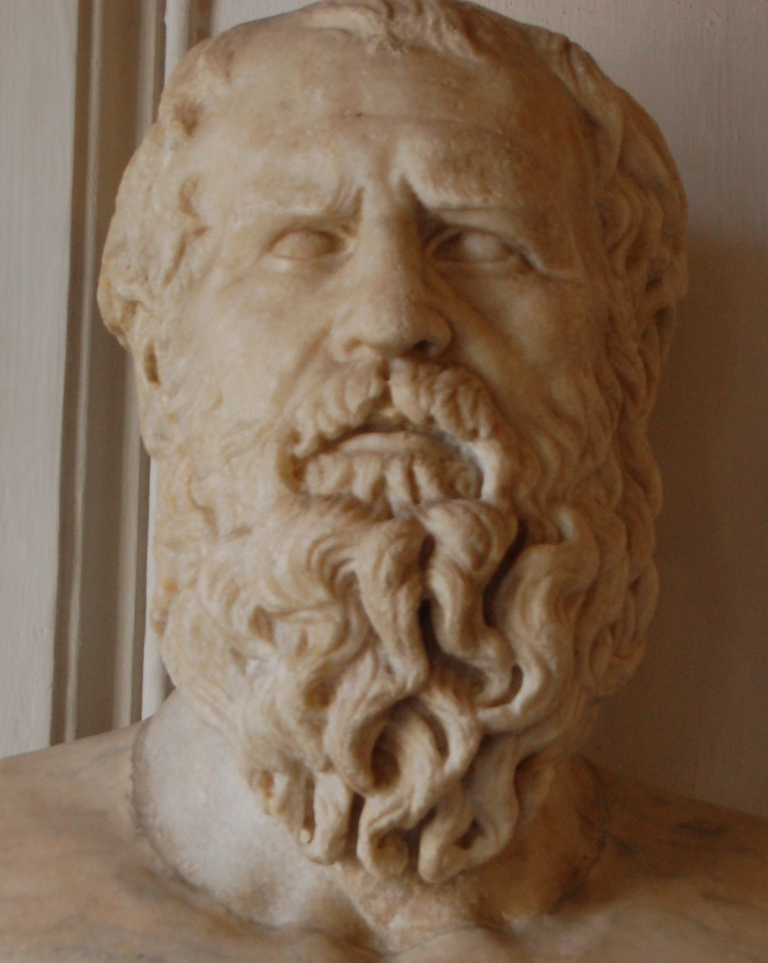
Heraclitus
Greek philosopherWikipedia
728
MENTIONS
190
EPISODES
137
PODCASTS
Search complete. 728 mentions across 190 episodes found for "Heraclitus".
Nov 1, 2026

John DicksonHOST
Like earlier thinkers, Plato puzzled over the constantly changing physical world Things come into existence, they change, they pass away, and philosophers in the ancient world were really puzzled by this in a way that feels a bit foreign to us.
John DicksonHOST
Heraclitus, for example, before Plato, reckoned everything was in flux, so you never step into the same river twice because it's a different river five seconds later, if you get the idea.
John DicksonHOST
Parmenides responded, no, that's dumb.
John DicksonHOST
He went in the opposite direction.

speaker_6NARRATOR
everything which happens is as familiar and well known as the rose in spring and the fruit in summer for such is disease and death and calumny and treachery and whatever else delights fools or vexes them in the series of things those which follow are always aptly fitted to those which have gone before for this series is not like a mere enumeration of disjointed things which only has a necessary sequence but it is a rational connection And as all existing things are arranged together harmoniously, so the things which come into existence exhibit no mere succession, but a certain wonderful relationship.
speaker_6NARRATOR
Always remember the saying of Heraclitus, that the death of earth is to become water, and the death of water is to become air, and the death of air is to become fire, and reversely.
speaker_6NARRATOR
and think too of him who forgets whither the way leads, and that men quarrel with that with which they are most constantly in communion, the reason which governs the universe.
speaker_6NARRATOR
And the things which they daily meet with seem to them strange, and consider that we ought not to act and speak as if we were asleep, for even in sleep we seem to act and speak, and that we ought not, like children who learn from their parents, simply to act and speak as we have been taught.
1 HR 1 MIN LATER
speaker_9NARRATOR
For all things above, below, are the same and from the same, How long then? Think continually that all kinds of men, and all kinds of pursuits, and of all nations are dead, so that thy thoughts come down even to Philistine, and Phoebus, and Oregonian.
speaker_9NARRATOR
Now turn thy thoughts to the other kinds of men.
speaker_9NARRATOR
To that place, then, we must remove, where there are so many great orators, so many noble philosophers, Heraclitus, Pythagoras, Socrates, so many heroes of former days, and so many generals after them, and tyrants.
speaker_9NARRATOR
Besides these, Eudoxus, Hipparchus, Archimedes, and other men of acute natural talents, great minds, lovers of labor, versatile, confident, mockers even of the perishable and ephemeral life of man, as Menippus and such as are like him.

Bill BoerstNARRATOR
The porch has been credited with a great deal that really belonged to the Academy or the Lyceum.
Bill BoerstNARRATOR
If you strip Stoicism of its paradoxes and its willful misuse of language, what is left is simply the moral philosophy of Socrates, Plato, and Aristotle, dashed with the physics of Heraclitus.
Bill BoerstNARRATOR
Stoicism was not so much a new doctrine as the form under which the old Greek philosophy finally presented itself to the world at large.
Bill BoerstNARRATOR
It owed its popularity in some measure to its extravagance.
Bill BoerstNARRATOR
He did not begin teaching till 315, at the mature age of forty.
Bill BoerstNARRATOR
Aristotle had passed away in 322, and with him closed the great constructive era of Greek thought.
Bill BoerstNARRATOR
The Ionian philosophers had speculated on the physical constitution of the universe, the Pythagoreans on the mystical properties of numbers, Heraclitus had propounded his philosophy of fire, Democritus and Leucippus had struck out a rude form of the atomic theory, Socrates had raised questions relating to man, Plato had discussed them with all the freedom of the dialogue, while Aristotle had systematically worked them out.
Bill BoerstNARRATOR
the later schools did not add much to the body of philosophy.

Leon MeyerNARRATOR
81.
Leon MeyerNARRATOR
And now, when you see brothers apparently good friends and living in accord, do not immediately pronounce anything upon their friendship, though they should affirm it with an oath, though they should declare, For us to live apart in a thing, impossible.
Leon MeyerNARRATOR
For the heart of a bad man is faithless, unprincipled, inconstant, now overpowered by one impression, now by another.
Leon MeyerNARRATOR
Ask not the usual questions, were they born of the same parents, reared together, and under the same tutor? But ask this only, in what they place their real interest, whether in outward things or in the will.
Leon MeyerNARRATOR
But should you hear that these men hold the good to lie only in the will, only in rightly dealing with the things of sense, take no more trouble to inquire whether they are father and son or brothers, or comrades of long standing.
Leon MeyerNARRATOR
But, sure of this one thing, pronounce as boldly that they are friends, as that they are faithful and just.
Leon MeyerNARRATOR
For where else can friendship be found, than where modesty is? where there is an interchange of things fair and honest, and of such only.
Leon MeyerNARRATOR
82.

Beth ThomasNARRATOR
of Shelley and Arnold and Carlisle.
Beth ThomasNARRATOR
This note we hear thus early and thus clear in the dim and distant utterances of Heraclitus.
Beth ThomasNARRATOR
The mystery of existence, the unreality of what seems most real, the intangibility and evanescence of all things earthly, these thoughts obscurely echoing to us across the ages from Heraclitus, have remained, and always will remain, among the deepest and most insistent of the world's thoughts, in its sincerest moments and in its greatest thinkers.
Beth ThomasNARRATOR
chapter three pythagoras and the pythagoreans the birthplace of pythagoras is uncertain he is generally called the samian and we know at all events that he lived for some time in that island during or immediately before the famous tyranny of polycrates all manner of legends are told of the travels of pythagoras to egypt chaldea phoenicia and even to india Others tell of a mysterious initiation at the sacred cave of Jupiter in Crete, and of a similar ceremony at the Delphic Oracle.
Beth ThomasNARRATOR
What is certain is that at some date towards the end of the 6th century BC, he removed to southern Italy, which was then extensively colonized by Greeks, and that there he became a great philosophic teacher, and ultimately even a predominating political influence.

GemmaNARRATOR
Alexander, Pompey, and Gaius Caesar, who so often razed whole cities and cut off in battle so many myriads of horses and foot, at last departed from this life themselves.
GemmaNARRATOR
Heraclitus, after his many speculations on the conflagration of the world, died swollen with water and plastered with cow dung.
GemmaNARRATOR
Vermin destroyed Democritus.
GemmaNARRATOR
Socrates was killed by vermin of another sort.
43 MINS LATER
speaker_7NARRATOR
This relation is not that which exists in a mere enumeration of independent things, and depends merely on some arbitrary convention.
speaker_7NARRATOR
It is a rational relationship.
speaker_7NARRATOR
And just as things now existing are ranged harmoniously together, so those which come into existence display no bare succession, but a wonderful harmony with what preceded Remember always the sayings of Heraclitus, that the death of earth is to become water, the death of water to become air, and the death of air to become fire, and so conversely.
speaker_7NARRATOR
Remember in what a case he is who forgets whither the way leads, that men are frequently at variance with their close and constant companion.

Norman GayfordHOST
So we go back to the pre-Socratics, and I think we go back...
Norman GayfordHOST
And we're talking about things that you and I have talked about for years, and we've referred to names, and some people who've listened to us will recognize these names, like Heraclitus.
Norman GayfordHOST
One of the people that we're... beginning to formally in some ways look at, uh, question what was around them in non-mythological or religious ways.
Norman GayfordHOST
And so Heraclitus is talking about the, the constant state of change.
Norman GayfordHOST
You can't put your foot in the same river.
Norman GayfordHOST
Okay.
Norman GayfordHOST
We're coming closer to that definition mentioned before.
Norman GayfordHOST
Then we have Aristotle, who's writing essentially for his son, but beyond that, the Nicomachean ethics.

Danny MassaroHOST
yeah
John StaskowskiHOST
the wolf called the wolf or the wolf of something or whatever even he who's literally the goat so he can't go like no one's done what i've done i'm the best ever just fact isn't it even he's like you could just tell he's kind of like a deep dissatisfaction with just his life and what he's what he can't long do anymore and it's just like see for that level it just tells you all there is like business whatever it is very very rarely have i ever come across anyone who's just like yeah i love my life just buzzing like just like i love everything i'm doing i'm happy i'm flourishing and these are like successful people so there's i think that's the thing of like whose definition of success for one and like if it's just always like an external measure against something else like you said whether it's like oh now i've got a golf handicap i mean i did that for years suddenly it's like you your name on the scoreboard yeah in the competition and like where you rank it's just like everything becomes an external point of reference rather than just that like think said of just the internal world of the game that's cut off from everything right and it is its own internal purpose like you mentioned time earlier as well he sort of says the whole thing of like being future focused well yeah play brings you into the present but he sees it as like i think he even phrases it as it gives you like a glimpse of eternity it's almost like time doesn't disappear because there's always like any game there's a beginning a middle and an end isn't there like to it so it's not like you just get rid of time you're fundamentally in time but at the same time there's like an eternity to it where it's just like it is like its own world which in the later book that he comes out in 1960 he starts talking about the world as being at play so it's like a cosmic level even the universe is just playful it's playing and it's moving forward and it's like all these interactions and like none of it's predictable really it's all just like in flux very kind of he talks about Heraclitus doesn't he that so when you're playing whether it's lobbing apples around or a game of squash or whatever with Leo you kind of get in a glimpse of eternity of this eternal universe that's been playing and for billions of years and it'll probably go on playing for billions of years you kind of tap it into that main line of just doing it for its own sake instead of like I talk about like it's like a prescription society now isn't it where everything's a prescription right Danny you're a bit pissed off not feeling yourself a bit down play throw the apple for 30 minutes every day there's your prescription to re-find happiness or go for a walk in nature ever you know like is it forest breathing or something they call it not like a name hasn't it you can't just go for a walk it's now a prescription for bathing in nature for like 40 minutes times yeah so that's that's kind of the gist of it in a way isn't it just like yeah you've got to somehow build this into your life without building it into your life without it becoming another goal another prescription
Danny MassaroHOST
Since reading this last week, a couple of weeks ago, I've noticed bits of things, just obviously your perceptions are on it and you're hearing it now.
Danny MassaroHOST
I heard a few things.
33 MINS LATER
John StaskowskiHOST
It is kind of saying, be more childlike.
John StaskowskiHOST
But what Fink is also saying is, but that's the kind of how the world is, how the cosmos, universe, whatever you want to call it, it is playful.
John StaskowskiHOST
Heraclitus was famously, he saw it as war and strifes.
John StaskowskiHOST
It's always like competing... life is like this fire and this flame and it's always moving and dancing and sometimes it goes out and other it's like if you see life like that i think it becomes natural to just play more and engage with it on that basis so that's definitely one for me in terms of maybe some questions something i had noted down was does life need an ultimate purpose to be meaningful That's something people can consider in terms of like, do you always need an outcome or a product or some kind of output from every activity that you do? I personally don't think it does.

EstherGUEST
Yes, it's interesting that he finds the metaphor.
EstherGUEST
So that in a sense, he finds, you know, if we think about other philosophers, like, let's say, Heraclitus and fire or something, or the river or whatever, you know, that you find examples from which to pick up a metaphor that become, you know, that you bring it up as philosophy.
EstherGUEST
Then obviously there's a sort of element where there's a sort of like, extraction and because that's done by a male uh is interesting and also what is interesting is that the whole thing about how again men are pregnant and that this for example i found it really interesting um is that men are already pregnant by just being turned on So they are already wanted.
EstherGUEST
Well, there's almost I mean, there's almost I think

Randolph PittsHOST
Both meanings call forth the distinction between doxa and episteme.
Randolph PittsHOST
with which Parmenides, Heraclitus, and Plato opened the history of Western philosophy.
Randolph PittsHOST
These three thinkers, as different as they were, were, however, in agreement on one basic point.
Randolph PittsHOST
Philosophical wisdom is not to be found in the opinions of the multitude.
180 more episodes mention Heraclitus.
Create an account to see the whole feed, search across every transcript, and follow the entities you care about.