Henry's law
13
MENTIONS
7
EPISODES
6
PODCASTS
Search complete. 13 mentions across 7 episodes found for "Henry's law".
Sep 23, 2026

Eric KnightHOST
Physics will always find equilibrium.
Eric KnightHOST
Henry's Law with the gases in the water and the air, and then LSI in this case.
Eric KnightHOST
It always seems to find equilibrium.
Eric KnightHOST
So take that lesson as you will.

RobbieGUEST
Um, but when it comes to volatiles, it's really the partial pressure that we care about in terms of onset of effect, not the total amount in blood.
RobbieGUEST
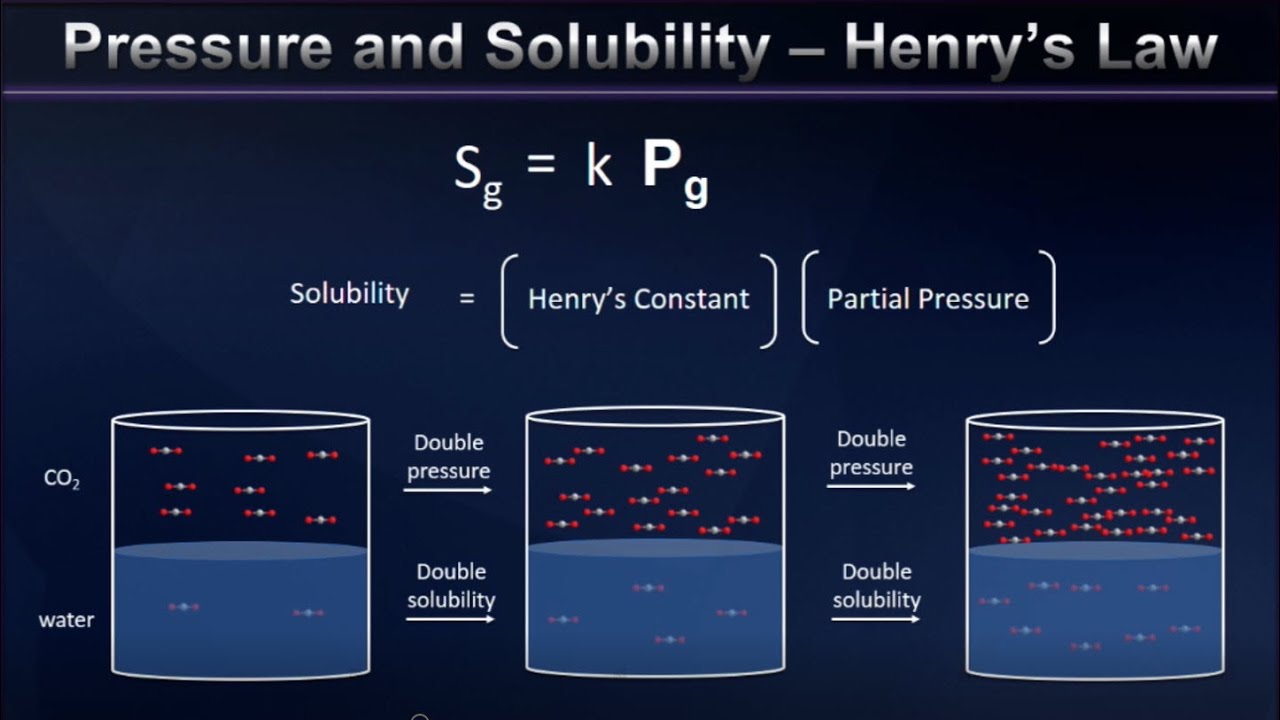
And the thing that I found helpful here was looking at Henry's Law, um, which basically states that the concentration, um, is equal to the Henry's law constant, um, which is pretty much the partition coefficient times the partial pressure.
RobbieGUEST
Um, and basically that means that, uh, for an agent, a lower blood gas coefficient means that less, less dissolved in blood means less a lower blood gas partition coefficient, if that makes sense.
RobbieGUEST
So that means you achieve that partial pressure faster, effectively.

Hank GreenHOST
Our script supervisor is Katherine Greend, and- Greend? I know your name! You're my wife! It's your name, too! It's my name, too! And unfortunately for all of us, that brings us to the end of this day's episode of Crash Course Chemistry.
Hank GreenHOST
Also, you learned about Henry's Law, which states that the concentration of a dissolved gas equals the partial pressure of that gas above the solution of muh- guh- you've learned how to calculate the equilibrium conditions of reactions just from just from just from knowing their monkey and you may even have learned a little bit about the quadratic equation i
speaker_6UNKNOWN
see
speaker_7SOUNDBITE_SPEAKER
you
Hank GreenHOST
Now, it's easy to calculate this change in pressure thanks to William Henry, a friend of John Dalton of Dalton's Law of Partial Pressure.
Hank GreenHOST
According to Henry's Law, the concentration of a dissolved gas equals the partial pressure of the gas above the solution multiplied by a constant that expresses the solubility of the gas in that solution.
Hank GreenHOST
And we can use Henry's Law to figure out how much carbon dioxide is dissolved in our can of soda.
Hank GreenHOST
The pressure of CO2 in a can is 5.0 atmospheres, and you can look up the solubility of CO2 in an aqueous solution.
Hank GreenHOST
3.4 times 10 to the negative 2
Hank GreenHOST
And unfortunately for all of us, that brings us to the end of this episode of Crash Course Chemistry.
Hank GreenHOST
If you've been paying attention today, you learned that solutions can be described in terms of molarity, molality, or mass percent, that polar solvents tend to dissolve polar solutes, and non-polar solvents tend to dissolve non-polar solutes.
Hank GreenHOST
You also learned about Henry's Law, which states that the concentration of dissolved gas equals the partial pressure of that gas above the solution multiplied by a constant, and that there are a lot of burps in every single can of Coke.

Jon CooperHOST
That part's still on you, not the math.
Jon CooperHOST
And in a case where you overshoot to 7.2 when you're aiming for 7.4, so what? No harm done, and Henry's Law is going to fix your mistake in about two hours anyway.
Jon CooperHOST
Before we get to the next question, a quick word on where the rest of this stuff lives.
Jon CooperHOST
Every month I put together something called The Standard.

Ian GawthropeGUEST
And they are, that's dissolved gas.
Ian GawthropeGUEST
And that's, I'm not going to bore everyone with physics today, but that is Henry's law.
Ian GawthropeGUEST
Your can of Coke, or for Wishy, your can of beer.
Megan CurrieHOST
Yep.
Ian GawthropeGUEST
So that's been pressurized with carbon dioxide as a gas.
Ian GawthropeGUEST
But the gas that we mainly breathe is nitrogen.
Ian GawthropeGUEST
So if you go down deeper, Henry's law says that the more gas that is dissolved inside you.
Ian GawthropeGUEST
So for decompression sickness, that gas is dissolved inside you.

Brad PitzeleGUEST
What we don't know is are those red blood cells reaching the tissues that need the oxygen? And because of the swelling inside your circulatory system, often they're not.
Brad PitzeleGUEST
And one of the cool things about when you exercise with oxygen is you're you use the scientific principle called Henry's Law, which basically forces oxygen not to only saturate your red blood cells, but to also saturate your blood plasma, which is like this clearish brown liquid that the red blood cells normally ride on.
Brad PitzeleGUEST
Now, why that's important is two reasons.
Brad PitzeleGUEST
One, it means every unit of blood can have more oxygen and increases the oxygen carrying capacity of the blood.