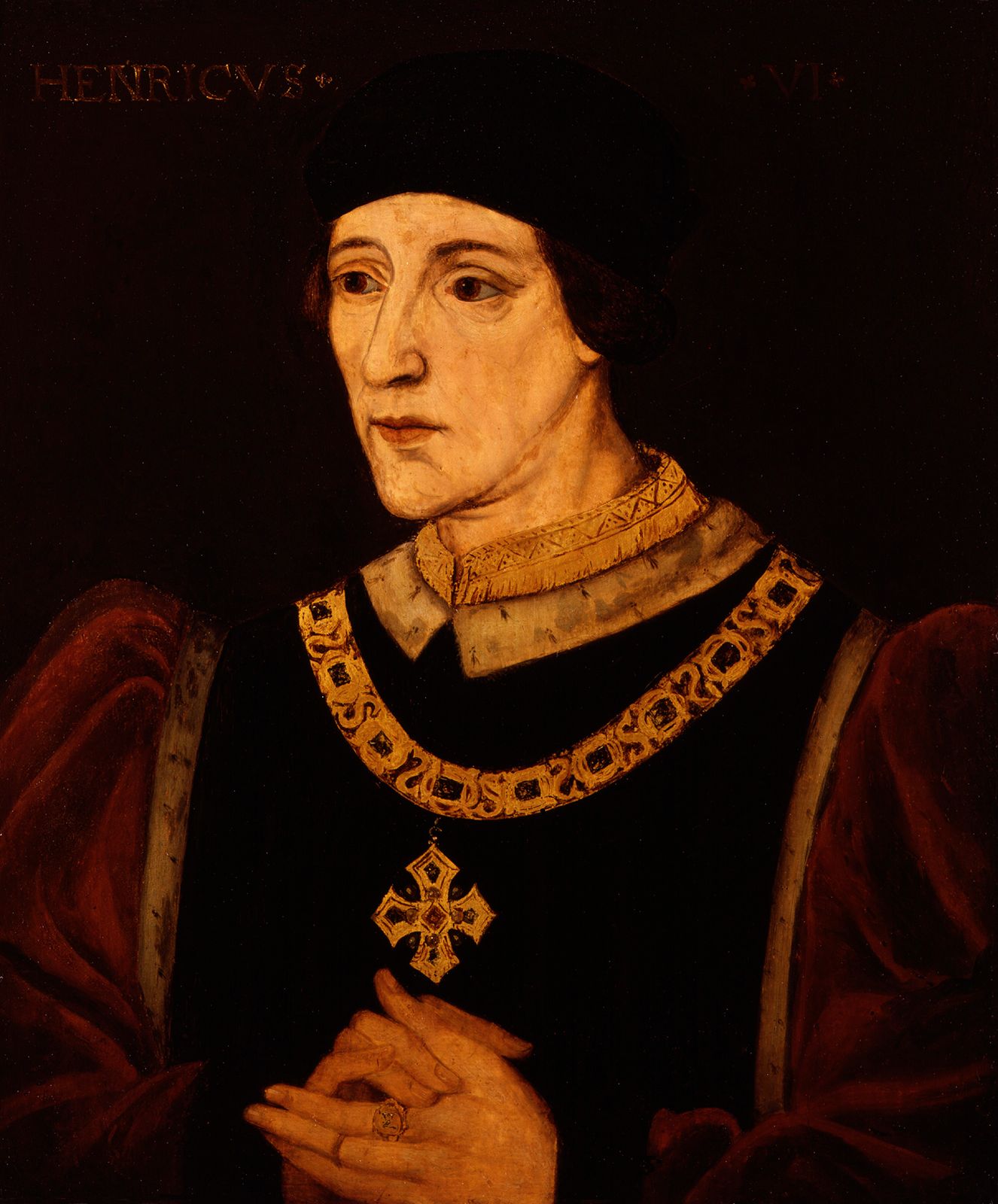
Henry VI
Former King of EnglandWikipedia
737
MENTIONS
125
EPISODES
116
PODCASTS
Search complete. 737 mentions across 125 episodes found for "Henry VI".
Sep 12, 2026

Pamela NagamiNARRATOR
Read by Pamela Nagami.
Pamela NagamiNARRATOR
Chapter seven: Henry VI, Part One: The King's Minority and the French War.
Pamela NagamiNARRATOR
The death of Henry V was an event which the English could not help feeling as a calamity of no ordinary kind.
Pamela NagamiNARRATOR
No other of their kings had ever been so lamented.
5 MINS LATER
Pamela NagamiNARRATOR
As for France, King Charles, according to Henry's dying request, first offered the regency to the Duke of Burgundy, and on his refusal gave it to Bedford.
Pamela NagamiNARRATOR
He was at first to govern in the name of Charles, but within two months after the death of Henry, the unhappy King of France also died.
Pamela NagamiNARRATOR
On October 21, 1422, the infant who had already succeeded to the throne of England by the name of Henry VI was now by the Treaty of Troyes King of France as well, and had in his uncle Bedford the ablest administrator that could have been found to advance his interests there.
Pamela NagamiNARRATOR
The Dauphin, however, on his father's death, of course claimed to succeed him.

Lee SmalleyNARRATOR
These were not arbitrary changes.
Lee SmalleyNARRATOR
The whim of this monarch or that, Henry VIII and Edward VI, did only what others in their place would and must have done.
Lee SmalleyNARRATOR
They were certainly sovereigns with convictions of their own, but their attitude of mind was but the zeitgeist, the spirit of the age, and they did not so much originate it as be swayed by it.
Lee SmalleyNARRATOR
Those statesmen who have been held meanly subservient to them were, after all, men of like convictions.
4 HRS 58 MINS LATER
Lee SmalleyNARRATOR
It owes its present stately proportions and perpendicular style largely to the benefactions of Greville and others.
Lee SmalleyNARRATOR
The tower is remarkable for a buttress, which is in some ways a kind of highly developed mullion running through the centre of the window of the lower stage.
Lee SmalleyNARRATOR
It is perhaps rather more curious than beautiful, and as it cannot be of any constructional value and adds little if anything to the stability of the tower, we can only regard it as one of those freaks of the last phase of Gothic architecture which tell us, if we have but the wit to understand, that Reformation or no Reformation, with Henry VIII or without, the Gothic spirit was dying.
Lee SmalleyNARRATOR
The curious ogee-shaped roof of a building seen in the foreground of the accompanying view of the church is that of a garden pavilion or gazebo of Campton House, the lordly mansion built in 1613 by Sir Baptist Hicks, first Viscount Campton.

Pamela NagamiNARRATOR
In 1470 a rapid revolution followed in England.
Pamela NagamiNARRATOR
Henry VI found himself once more upon the throne, while Edward took refuge in Burgundy to the great annoyance of Charles the Bold.
Pamela NagamiNARRATOR
In spite of the fact that the fugitive was his brother-in-law, Charles was fond of dwelling upon his own Lancastrian descent through his Portuguese mother, being alive to the possibility of succeeding in this way to the English throne.
Pamela NagamiNARRATOR
His solution of the difficulty was characteristic of the time.
Pamela NagamiNARRATOR
While publicly recognizing Henry VI as king and threatening death to any of his subjects who should join Edward, he secretly gave him help to return to England.
Pamela NagamiNARRATOR
The utter overthrow of the Lancastrian cause at Barnet and Tewkesbury was a blow to the hopes of Louis XI, for whom fresh trouble with Burgundy, Brittany, and Guyenne had already arisen through the agency of St. Paul.
Pamela NagamiNARRATOR
This noble was at once a vassal of Burgundy and constable or commander-in-chief of the French army.
19 MINS LATER
Pamela NagamiNARRATOR
Anne de Beaujeu had now retired from the regency, but expressed her strong disapproval of a policy she was no longer able to prevent.

Leonard WilsonNARRATOR
The making of this bridge was a great hindrance to the town of Wallingford, whither the trade was of them that came out of Gloucestershire, but now they pass by Abingdon.
Leonard WilsonNARRATOR
This John de St. Helens lived about the beginning of the reign of Henry VI.
Leonard WilsonNARRATOR
This John builded the fair hospital by St. Helens in Abingdon, and gave fifty lee lands by year to the maintainers of it and the bridge.
Leonard WilsonNARRATOR
The bridge of Archstone at Dorchester is but a new thing to speak of, and there was a ferry at high waters over Thames, and the bridge of Abingdon seemeth to have been the—missing words.
Leonard WilsonNARRATOR
Talbot, Earl of Shrobsbury, and his son Lord Lyle slain in France.
Leonard WilsonNARRATOR
This Earl's bones were brought out of Normandy to Whitchurch in Shropshire.
Leonard WilsonNARRATOR
Talbot, next Earl to him, slain at Northampton Field, taking King Henry VI's part.
Leonard WilsonNARRATOR
This earl had five sons.

speaker_22NARRATOR
In the treaty, the French king also agreed to give Henry his daughter, the Princess Catherine, in marriage.
speaker_22NARRATOR
She became the mother of the English king, Henry VI.
speaker_22NARRATOR
the arrangement that an english sovereign should be king of france was never put into effect for in less than two years after the treaty was signed the reign of the great conqueror came to an end henry died In the reign of his son, all his work in gaining French territory was undone.
speaker_22NARRATOR
By the time that Henry VI was twenty years old, England, as you will read in the story of Joan of Arc, had nothing left of all that had been won by so many years of war, except the single town of Calais.
David KleperikNARRATOR
CHAPTER XXXI.
David KleperikNARRATOR
JOAN OF ARK.

Elizabeth KlettNARRATOR
I like the melodious sing-song, the clear, simple one-line and two-line sayings, and the occasional rhymed tags, like the half-closes in an eighteenth-century symphony, in Peel, Kidd, Green, and The Histories of Shakespeare.
Elizabeth KlettNARRATOR
How anyone with music in him can turn from Henry VI— john and the two richards to such a mess of verse half developed into rhetorical prose as cymbeline is to me explicable only by the uncivil hypothesis that the artistic qualities in the elizabethan drama do not exist for most of its critics so that they hang on to its purely prosaic content and hypnotize themselves into absurd exaggerations of the value of that content even poets fall under the spell ben jonson described marlowe's line as mighty as well put michael angelo's epitaph on the tombstone of paolo uccello no wonder johnson's blank verse is the most horribly disagreeable product in literature and indicates his most prosaic mood as surely as his shorter rhymed measures indicate his poetic mood marlowe never wrote a mighty line in his life cowper's single phrase toll for the brave drowns all his mightinesses as great tom drowns a military band but marlowe took that very pleasant-sounding rigmarole of peel and green and added to its sunny daylight the insane splendours of night and the cheap tragedy of crime because he had only a common sort of brain he was hopelessly beaten by shakespeare but he had a fine ear and a soaring spirit in short one does not forget wanton arethusa's azure arms and the like but the pleasant-sounding rigmarole was the basis of the whole thing and as long as that rigmarole was practised frankly for the sake of its pleasantness it was readable and speakable it lasted until shakespeare did to it what raphael did to italian painting that is overcharged and burst it by making it the vehicle of a new order of thought involving a mass of intellectual ferment and psychological research The rigmarole could not stand the strain, and Shakespeare's style ended in a chaos of half-shattered old forms, half-emancipated new ones, with occasional bursts of prose eloquence on the one hand, occasional delicious echoes of the rigmarole, mostly from Calabans and mask personages, on the other, with, alas, a great deal of filling up with formulary blank verse which had no purpose except to save the author's time and thought.
speaker_1NARRATOR
When a great man
Elizabeth KlettNARRATOR
destroys an art form in this way, its ruins make palaces for the clever would-be great.

speaker_4NARRATOR
Without a father even from his birth, driven abroad in his childhood owing to the attainder of his family, more than once nearly delivered up to his enemies, and owing life and liberty to his own and his friend's astuteness, His ultimate conquest of the crown was scarcely so much a triumph of ambition as the achievement of personal safety.
speaker_4NARRATOR
He could not help his birth, and in spite of the imperfections in his title, he could not help being regarded as head of the House of Lancaster after Henry VI, and his son had been cut off.
speaker_4NARRATOR
He could not help, in short, being an object of suspicion and jealousy to Edward IV and Richard III successively, even if he had made no effort to dispossess them of the throne.
speaker_4NARRATOR
and in truth, against Edward, he seems to have done nothing for his own part, though the Earl of Oxford's expedition to St. Michael's Mount must have been with a view to advance his claims.
speaker_4NARRATOR
It was through his mother that he derived his claim for the crown.
speaker_4NARRATOR
For though his father traced his descent from Cadwalader, and the Welsh were pleased with his pedigree, it was only spoken of when he came to the throne as conferring some additional luster on his title.
speaker_4NARRATOR
Nor could the fact that his paternal grandfather, Sir Owen Tudor, a simple knight of Wales, was bold enough to marry the widow of Henry V, daughter to Charles VI of France, in any way advance his pretensions, though it made his father a half-brother to Henry VI.
speaker_4NARRATOR
and allied him with the Royal House of France.

Algie PugVOICE_ACTOR
George Bevers, read by Algie Pugg.
Arielle LipshireVOICE_ACTOR
Henry VI, read by Arielle Lipshire.
Arielle LipshireVOICE_ACTOR
Harold, read by Sandra.
Arielle LipshireVOICE_ACTOR
Jack
42 MINS LATER
David GoldfarbVOICE_ACTOR
Away.
Roseanne SchmidtNARRATOR
Exalt.
Roseanne SchmidtNARRATOR
End of Act 1 Act 2 of Henry VI, Part 2 by William Shakespeare This is a LibriVox recording.
Roseanne SchmidtNARRATOR
All LibriVox recordings are in the public domain.

BookBardNARRATOR
Richard III, though not printed till 1597, was probably written not later than 1593.
BookBardNARRATOR
We know with certainty that Marlowe collaborated with Shakespeare in preparing for the stage the three parts of the chronicle history of Henry VI, and there are many items of internal evidence to indicate that Marlowe collaborated also in the concoction of Richard III.
BookBardNARRATOR
This would date the drama before the tragic death of Marlowe, who was born in 1564 and was murdered at the early age of 29.
BookBardNARRATOR
William Shakespeare was two months younger than his colleague.
BookBardNARRATOR
The chronicle histories of the Elizabethan playwrights were produced continuously, one after another, like those puppet plays of the Neapolitans that relate the legends of Carlo Mangio and take up the story every night where they left it off the night before.
BookBardNARRATOR
The points at which an Elizabethan drama of this type began and ended were, therefore, arbitrary and almost accidental.
BookBardNARRATOR
The figure of the bunch-backed Duke of Gloucester appeared, as a matter of course, in the later scenes of the chronicle history of Henry VI before a subsequent play was devoted to the record of his own reign.
BookBardNARRATOR
Colley Cibber, therefore, exercised a thoroughly legitimate prerogative when he decided to begin his depiction of the character of Richard III by presenting a couple of scenes culled from the antecedent chronicle history of Henry VI.

KimHOST
The prince follows in the footsteps of his father, Uncle Prince Harry, and roughly 20 British prime ministers in attending the elite private all-boys boarding school where fees run about 65,000 pounds, or roughly $80,000 a year.
KimHOST
According to the BBC, Eton was founded way back in 1440 by King Henry VI.
KimHOST
[instrumental music] A deflating report about party balloons.
KimHOST
According to MarketWatch, helium is now among the list of goods and products in short supply due to the Iran war.
115 more episodes mention Henry VI.
Create an account to see the whole feed, search across every transcript, and follow the entities you care about.