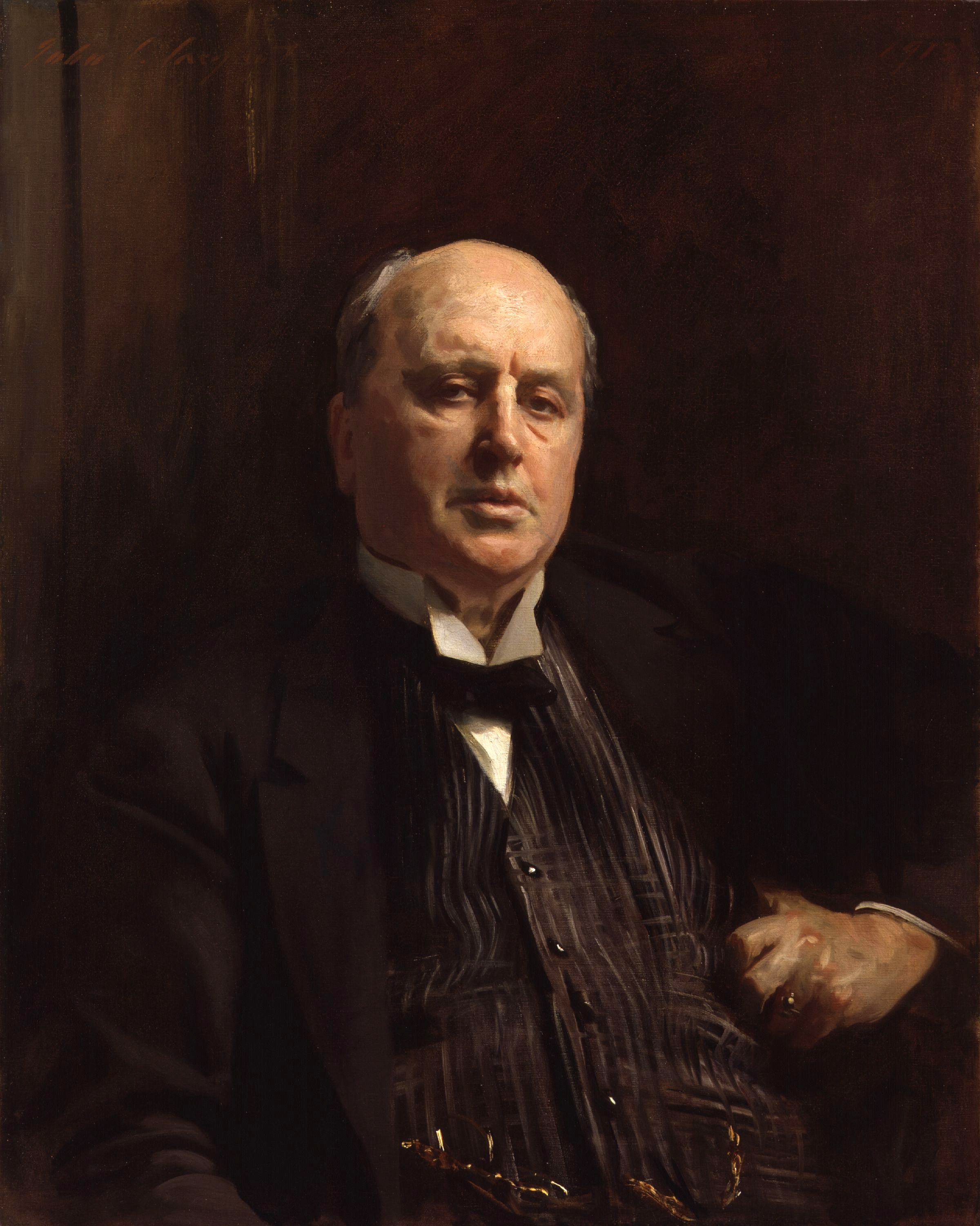
Henry James
American-British authorWikipedia
534
MENTIONS
217
EPISODES
166
PODCASTS
Search complete. 534 mentions across 217 episodes found for "Henry James".
Sep 16, 2026

Kirsten WeaverNARRATOR
But it is a part of English hypocrisy, or let it be more politely said, English reserve.
Kirsten WeaverNARRATOR
that whilst we are fluent enough in grumbling about small inconveniences we insist on making light of any great difficulties or griefs that may beset us and just there i suppose is the reason why our great novelists have shunned great books as subject-matter it is fortunate for us jarring though it is to our patriotic sense that mr henry james was not born an englishman that he was born of a race of specialists men who are impenitent specialists in whatever they take up be it sport commerce politics anything and it is fortunate for us that in paris and in the straightest literary sect there his method began to form itself and the art of prose fiction became to him a religion in that art he finds as much inspiration as swinburne found in the art of poetry just as swinburne was the most learned of our poets so is mr james the most learned of our let us say our prose writers i doubt whether the heaped total of his admirations would be found to outweigh the least one of the admirations that swinburne had but though he has been a level-headed reader of the works that are good enough for him to praise his abstract passion for the art of fiction itself has always been fierce and constant partly to the parisian partly to the american element in him we owe the stories that he and of our great writers he only has written about books and the writers of books here indeed in these incomparable stories are imaginary great books that are as real to us as real ones are sometimes as in the author of beltrafio a great book itself is the very hero of the story we are not told what exactly was the title of that second book which ambient's wife so hated that she let her child die rather than that he should grow up under the influence of its author but i have a queer conviction that it was the daisies usually in these stories it is through the medium of some ardent young disciple speaking in the first person that we become familiar with the great writer it is thus that we know hugh veriker throughout whose twenty volumes was woven that message or meaning that figure in the carpet which eluded even the elect it is thus that we know neil parade the manuscript of whose last book was mislaid and lost so tragically so comically and it is also through parade's disciple that we make incidental acquaintance with guy walsingham the young lady who wrote obsessions and with dora forbes the burly man with a red moustache who wrote the other way round these two books are the only inferior books mentioned by mr james but stay i was forgetting the top of the tree by amy evans and also those nearly forty volumes by henry st george for all the greatness of his success in life henry st george is the saddest of the authors portrayed by mr james his shadow mere was splendid and its splendour is the measure of his shame the shame he bore so bravely in the ruck of his output he is the only one of those authors who did not do his best of him alone it may not be said that he was generous and delicate and pursued the prize he is a more pathetic figure than even dencombe the author of the middle years dencombe's grievance was against fate not against himself it had taken too much of his life to produce too little of his art the art had come but it had come after everything else ah for another go ah for a better chance a second chance that's the delusion there never was to be but one we work in the dark we do what we can we give what we have our doubt is our passion and our passion is our task the rest is the madness of art the scene of dencombe's death is one of the most deeply beautiful things ever done by mr james it is so beautiful as to be hardly sad it rises and glows and gladdens it is more exquisite than anything in the middle years no i will not say that mr james's art can always carry to us the conviction that his character's books are as fine as his own i crave it may be a foolish whim but i do crave ocular evidence for my belief that those books were written and were published i want to see them all ranged along goodly shelves a few days ago i sat in one of those libraries which seemed to be doorless nowhere to the eye was broken the array of serried volumes each door was flush with the surrounding shelves Across each the edges of the shelves were mimicked, and in the spaces between these edges the backs of books were pasted congruously with the whole effect.
Kirsten WeaverNARRATOR
Some of these backs had been taken from actual books.
Kirsten WeaverNARRATOR
Others had been made specially and were stamped with facetious titles that rather depressed me.

David WalesNARRATOR
Robert Louis Stevenson showed how important it was to say things agreeably, even when you had not very much to say.
David WalesNARRATOR
Henry James showed that there was so much to say about everything that you could not possibly get to the end of it, and Rudyard Kipling showed that the great thing was to see things as they were.
David WalesNARRATOR
At the beginning of the 90s, everyone was immensely busied over the way that things were done.
David WalesNARRATOR
The Yellow Book sprang into a bright existence, flamed, and died.
David WalesNARRATOR
Once she was And so the matter continues.
David WalesNARRATOR
It is not so much a deliberate evocation of the most difficult of methods, this manner of narration, as a poignant witness to Conrad's own breathless surprise at his discoveries.
David WalesNARRATOR
Mr. Henry James, speaking of this enforced collection of oratorical witnesses, says, It places Mr. Conrad absolutely alone as a votary of the way to do a thing that shall make it undergo most doing.
David WalesNARRATOR
And his amazement at Conrad's patient pursuit of unneeded difficulties may seem to us the stranger if we consider that in What Maisie Knew and The Awkward Age he has practiced almost precisely the same form himself.

James K. WhiteNARRATOR
The most original novelists endeavored to vary the monotony of their task by introducing intricate considerations of form.
James K. WhiteNARRATOR
Flaubert and Henry James devised for themselves subtle problems concerning the angle of presentation and the identity of the hypothetical consciousness to which the events of the fiction were present.
James K. WhiteNARRATOR
They made the writing of novels an infinitely subtle craft and they increased its prestige and mystery.
James K. WhiteNARRATOR
For many years indeed to within the last decade, their principles and subtleties were regarded with an awful reverence.
1 HR 54 MINS LATER
James K. WhiteNARRATOR
It is that which holds us.
James K. WhiteNARRATOR
Dickens sees Mrs. Gamp and Betsy Prigg.
James K. WhiteNARRATOR
Henry James sees Daisy Miller.
James K. WhiteNARRATOR
Charles Reed watches the struggle of Dennis and Gerard with the bear as it is excited over the fight between the gasmen and Neat.

Chufi GaleazziNARRATOR
Yet even near the Ennius and Napoleon, our American men look worthy to be perpetuated in marble or bronze, if it were only for their air of calm, unpretending sagacity.
Chufi GaleazziNARRATOR
Mr. Henry James, Jr., writing of Nathaniel Hawthorne, speaks of the Massachusetts of forty or more years ago as poor in its aesthetic resources.
Chufi GaleazziNARRATOR
Works of art, indeed, were then few in number, and the decorative industry, in its present extent, was not dreamed of.
Chufi GaleazziNARRATOR
But in the intellectual form of appreciative criticism, the Boston of that day was richer than the city of our own time.

John GreenmanNARRATOR
I will have a stenographer there, and you can start dictating your stories, and we shall set the world laughing, putting them in a book." Fisher did, and here's the book.
John GreenmanNARRATOR
Twain and Field did not expatriate themselves to the extent of other gifted Americans, Henry James, Bret Harte, Whistler, Abbey, and Sargent.
John GreenmanNARRATOR
Yet Twain settled down for months and even years in various European countries, while Field tried, during a hundred days or more, to make a go of it in London before capitulating to climate and home hunger.
John GreenmanNARRATOR
Previous glimpses of these two great American humorists during their several sojourns in Europe have come to us almost wholly through their letters to friends at home.

Taylor CaronGUEST
So there's Melville.
Taylor CaronGUEST
And then Henry James said that Hawthorne was the great American novelist.
Taylor CaronGUEST
So he's kept his place in American literature for that reason.
Taylor CaronGUEST
But he's kind of hard to read.
Taylor CaronGUEST
The Scarlet Letter is, I actually think, the most advanced level of Hawthorne that you can get to and that it is a bit impenetrable because he has his own language.
Taylor CaronGUEST
It's
Jack TruckenpedderHOST
like starting Henry James with The Golden Bowl or Wings of the Dove.
Jack TruckenpedderHOST
Just go back, read Portrait of a Lady, read Washington Square.

MichelleHOST
I think it's – so there's like a whole bunch of films from – actually, let's back up.
MichelleHOST
There's this whole tradition that starts with, let's say, Henry James and then goes on through to recently, right, or even today.
MichelleHOST
There's this subgenre of literature and film where Americans come to Europe to have an experience.
Jason SacksHOST
Mm-hmm.

Nicholas CliffordNARRATOR
For more information or to volunteer, please visit LibriVox.org.
Nicholas CliffordNARRATOR
The Tragic Muse by Henry James.
Nicholas CliffordNARRATOR
Chapter thirty-two.
Nicholas CliffordNARRATOR
It mattered not so much what the doctors thought—and Sir Matthew Hope, the greatest of them all, had been down twice in one week—as that Mr. Chater, the omniscient butler, declared, with all the authority of his position and his experience, that Mr. Carteret was very bad indeed.
Nicholas CliffordNARRATOR
For more information or to volunteer, please visit librivox.org.
Nicholas CliffordNARRATOR
The Tragic Muse by Henry James.
Nicholas CliffordNARRATOR
Chapter thirty-one.
Nicholas CliffordNARRATOR
If he was ruffled by some of her conditions, there was thus comfort and consolation to be drawn from others, beside the essential fascination, so small the doubt of that now, of the young lady's own society.
Nicholas CliffordNARRATOR
For more information or to volunteer, please visit LibriVox.org.
Nicholas CliffordNARRATOR
The Tragic Muse by Henry James, Chapter 30.
Nicholas CliffordNARRATOR
It was not till after the noon of the next day that he was to see Miriam Ruth.
Nicholas CliffordNARRATOR
He wrote her a note that evening to be delivered to her at the theater, and during the performance she sent round to him a card with, All right, come to luncheon tomorrow, scrawled on it in pencil.
207 more episodes mention Henry James.
Create an account to see the whole feed, search across every transcript, and follow the entities you care about.