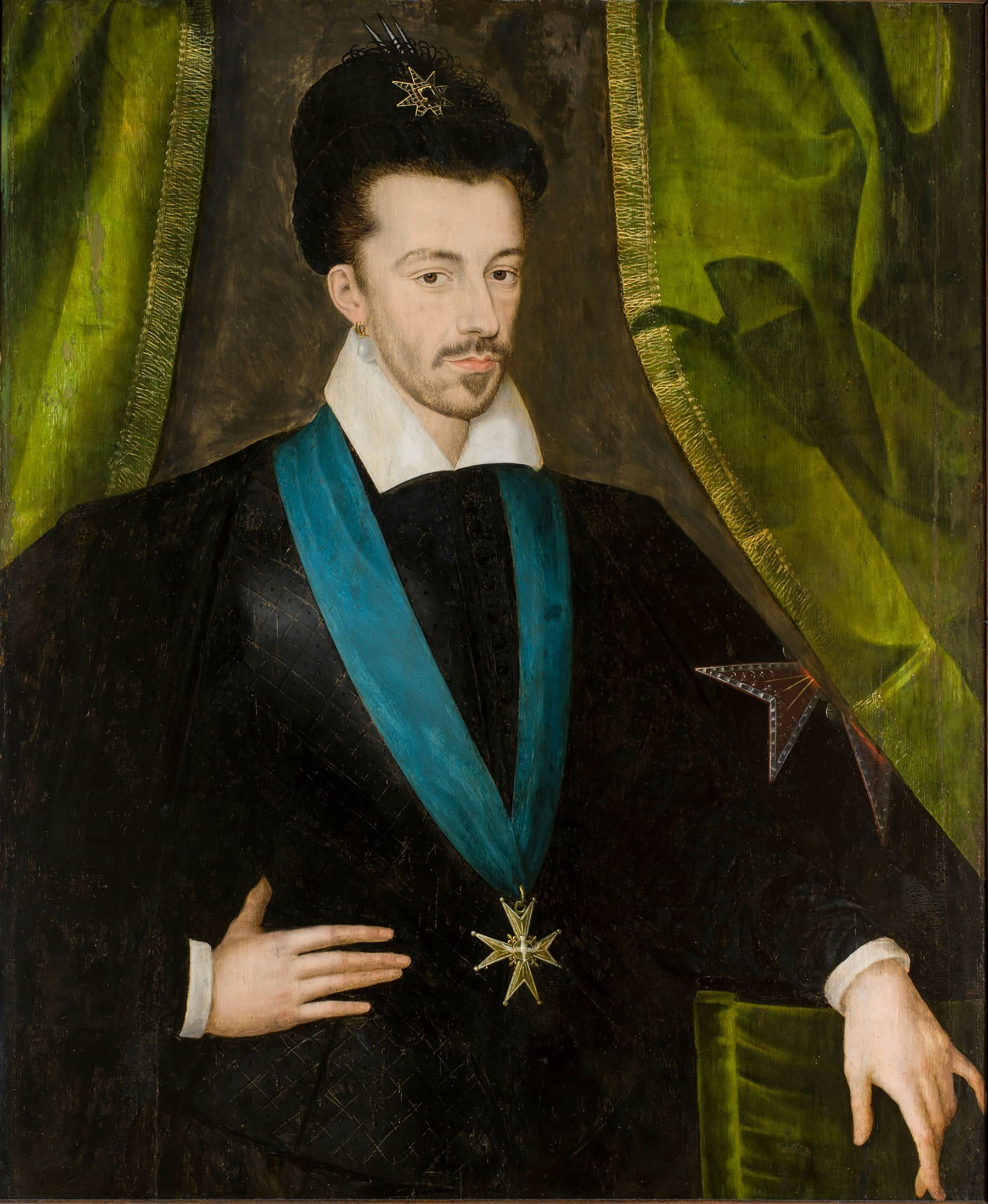
Henry III of France
Former King of PolandWikipedia
9
MENTIONS
5
EPISODES
5
PODCASTS
Search complete. 9 mentions across 5 episodes found for "Henry III of France".
Oct 11, 2026

speaker_4NARRATOR
Like him, we learn to swallow and not to find bitter the venom of servitude.
speaker_4NARRATOR
It cannot be denied that nature is influential in shaping us to her will and making us reveal our rich or meager endowment.
speaker_4NARRATOR
Yet it must be admitted that she has less power over us than custom, for the reason that native endowment, no matter how good, is dissipated unless encouraged, whereas environment always shapes us in its own way, whatever that may be, in spite of nature's gifts.
speaker_4NARRATOR
The good seed that nature plants in us is so slight and so slippery that it cannot withstand the least harm from wrong nourishment.

Leon HarveyNARRATOR
There was at that time a very conscious rivalry with a huge Slavic power to the east, and Poland revealed great military possibilities.
Leon HarveyNARRATOR
A line of brilliant captains succeeded Stephen Bathory, the energetic Transylvanian prince, who was elected to fill the throne made vacant in 1574 by the rapid flight of Henry of Valois.
Leon HarveyNARRATOR
Stephen fought some of the most splendid campaigns in all Polish history, driving Ivan the Terrible back, and forcing him to peace.
Leon HarveyNARRATOR
But the reign of this great man was brief, 1575-1586.
Leon HarveyNARRATOR
During the third she declined in political strength, and greatly in the amount of her belligerency.
Leon HarveyNARRATOR
Poland, 1540-1795 Casimir IV, 1447-1492 1454-1466 Livonian Order 1471-1479 Matthias Corvin Hunyadi of Hungary 1486-1489 Turkey 1490 Raid of Cossacks, Tartars, Magyars, etc.
Leon HarveyNARRATOR
John Albert, 1492-1501 1492-1494 War between Lithuania and Moscow 1497 Short Turkish War 1497-1498 Stephen of Moldavia Alexander, 1501-1506 1500-1503 Moscow 1500-1506 Stephen of Moldavia 1506 Khan of the Crimea Sigismund I, 1506-1548 1508 Moscow 1510 Tatar Raid 1511-1526 Russia 1516 Tatar Raid 1519 Tatar Raid 1520-1521 Livonian Order 1527 Tatar Raid 1530 Moldavia 1533 Tatar Raid 1534-1537 Russia Sigismund II, 1548-1572 1552 Interference in Wallachia 1556-1557 Livonian Order Beginning of the First Great Northern War Interregnum, 1572-1573 Henry of Valois, 1573-1574 Stephen Bathory, 1575-1586 1572-1575, Russia 1575, Tatar invasion 1583-1590, Turkish war along border Sigismund III, 1587-1632 1587-1588, Archduke Maximilian and the Soborowski 1590, Confederation against Samoisky 1595, Turkey 1596, Cossacks put down by Sulkowski 1598-1600, Cossacks again put down by Sulkowski 1600-1609, Sweden 1606, Confederation of Szebratowski 1607-1609, Insurrection of Szebratowski 1609-1618, Russia, a result of Russia's anarchy 1613, Cossack expedition in Black Sea 1615-1616, Cossack rebellion 1617, Cossack rebellion 1618-1621, Turkey 1623-1625, Cossacks who were subdued 1626-1629, Sweden, campaign of Gustavus Adolphus Wladyslaw IV 1632-1648 1632-1634, Russia, ended by Treaty of Polianowska 1632-1634, Turkey 1634, Cossack revolt 1636, Cossack revolt 1638, Cossack revolt 1638, attack on Danzig and destruction of fleet by Danes 1646-1648, Tatar and Turkish raids in Poland John Casimir 1648-1668 1648-1649, Tatar Khan of Crimea in war with Poland 1648-1649, Cossack rebellion headed by Chmelnicki 1651-1654, Cossack rebellion and secession from Poland 1654-1656, Russia ended by Armistice of Vilna 1655-1660, Sweden, the deluge in Poland, ended by Peace of Oliwa 1656-1657, Brandenburg, ended by Treaty of Wellau, freeing Prussia 1657-1662, Rogozi of Transylvania 1658-1667, renewal of Russian war, ended by Peace of Andrusovo 1667-1668, Cossacks and Tatars headed by Doroshenko Michael Wisniowiecki 1669-1673 1672, Turkey John III Sobieski 1674-1696 1673-1675, Turkey 1683-1699, Turkey, Sobieski's Vienna triumph Augustus II 1697-1704 Stanislaus Leszczyński 1704-1709 1701-1706, Sweden, ended by a truce which was made permanent Augustus III 1733-1763 1733-1735, War of the Polish Succession against Russia Stanislaus II Poniatowski 1764-1795 1768-1772, War of the Confederation of Bar, leading to First Partition 1792, Resistance to Russia and the Second Partition 1794, Russia leading to the Third Partition 1795, Prussia leading to the Third Partition End of Section 8 Section 9 of Is War Diminishing by Frederick Adams Woods and Alexander Pulsie This is a LibriVox recording.
Leon HarveyNARRATOR
All LibriVox recordings are in the public domain.

Pamela NagamiNARRATOR
The French monarchy has had the privilege of being sanctified by a certain number of queens whose virtues might be called a compensation for court scandals and who have contributed more than any others to preserve the moral authority of the throne.
Pamela NagamiNARRATOR
Just as under the reigns of the later Valois, Claude of France, Elizabeth of Austria, and Louise de Vaudemont redeemed the vices of Francis I, Charles IX, and Henry III by their purity of heart, so Marie Therese may be said to have recompensed morality for the injuries inflicted on it by Louis XIV.
Pamela NagamiNARRATOR
History should not forget this woman in whose veins flowed the blood of Charles V and that of Henry IV, this sovereign who wore her royal mantle with dignity even while comparing it to a winding sheet, this model wife who loved her husband with all the strength of her soul and never approached him but with a mingled respect, fear, and tenderness, this devoted mother who made it her care to move the heart of the young prince whose mind was committed to the charge of Bossuet, this holy woman who has proved that a palace may become a sanctuary and that a Christian heart may beat under velvet and ermine as well as under a robe of frieze.
Pamela NagamiNARRATOR
Marie Therese, born like Louis XIV in 1638, was but a few days younger than he.
3 HRS 47 MINS LATER
Pamela NagamiNARRATOR
It seems to me impossible to comprehend what God does with us, and that we ought to confine ourselves to admiring his omnipotence without desiring to argue about his goodness and justice.
Pamela NagamiNARRATOR
The beautiful and touching ceremonies of Catholicism, the long sermons, the protracted offices, did not greatly please Madame.
Pamela NagamiNARRATOR
I think she writes that Monsieur is a devotee and that he resembles Henry III in every way.
Pamela NagamiNARRATOR
If this is the road to heaven, I shall certainly never enter it, seeing that I find it impossible to hear a high mass.

Simon WhistlerHOST
At the same time, Christine being accepted had given him a newfound confidence.
Simon WhistlerHOST
Dumas dashed off another historical play, Henri III, which was likewise accepted and moved into production ahead of Christine.
Simon WhistlerHOST
He began to meet people like Witte Huger and Honor de Balzac, up-and-comers in the new styles of French writing.
Simon WhistlerHOST
Unfortunately, there were others who noticed Dumas' rise too.
Simon WhistlerHOST
Either you drop this theater nonsense or I'll fire you.
Simon WhistlerHOST
Dumas took the latter option.
Simon WhistlerHOST
Henri III debuted on February 11, 1829, the first Dumas play to ever see production.
Simon WhistlerHOST
The house was packed that night.

Annie SargentHOST
Aha
Rowena SjovallGUEST
... was assassinated there by, uh, Henri III.
Rowena SjovallGUEST
[laughs]
Annie SargentHOST
Aha.