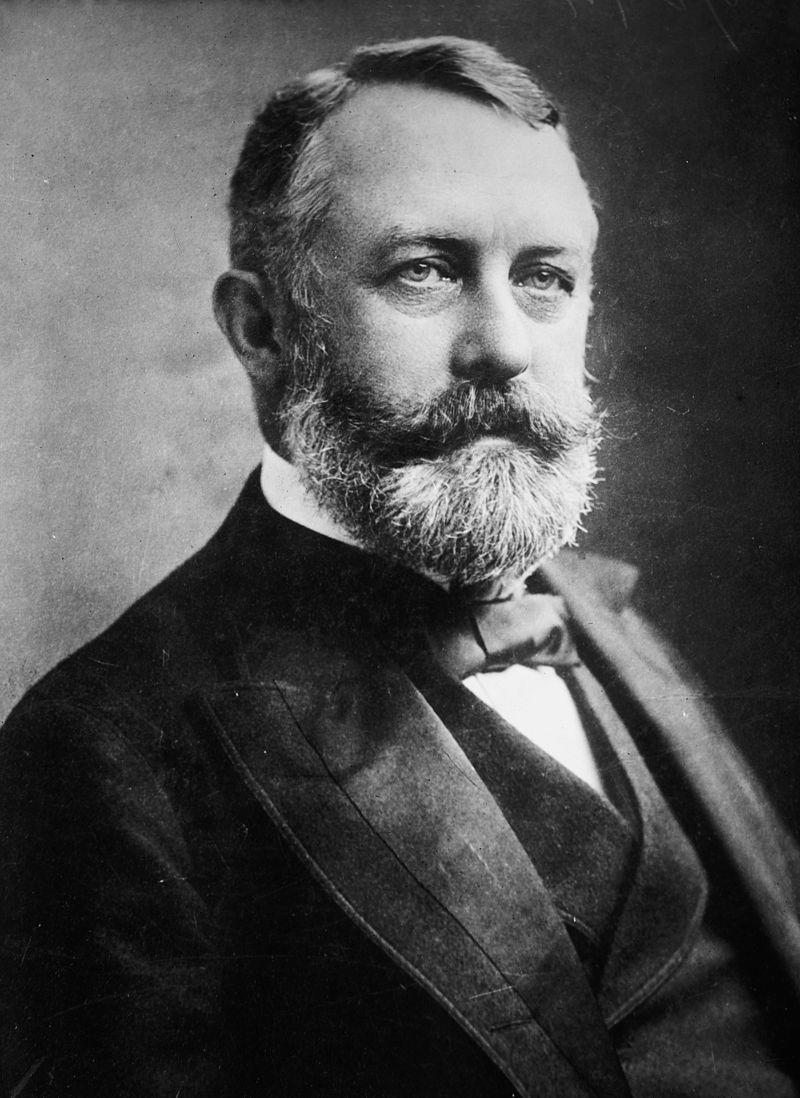
Henry Clay Frick
American industrialist and financierWikipedia
64
MENTIONS
22
EPISODES
21
PODCASTS
Search complete. 64 mentions across 22 episodes found for "Henry Clay Frick".
Nov 18, 2026

John HilaryGUEST
That's in the first generation.
John HilaryGUEST
And then later, of course, Henry Clay Frick and the Huntingtons.
John HilaryGUEST
But what I tried to show was at that time, when these collections were coming onto the market in Britain, you had here in Britain this group of German Jews who spent hundreds of thousands of pounds, I mean, in the equivalent today of hundreds of millions of pounds, buying up these treasures and putting them into their own collections.
John HilaryGUEST
So that, I think, is the context in which they were buying, that continued all the way up to the rupture of the First World War.

Keith HocktonHOST
Milton Hershey, whose fortune came from chocolate, had actually made arrangements to travel but return to America earlier.
Keith HocktonHOST
Henry Clay Frick, the steel magnate and art collector.
Keith HocktonHOST
Well, he also changed his plans.
Keith HocktonHOST
So did George Vanderbilt, another member of one of America's great dynasties.

Patty SteeleHOST
There are a few of those magnificent buildings still around.
Patty SteeleHOST
Henry Clay Frick's mansion is now a gorgeous art museum that gives you a look at that lifestyle, filled with his art collection and furniture of that era.
Patty SteeleHOST
And the Andrew Carnegie mansion is now a part of Smithsonian's Cooper Hewitt Design Museum.
Patty SteeleHOST
But for hundreds of other fabulous homes, the wrecking ball came before anyone seriously considered trying to preserve them.

Patty SteeleHOST
There are a few of those magnificent buildings still around.
Patty SteeleHOST
Henry Clay Frick's mansion is now a gorgeous art museum that gives you a look at that lifestyle, filled with his art collection and furniture of that era.
Patty SteeleHOST
And the Andrew Carnegie mansion is now a part of Smithsonian's Cooper Hewitt Design Museum.
Patty SteeleHOST
But for hundreds of other fabulous homes, the wrecking ball came before anyone seriously considered trying to preserve them.

Walter StahrGUEST
So he's an impressive guy in his own right.
Walter StahrGUEST
And then he's the father of four very impressive brothers.
Walter StahrGUEST
The oldest, Charles, is the publisher of the Cincinnati Times Star, owns a couple baseball teams, major philanthropist.
Walter StahrGUEST
You can visit his house even today.
Walter StahrGUEST
So that's family.
Walter StahrGUEST
In terms of Tapp's own childhood, a fairly conventional childhood in Cincinnati, attends public schools, does well.
Walter StahrGUEST
and then, like his father and older half-brothers before him, goes to Yale.
Walter StahrGUEST
I think it's sort of written in the stars from the day the kid is born that he's going to go to Yale.

Patty SteeleHOST
There are a few of those magnificent buildings still around.
Patty SteeleHOST
Henry Clay Frick's mansion is now a gorgeous art museum that gives you a look at that lifestyle, filled with his art collection and furniture of that era.
Patty SteeleHOST
And the Andrew Carnegie mansion is now a part of Smithsonian's Cooper Hewitt Design Museum.
Patty SteeleHOST
But for hundreds of other fabulous homes, the wrecking ball came before anyone seriously considered trying to preserve them.

Carl RaymondHOST
And this is extraordinary from so many different points of view, one of which is that you can go inside.
Carl RaymondHOST
It is open to the public as the Frick Collection, and it houses Henry Clay Frick's collection that has been expanded.
Carl RaymondHOST
So would you talk a little bit about what do we see when we look at the exterior of that house?
Emma Guest-ConsalesGUEST
The Frick Mansion was designed by Thomas Hastings and much more refined and much less elaborate style than what happens at the Sloan Mansion before that.
Emma Guest-ConsalesGUEST
We're talking 1911, 1912.
Emma Guest-ConsalesGUEST
But the city didn't want it, so the building ultimately was demolished, which is why Richard Morris Hunt looks at somebody else's building.
Emma Guest-ConsalesGUEST
And so it was built for Henry Clay Frick, for his wife, and for their daughter.
Emma Guest-ConsalesGUEST
So the three of them move in with a staff of 20 to 30 people in this enormous house.

KianHOST
In her 2024 book, The Politics of Collecting, Race and the Aesthetization of Property, Eun Song Kim argues that the birth of the modern American museum served to launder elite wealth hand-in-hand with the suppression of organized labor.
KianHOST
Kim traces the genealogy of prestigious private collections back to the violent suppression of the 1892 Holmstead strike in Pennsylvania, as steel magnate Henry Clay Frick crushed unionized workers fighting for basic dignity.
KianHOST
He simultaneously amassed one of the world's most celebrated fine art collections, anchoring the elite patronage to the rise of Taylorist labor control.
KianHOST
Kim's main point is that private collections and public museums played a major role of cleaning dirty money, turning wealth stolen from workers and brutal labor suppression into something respectable and noble.

KyleHOST
So Ruff was a Pittsburgh businessman who had earlier worked as a contractor in Illinois, and he organized the South Fork Fishing and Hunting Club as an exclusive summer retreat.
KyleHOST
Henry Clay Frick, who we have talked about on the podcast before, he encouraged others to join, and he became a promoter and spokesman for the club.
KyleHOST
He was a member, along with Andrew Carnegie, Andrew Mellon, robert pitcairn and the lawyers philander senox and james hay reed so lots of like important names of the area and time most of the members in the club were from pittsburgh the one johnstown native was cyrus elder chief counsel for cambria iron who bought the club membership of daniel j moral after moral's death benjamin ruff was president until he died in 1887 and elias hunger took over John G.
KyleHOST
Park Jr. was the resident engineer.

Kathy EmmonsHOST
It seems early, but okay.
Kathy EmmonsHOST
I mean, the tradition dates back to 1913, when a fundraising campaign led by Councilman Robert Garland brought the first city Christmas tree to the empty property owned by Henry Clay Frick between 5th and 6th Avenues, and it was moved to its current location in in 1914 it'll get all lit up um november 21st on grand street in front of the city county building much more to come with gerald gilliam next it's your friday edition of the ride home I don't remember a time before Christianity Today.
Kathy EmmonsHOST
So if you're a magazine reader, if you're somebody who kind of is interested to see how trends go in faith communities, how issues are discussed, how things are reported, Christianity Today was the flagship publication of the Evangelical Church in America for, I don't know, the last 70 years.
Kathy EmmonsHOST
Well, within the last three months, a lot has gone down.
12 more episodes mention Henry Clay Frick.
Create an account to see the whole feed, search across every transcript, and follow the entities you care about.