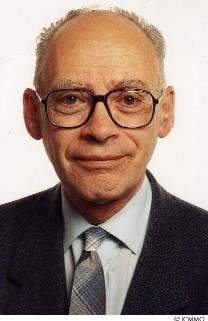
Henri B. Kagan
French chemistWikipedia
73
MENTIONS
59
EPISODES
47
PODCASTS
Search complete. 73 mentions across 59 episodes found for "Henri B. Kagan".
Oct 16, 2026

GabeHOST
It can be really serious though, because your body is not used to whatever the handedness that it's not built around, right? So just, uh, it, it's not used to handling that.
GabeHOST
Uh, and so what this, uh, the last of the natural sciences to receive the Nobel Prizes for this year was chemistry in the last few days, and it's gone to Henry Kagan and Kenzo Soai.
GabeHOST
And to q- quote the actual award, "For the discovery of non-linear effects and autocatalysis in asymmetrical organic synthesis," which is a very complicated way to s- kinda say they figured out how to make a mixture from in, of both left-handed and right-handed molecules and turn that into one or the other, where you just get pretty much exclusively right-handed or exclusively left-handed.
GabeHOST
Which is very important for things like drug manufacturing, where you often need just one or the other and can't have the other in there.
GabeHOST
The, where this starts is with Kagan, the first of the two people.
GabeHOST
So any three people can win a Nobel Prize, can share it, so two got the chemistry prize this year.
GabeHOST
Uh, and he began his work in Paris in the '80s.
GabeHOST
Um, a- an amazing thing to be able to do, replicating what must have happened in life in a lab in a way that chemistry hadn't see- been able to do before, uh, and has, has paved the way to a whole bunch of stuff.

Matilda SercombeHOST
[ding] Fact number four.
Matilda SercombeHOST
The 2026 Nobel Prize in Chemistry was awarded to Henri Kagan from France and Kenzo Serai from Japan.
Jenny LynchHOST
Molecules are made up of atoms that are bound together, and some molecules come in two different three-dimensional shapes that are mirror images of each other.
Jenny LynchHOST
Even though the mirror image molecules have the same number of atoms and the same types of atoms, the two different shapes can make the chemicals behave differently.

Stuart GaryHOST
Using IceCube, astronomers have been able to capture neutrinos from extremely energy-rich processes in the distant universe, opening up a new window.
Stuart GaryHOST
The Nobel Prize in Chemistry has been awarded to Henri Kagan and Kensei Soai for the discovery of nonlinear effects in autocatalysts in asymmetric organic synthesis.
Stuart GaryHOST
All amino acids exist in two mirrored variants, but only one of them is found in proteins in living cells, and the other is rarely found in nature.
Stuart GaryHOST
And Kagan and Kenzo were able to find out how this homochirality can emerge.

Stuart GaryHOST
Using IceCube, astronomers have been able to capture neutrinos from extremely energy-rich processes in the distant universe, opening up a new window.
Stuart GaryHOST
The Nobel Prize in Chemistry has been awarded to Henri Kagan and Kenzie Soai for the discovery of nonlinear effects and autocatalysts in asymmetric organic synthesis.
Stuart GaryHOST
All amino acids exist in two mirrored variants, but only one of them is found in proteins in living cells, and the other is rarely found in nature.
Stuart GaryHOST
And Kagan and Kenzo were able to find out how this homochirality can emerge.

Steven NovellaHOST
... was just thinking about that.
Kara Santa MariaHOST
[laughs] So, uh, first we'll talk about Henri Kagan.
Kara Santa MariaHOST
He, uh, he was born on December 15, 1930.
Kara Santa MariaHOST
So this man is 95 years old, about to be 96 years old, yes, i- in France, and let's talk a little bit about his contribution.
6 MINS LATER
Kara Santa MariaHOST
They didn't know how, and they didn't know that, you know, whether or not it was a runaway reaction.
Kara Santa MariaHOST
So cut to our two Nobel laureates.
Kara Santa MariaHOST
So we're gonna start with Henri Kagan.
Kara Santa MariaHOST
So in the '90s, he had the, uh, chutzpah to challenge a long-held kind of universal truth that was taken for granted within the chemistry community.

Ragavendra R. BaligaHOST
This year's Nobel Prize in Chemistry has health implications.
Ragavendra R. BaligaHOST
It was awarded to Frenchman Henri Kagan and Japanese scientist Kenzo Soai for the discovery of nonlinear effects and autocatalysis in asymmetric organic synthesis, according to the Royal Swedish Academy of Sciences.
Ragavendra R. BaligaHOST
What is a molecular hand? Explained simply, your left and right hands are mirror images, but you can't place one perfectly on top of the other.
Ragavendra R. BaligaHOST
Molecules can do this too.

BaileyHOST
Here's a look at this year's laureates.
BaileyHOST
French chemist Henri Kagan and Japanese chemist Kenzo Soai won the prize in, you guessed it, chemistry, for successfully producing just one mirror-image molecule, a process previously only seen in nature.
BaileyHOST
Stanford professor Karl Deisseroth and German professors Peter Hegemann and George Nagel won the physiology/medicine prize for their contributions to optogenetics, a technique that uses light to toggle brain cells.
BaileyHOST
Belgian-born UW Madison physicist Francis Halzen won for using Antarctic ice to catch elusive ghost particles from deep space.

Coy WireHOST
Now to chemistry, where one of this year's Nobel Prizes is going to two scientists helping solve one of life's strangest molecular mysteries.
Coy WireHOST
Henri B. Kagan of France, Kenzo Soai of Japan won the Nobel Prize in Chemistry for discoveries involving something called chirality.
Coy WireHOST
Here's the easy way to think about this.
Coy WireHOST
Hold up your hands.

Angelica WaiteCORRESPONDENT
The twenty twenty-six joint winner for the Nobel Prize for Chemistry says he was grocery shopping when he got the news.
Angelica WaiteCORRESPONDENT
Professor Kenzo Soy has been chosen for the honor for his work at Tokyo University of Science with ninety-five-year-old French scientist Henri Kagan.
Angelica WaiteCORRESPONDENT
The pair solved a long-standing riddle of asymmetric mirror image molecules, a discovery hugely important for pharmaceutical manufacturing.
Angelica WaiteCORRESPONDENT
Professor Soy says he's delighted to have advanced understanding of an important phenomenon.

JJ Grichnik-ParsonsHOST
The Nobel Prize in Physics will go to Belgian astrophysicist Francis Halsen for his innovations in detecting high-energy extraterrestrial neutrinos in twenty thirteen, allowing scientists to trace violent cosmic events like exploding stars and black holes.
JJ Grichnik-ParsonsHOST
The Nobel Prize in Chemistry will be awarded to both French chemist Henri Kagan and Japanese chemist Kenso Soi for their careers as pioneers in the field of asymmetric catalysis, which has been greatly beneficial to pharmaceutical science.
JJ Grichnik-ParsonsHOST
Finally, the Nobel Prize in Physiology or Medicine will be shared by Karl Deisseroth, Peter Hegeman, and Georg Nagel for their discoveries concerning light-gated ion channels and optogenetics, which has potential clinical use applications, including restoring vision to patients with retinal degenerative diseases and blindness.
JJ Grichnik-ParsonsHOST
The winner of the Nobel Peace Prize will be announced today, October ninth, and the winner of the Prize in Economic Sciences will be awarded on Monday, October twelfth.
49 more episodes mention Henri B. Kagan.
Create an account to see the whole feed, search across every transcript, and follow the entities you care about.