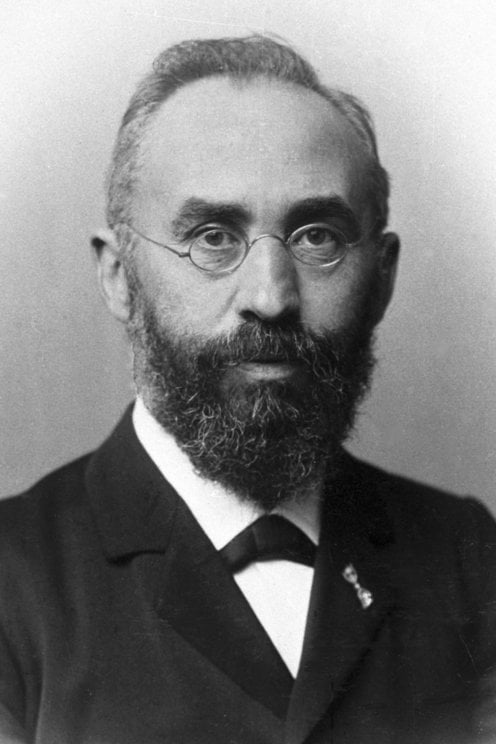
Hendrik Lorentz
Dutch theoretical physicistWikipedia
38
MENTIONS
5
EPISODES
3
PODCASTS
Search complete. 38 mentions across 5 episodes found for "Hendrik Lorentz".
Nov 21, 2026

speaker_0NARRATOR
This was the key distinction between the ether theory and the theory we have today, but Larmore's work still is generally credited as the first theoretical proposal of time dilation.
speaker_0NARRATOR
Over the next several years, Hendrik Lorentz and Henri Poincaré refined the mathematics behind time dilation, but once Einstein came along in 1905, everything changed.
speaker_0NARRATOR
Einstein proposed that the ether is unnecessary and that there is no absolute time at all.
speaker_0NARRATOR
In his theory of special relativity, the slowing belongs to time itself, which means it happens to every clock, and each observer sees the other's clock running slow.

Thomas BoskNARRATOR
It was the researches of Rieke, later of Drude, and above all those of J.J. Thomson, which have allowed it to assume an acceptable form.
Thomas BoskNARRATOR
All these attempts are connected, however, with the general theory of Lorentz, which we will examine later.
Thomas BoskNARRATOR
It will be admitted that metallic atoms can, like the saline molecule in a solution, partially dissociate themselves.
Thomas BoskNARRATOR
Electrons, very much smaller than atoms, can move through the structure, considerable to them, which is constituted by the atom from which they have just been detached.
1 HR 14 MINS LATER
Landis DavidsonNARRATOR
In the simplest theory, we will imagine an electron which may be displaced from its position of equilibrium in all directions, and is, in this displacement, submitted to attractions which communicate to it a vibration like a pendulum.
Landis DavidsonNARRATOR
These movements are equivalent to tiny currents, and the mobile electron, when animated with a considerable velocity, must be sensitive to the action of the magnet which modifies the form of the trajectory and the value of the period.
Landis DavidsonNARRATOR
This almost direct consequence was perceived by Lorentz, and it led him to the new idea that radiations emitted by a body ought to be modified by the action of a strong electromagnet.
Landis DavidsonNARRATOR
An experiment enabled this prevision to be verified.
speaker_12NARRATOR
half a century ago hopes ran high indeed the unity of force had just been revealed to us by the discovery of the conservation of energy and of its transformation this discovery also showed that the phenomena of heat could be explained by molecular movements although the nature of these movements was not exactly known no one doubted but that they would be ascertained before long as for light the work seemed entirely completed so far as electricity was concerned there was not so great an advance electricity had just annexed magnetism this was a considerable and a definitive step towards unity but how was electricity in its turn to be brought into the general unity and how was it to be included in the general universal mechanism no one had the slightest idea as to the possibility of the inclusion all were agreed they had faith finally as far as the molecular properties of material bodies are concerned the inclusion seemed easier but the details were very hazy in a word hopes were vast and strong but vague today what do we see in the first place a step in advance immense progress the relations between light and electricity are now known the three domains of light electricity and magnetism formerly separated are now one and this annexation seems definitive nevertheless the conquest has caused us some sacrifices optical phenomena became particular cases in electric phenomena as long as the former remained isolated it was easy to explain them by movements which were thought to be known in all their details that was easy enough but any explanation to be accepted must now cover the whole domain of electricity this cannot be done without difficulty the most satisfactory theory is that of lorentz it is unquestionably the theory that best explains the known facts the one that throws into relief the greatest number of known relations the one in which we find most traces of definitive construction that it still possesses a serious fault I have shown above.
speaker_12NARRATOR
It is in contradiction with Newton's law that action and reaction are equal and opposite.
speaker_12NARRATOR
Or rather, this principle, according to Lorentz, cannot be applicable to matter alone.
speaker_12NARRATOR
If it be true, it must take into account the action of the ether on matter, and the reaction of the matter on the ether.
speaker_12NARRATOR
Now, in the new order, it is very likely that things do not happen in this way.
2 HRS 3 MINS LATER
Ashwin JainNARRATOR
Thus, all these phenomena, looked upon as currents of convection, electric sparks, electrolytic currents, cathodic rays, act in the same manner on the galvanometer and in conformity to Rowling's law.
Ashwin JainNARRATOR
part six lawrence theory we need not go much further according to lawrence theory currents of conduction would themselves be true convection currents electricity would remain indissolubly connected with certain material particles called electrons the circulation of these electrons through bodies would produce voltaic currents and what would distinguish conductors from insulators would be that the one could be traversed by these electrons while the others would check the movement of the electron.
Ashwin JainNARRATOR
Lorentz theory is very attractive.
Paul AdamsNARRATOR
It also seemed to be a necessary consequence of the fact that light is capable of polarisation, that this medium, the ether, must be of the nature of a solid body, because transverse waves are not possible in a fluid, but only in a solid.
Paul AdamsNARRATOR
thus the physicists were bound to arrive at the theory of the quasi rigid luminiferous ether the parts of which can carry out no movements relatively to one another except the small movements of deformation which correspond to light waves this theory also called the theory of the stationary luminiferous ether moreover found a strong support in an experiment which is also of fundamental importance in the special theory of relativity the experiment of from which one was obliged to infer that the luminiferous ether does not take part in the movements of bodies the phenomenon of aberration also favoured the theory of the quasi rigid ether The development of the theory of electricity, along the path opened up by Maxwell and Lorentz, gave the development of our ideas concerning the ether quite a peculiar and unexpected turn.
Paul AdamsNARRATOR
For Maxwell himself the ether indeed still had properties which were purely mechanical, although of a much more complicated kind than the mechanical properties of tangible solid bodies.
Paul AdamsNARRATOR
but neither maxwell nor his followers succeeded in elaborating a mechanical model for the ether which might furnish a satisfactory mechanical interpretation of maxwell's laws of the electromagnetic field The laws were clear and simple, the mechanical interpretations clumsy and contradictory.
speaker_4ADVERTISER
At participating McDonald's for a limited time.
Paul AdamsNARRATOR
the ether appears indistinguishable in its functions from ordinary matter within matter it takes part in the motion of matter and in empty space it has everywhere a velocity so that the ether has a definitely assigned velocity throughout the whole of space there is no fundamental difference between hertz's ether and ponderable matter which in part subsists in the ether the hertz theory suffered not only from the defect of ascribing to matter and ether on the one hand mechanical states and on the other hand electrical states which do not stand in any conceivable relation to each other it was also at variance with the results of phezo's important experiment on the velocity of the propagation of light in moving fluids and with other established experimental results such was the state of things when h a lorentz entered upon the scene he brought theory into harmony with experience by means of a wonderful simplification of theoretical principles he achieved this the most important advance in the theory of electricity since maxwell by taking from ether its mechanical and from matter its electromagnetic qualities As in empty space, so too in the interior of material bodies, the ether, and not matter viewed atomistically, was exclusively the seat of electromagnetic fields.
Paul AdamsNARRATOR
According to Lorentz, the elementary particles of matter alone are capable of carrying out movements, their electromagnetic activity is entirely confined to the carrying of electric charges.
Paul AdamsNARRATOR
Thus, Lorenz succeeded in reducing all electromagnetic happenings to Maxwell's equations for free space.

Benjamin OutramNARRATOR
Tonight has one idea in it, and the idea is large, but it will come to meet you slowly, and it doesn't mind at all if you're asleep when it arrives.
Benjamin OutramNARRATOR
The theory belonged to Hendrik Lorentz, a Dutch physicist, one of the most admired of his age.
Benjamin OutramNARRATOR
Einstein kept a portrait of him, and said more than once that Lorentz meant more to him than anyone he'd ever met.
Benjamin OutramNARRATOR
At the close of the 19th century, Lorentz built a magnificent machine of a theory around a single, reasonable idea, that light must travel through something, a medium, an invisible ocean filling all of space, which physics called the ether.
Benjamin OutramNARRATOR
Waves need water.
Benjamin OutramNARRATOR
Sound needs air.
Benjamin OutramNARRATOR
Ever.
Benjamin OutramNARRATOR
Now here is the part that matters for tonight.