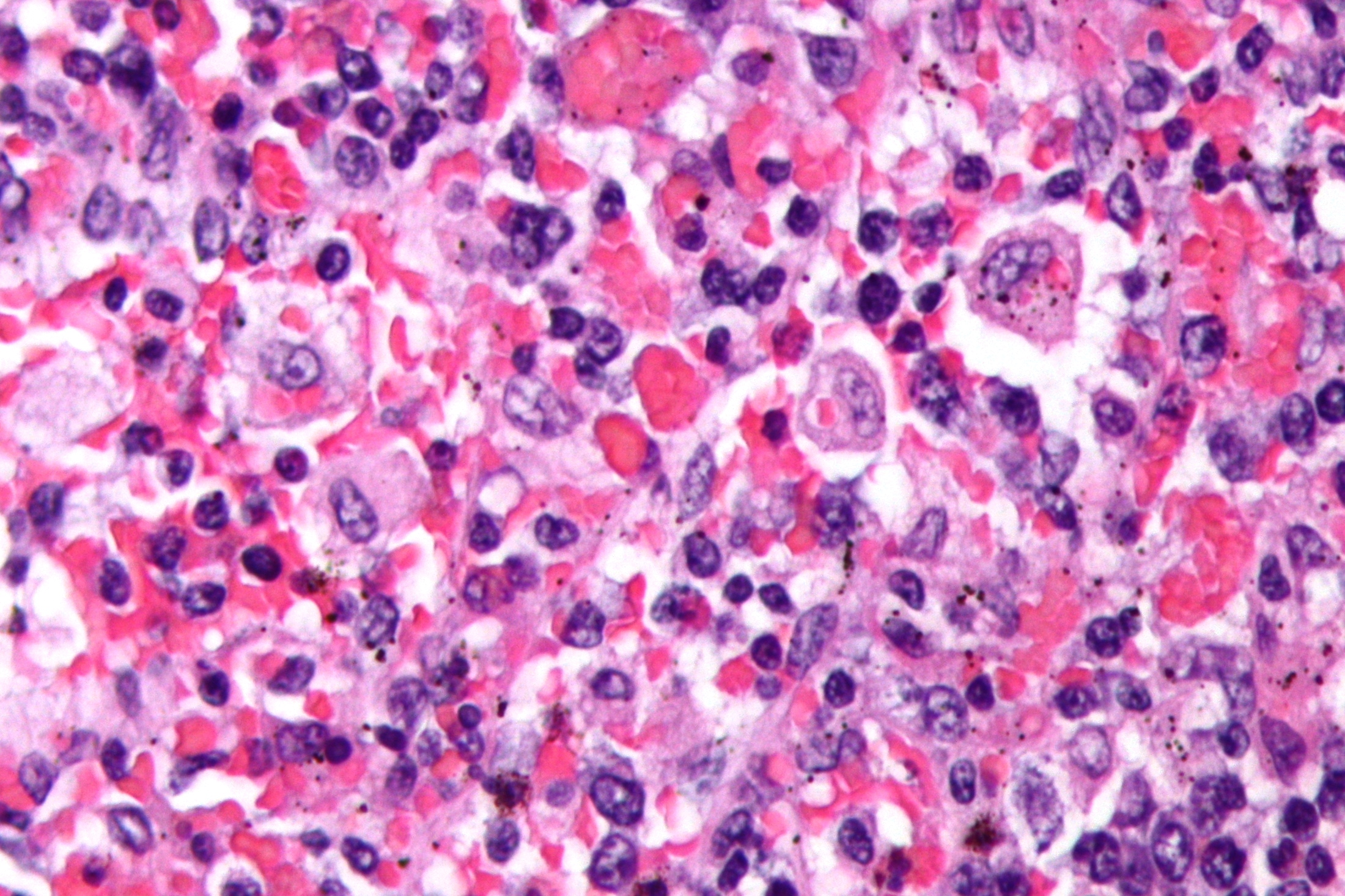
hemophagocytic lymphohistiocytosis
SyndromeWikipedia
152
MENTIONS
10
EPISODES
10
PODCASTS
Search complete. 152 mentions across 10 episodes found for "hemophagocytic lymphohistiocytosis".
Nov 3, 2026

CaleHOST
Yeah.
CaleHOST
That's the intro to our HLH episode, guys.
BasharHOST
Although, other Nick, that sounds like you have excellently credentialed to be on the show.
BasharHOST
Can I ask, where are you from? I'm

Randy CarlsonHOST
so when you say your spouse left you and you said it was a big why i mean you said selfishness what what was going on that caused her to say i'm done uh
JuanAUDIENCE
so what caused her was uh so we were trying to have kids unfortunately we lost our first our first child and then once I found out the type of cancer or autoimmune disorder, it's called HLH, they said it's hereditary.
JuanAUDIENCE
So we decided to not have kids anymore and they went, they said that they didn't want to continue our marriage because they wanted a family and so did I.
JuanAUDIENCE
So things just didn't work out for us as we planned.

Tammy YauHOST
And then atypical lymphocytes that we mentioned before is also very classic for mono.
Tammy YauHOST
Some other less common presentations include aseptic meningitis, encephalitis, transverse myelitis, optic neuritis, cranial nerve palsy, the Alice in Wonderland syndrome, Guillain-Barré, splenic rupture, thrombocytopenia, hemolytic anemia, and cranial otocytosis, and HLH.
Tammy YauHOST
So all these are very rare, but I think you get tested the most on like splenic rupture.
Lidia ParkHOST
Yeah, for sure, which we'll talk about in a bit actually.
Tammy YauHOST
Treatment is generally supportive.
Tammy YauHOST
Antivirals are not routinely recommended for mono.
Tammy YauHOST
But sometimes in severe diseases like with HLH or immunocompromised patients, we will give antivirals and immunomodulators.
Tammy YauHOST
But this is done with close consultation with infectious disease.

Marizelle ArceGUEST
Like I had a patient actually recently, he was diagnosed with an inflammatory response, right? They thought this inflammatory response, I'll give you the name of it.
Marizelle ArceGUEST
It's HLH, but it's this inflammatory response usually induced by some sort of cancer, lymphoma, leukemia, whatever it may be.
Marizelle ArceGUEST
Sometimes it's induced by a virus.
Marizelle ArceGUEST
Sometimes this inflammatory response...
Marizelle ArceGUEST
But they labeled you with this diagnosis of an inflammatory response.
Marizelle ArceGUEST
So when you walk out, you go, I know what I had.
Marizelle ArceGUEST
What did you have? HLH.
Marizelle ArceGUEST
You know what HLH translates to? Inflammatory response.

speaker_0NARRATOR
Knowing the signs can save a life.
speaker_0NARRATOR
This is Investigating HLH, a podcast about hemophagocytic lymphohistiocytosis brought to you by Sobe, Inc.
Kari MageeHOST
Hi, and welcome to another episode of Investigating HLH.
Kari MageeHOST
I'm Keri McGee.
Kari MageeHOST
Today we're here with a group of physicians whose work has shaped HLH.
Kari MageeHOST
So today we're actually going to talk about the story of CXCL9 and really where it started, how we understand how it's evolved, and what it might look like in the future and how it can help with diagnosis and treatment.
Kari MageeHOST
We're here with Dr. Michael Jordan from Cincinnati Children's.
Kari MageeHOST
Dr. Jordan, go ahead.

Rohit GosainHOST
What are some of the chronic side effects that I need to keep in mind? Any lab checks along with ferritin, LDH that I should be keeping in mind?
Shernan HoltanGUEST
Most of the time, the serious inflammatory toxicity, CRS, ICANS, and rarely an HLH-like syndrome will have resolved by the time the patient goes back to you, even by two to three weeks post CAR T.
Shernan HoltanGUEST
So those should be handled before you receive them back.
Shernan HoltanGUEST
I think the most significant long-term side effects tend to be cytopenias.

Ori ScottGUEST
There's, of course, others as well.
Lara DunganHOST
One of the most dramatic manifestations of immune dysregulation, as we know, is HLH.
Lara DunganHOST
Maybe before we get into the details of what HLH is, could you maybe tell us where it sits in the spectrum of these primary immune regulatory disorders?
Ori ScottGUEST
Yeah, so as I've mentioned, there are a few different buckets or categories of immune dysregulation or immune dysregulation disorders.
Ori ScottGUEST
So HLH most of the time doesn't sit in the bucket of PERD because it typically is not related to regulatory T-cells.
Ori ScottGUEST
but it is sort of its own category of immune dysregulation.
Ori ScottGUEST
And I think maybe the most helpful thing to understand HLH is to first understand how a normal immune response terminates.
Ori ScottGUEST
So in the setting of, let's say, an infection, The initial phases of the immune response have to do with recognition of the invader or of the antigen by myeloid cells or antigen-presenting cells.

Ben FuchsHOST
I want, uh, that's why I wanted to read this to you.
Ben FuchsHOST
"My wife recently got HLH." What is HLH, you say? Well, I'm gonna tell you what HLH is.
Ben FuchsHOST
But I think, uh, and it's funny because that's how we think of illnesses.
Ben FuchsHOST
We got them.
Ben FuchsHOST
Not that we, our body has fallen apart, and our l- our, our life has been, you know, our lifestyle habits have been so dysfunctional or so counterproductive that our bodies start to exhibit dis-ease.
Ben FuchsHOST
They fall out of ease.
Ben FuchsHOST
The thinking is we got HLH, and it's not this guy's fault.
Ben FuchsHOST
It's not Robert's fault.

Ricky FraserHOST
We thought about ICANS.
Ricky FraserHOST
In the second episode, we thought about HLH or, uh, macrophage activation syndrome, and we thought about the HATE score, we thought about the diagnosis and the management.
Ricky FraserHOST
What I wanna do in this podcast, Anna, is pick up something that maybe we don't talk about enough, which is, how do we develop the services to be able to deliver the treatments? And I mean, when I say the treatments, I mean upstream as well from the treatment in terms of checking the patients, you know, able to have the treatment, we consent them properly, those bits.
Ricky FraserHOST
Sometimes maybe a little bit neglected.
Ricky FraserHOST
And then how do we manage in practice the, the, the cytokine release? We talked about that being within the hours, three to, you know, up to maybe 12, 14 hours.
Ricky FraserHOST
So what do we need to do in that period? How then, if ICANS is gonna develop a few days after that, how do we get our treatment helplines to know how seriously to take these symptoms? And then HLH is, as you mentioned, is a, is a sort of a downstream sort of side effect, slight oversimplification, but let's go with it for now.
Ricky FraserHOST
And therefore, how do we, you know, make sure those patients aren't missed? So let's sort of take it from the start, Anna.
Ricky FraserHOST
Let's think about centers across the UK, but beyond the UK.

Brian AlversonGUEST
You know, if there's w- two rules in medicine that I like to say, one is if there are a bunch of criteria, probably nobody knows what they're talking about.
Brian AlversonGUEST
That includes Kawasaki and HLH and all these things.
Brian AlversonGUEST
And the other rule is if you see a wide range, probably nobody knows what they're talking about.
Brian AlversonGUEST
And so what I'll say is these, these guidelines were written looking at a ton of papers, but all the papers chose a random number and said longer and shorter.