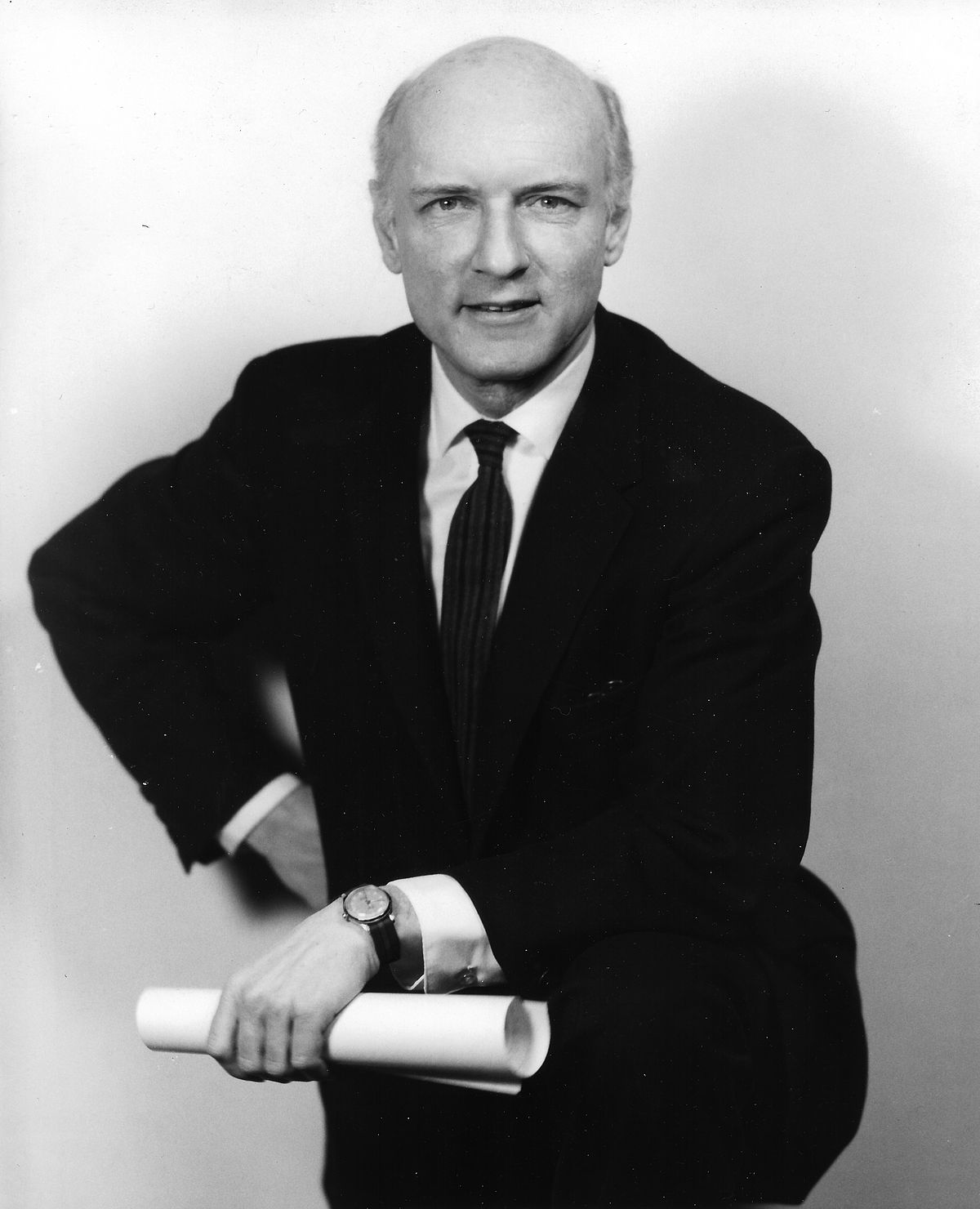
Heinz von Foerster
Austrian-American scientist and mathematicianWikipedia
13
MENTIONS
10
EPISODES
10
PODCASTS
Search complete. 13 mentions across 10 episodes found for "Heinz von Foerster".
Oct 21, 2026

Peter MansbridgeHOST
Well, that was a happy news story, right? The newspaper was actually right, but the prediction was wrong.
Peter MansbridgeHOST
That week, Austrian-American physicist Heinz von Foerster and two colleagues published a paper in Science with the stunningly succinct title Doomsday, Friday, 13th of November, 2026.
Peter MansbridgeHOST
The work was based on a simple observation – the time it took for the human population to double in size kept getting shorter.
Peter MansbridgeHOST
Using population estimates from about 400 BC until 1958, the authors, all from the Department of Electrical Engineering at the University of Illinois, Urbana-Champaign, came up with an equation that best described the trend.

Lucas PawlikGUEST
We're probing the unspeakable to give us a new model of reality.
Lucas PawlikGUEST
We're actually creating apocalypse through creating our questions like Herbert Brun with also a friend of Heinz von Foerster.
Lucas PawlikGUEST
He calls that what we do legitimate questions.
Lucas PawlikGUEST
And legitimate questions are questions where the answer is not known.
Lucas PawlikGUEST
But of course, I already mentioned the great Heinz von Förster, who introduced me into this narrative and the idea that we have a competition of poets going on for recreating our lives, for revealing... what stories we actually believe to be reality and therefore be able to change this fixed notion of reality then it was of course the great Humberto Maturana who told me the essence of civilization in the biology of love and the combination of course not only by love but also in tenderness is the well feeling through the nearness of the other and only if I feel well when you near me then I'm able to cooperate and to invent new forms of cooperation and this is how civilization begins and in the beginning was also a great influence ellen watts of course in in telling me this all relation between science and taoism and zen buddhism and also to my great love ludwig wittgenstein who had such great ideas as he wrote in his notebook.
Lucas PawlikGUEST
What do I call about what others say about the world? I want to talk about the world how I found it.
Lucas PawlikGUEST
he really puts this perspective that you have to find an objective truth and to learn what is already out there into an investigation as his great book the philosophical investigation already puts in into the very words and through the luck that i got to know Heinz von Foerster pretty much at the same time as I was introduced to the philosophy of Wittgenstein I did not follow the normal Wittgenstein course which is Wittgenstein himself wanted to understand like the indescribable reality through language and was always desperate that it did not work.
Lucas PawlikGUEST
While I'm coming from Ellen Watson, the Taoist perspective from early on, that, of course, you cannot put it into words.

Joe ArmstrongHOST
That's right, everybody.
Joe ArmstrongHOST
66 years ago, an Austrian-American physicist named Heinz von Forster, in cahoots with researchers from the University of Illinois, said that human society would come crashing down due to overpopulation.
Joe ArmstrongHOST
Their date? Exactly one month after the published date of this podcast episode on Friday, November the 13th, 2026.
Joe ArmstrongHOST
That's only four days before we reach our two-year podcast anniversary.

Paul MiddlebrooksHOST
Mm
Maxim RaginskyGUEST
... you know, von Foerster and, uh, you know, Varela and people like that.
Paul MiddlebrooksHOST
But to Willems then, the, the, um, the state...
Paul MiddlebrooksHOST
Okay, so let's say you could open up the, the system and see-

Tim DennisHOST
Um, another day, another doomsday prediction, except this time the prediction comes not from conspiracy theorists, but from scientists who publish their work in a respected scientific journal.
Tim DennisHOST
Penned by Austrian American professor Heinz von V- Heinz von Foerster.
Mallie FoxHOST
[laughs]
Tim DennisHOST
I feel like you really have to put it in there.

Viktor WiltHOST
So, take that.
Viktor WiltHOST
Let's see, who can I blame? Heinz von Forster, Patricia Mora, and Lawrence Amiotte.
Viktor WiltHOST
Yeah, I think we're going to be just fine.
Viktor WiltHOST
Yeah, they said we're going to be squeezed to death like there'd be so many people.

Todd BrandtHOST
Some guy in some science magazine.
Todd BrandtHOST
Heinz von Foerster, an Austrian-American professor and a cybernetics expert, and a couple of his students, uh, m- m- made this prediction back in 1960.
Mike TylerHOST
Wow.
NickPANELIST
Hmm.

Alan MacEachernGUEST
It's this American engineering prof actually, not even a demographer, but him and a couple of his students write this article.
Alan MacEachernGUEST
His name's Heinz von Forster.
Alan MacEachernGUEST
And they basically look at 24 calculations of the global population over the last 2000 years, and then kind of project that increase of the population into the future.
Alan MacEachernGUEST
And I mean, the first paragraph of the article is so funny because it basically says on this date, the human population will approach infinity.
6 MINS LATER
Alan MacEachernGUEST
So in that way, they were super serious.
Alan MacEachernGUEST
But also, it's Friday the 13th that they picked as being the day.
Alan MacEachernGUEST
And maybe not coincidentally, it's also the lead author, Heinz von Forster.
Alan MacEachernGUEST
It was also his birthday.

Alan MacEachernGUEST
That's right.
Alan MacEachernGUEST
So this is an, uh, an American, um, engineer named Von Foerster and his, uh, team of graduate students.
Alan MacEachernGUEST
They came up with this equation to explain what the population had been in the past and wh- where it was going.
Alan MacEachernGUEST
And of course, when, you know, they call this article Doomsday, and it, it, it seems kind of comical and satirical.

Tim PoolHOST
It also received careful and sustained scientific attention.
Tim PoolHOST
The authors, Heinz von Foerster, Foerster, an Austrian-American professor and cybernetics expert, and two of his students, Patricia M. Mora and Lawrence M. Emmiot, argued that human populations are exceptional and might grow beyond an exponential rate and an ever-increasing one.
Tim PoolHOST
Our great-great-grandchildren will not starve, they argued.
Tim PoolHOST
They will be squeezed to death." [laughs] Oh my God.