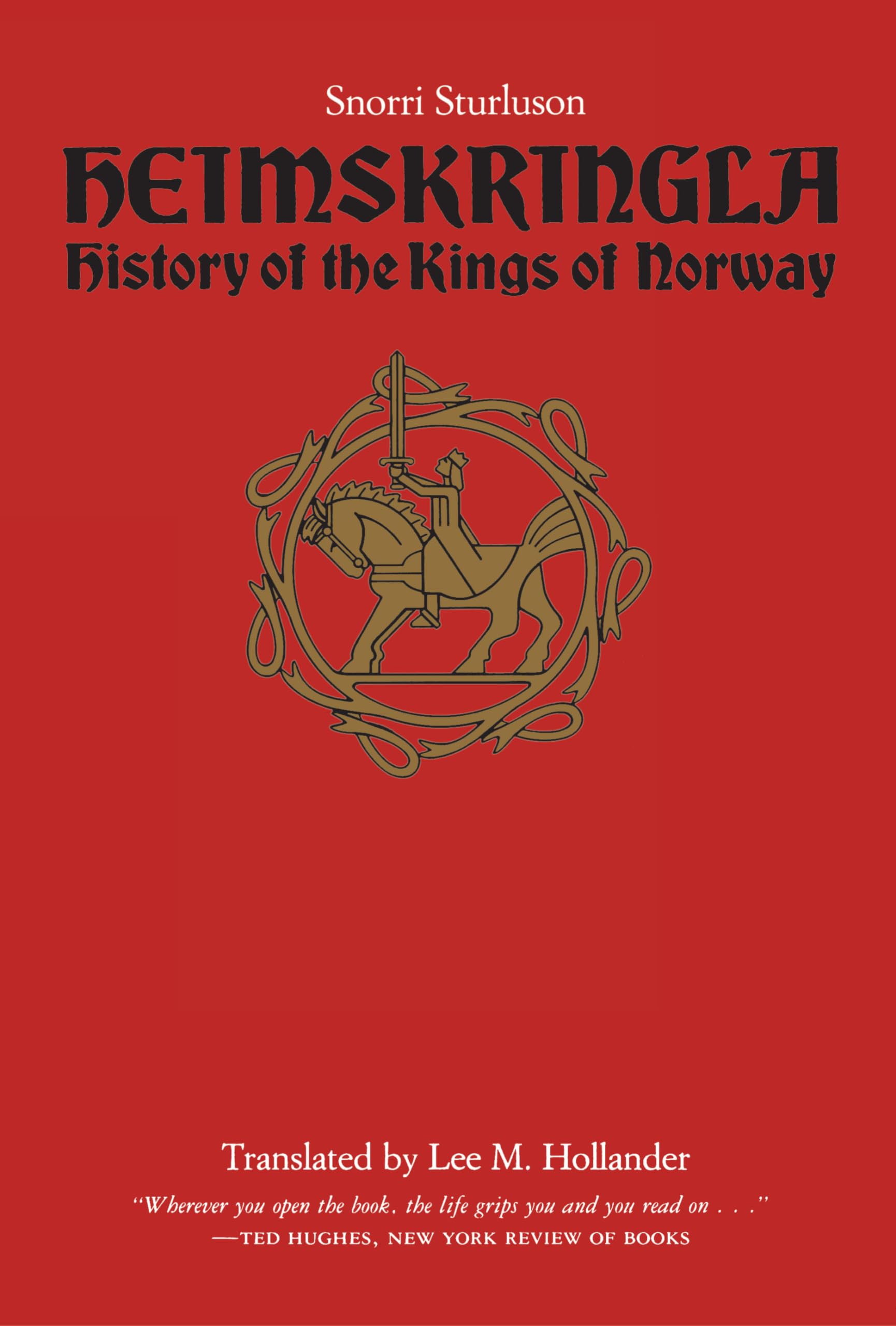
Heimskringla

Heimskringla

Book by Snorri SturlusonWikipedia

Search complete. 34 mentions across 16 episodes found for "Heimskringla".

Oct 8, 2026

ExpatriateNARRATOR
9:56
Yet it is well to remember that in his own lifetime, not his natural prose, but his artificial poetry was famous throughout the North.
ExpatriateNARRATOR
10:05
Snorri's greatest work is undoubtedly the Heimskringla.
ExpatriateNARRATOR
10:09
Beginning with a rationalized account of the founding of Northern civilization by the ancient gods, he proceeds through heroic legend to the historical period, and follows the careers of his heroes on the throne, in eastern courts and camps, or on forays in distant lands, from the earliest times to the reign of Sverrir, who came to the throne in 1184, five years after the author's birth.
ExpatriateNARRATOR
10:35
The materials at Snorri's disposal, says Magnussen, were oral tradition, written genealogical records, old songs or narrative lays, such as Tyldolf's tale of the Inglings, and Eyvind's Haloga tale, poems of court poets, that is, historic songs, which people knew by heart all from the days of Hairfair down to Snorri's own time.
ExpatriateNARRATOR
12:09
The seed of cause sown in the preceding must yield its crop of effect in the succeeding reign.
ExpatriateNARRATOR
12:16
This the writer of Lives of Kings must bear in mind.
ExpatriateNARRATOR
12:19
And so Snorri addresses himself to writing the first pragmatic history ever penned in any Teutonic vernacular, the Heimskringla.
ExpatriateNARRATOR
12:28
The evidence for Snorri's authorship of Heimskringla is not conclusive.
speaker_0NARRATOR
5:04
One of the most important sources for his adult life are the writings of Snorri Sturluson, the greatest Norse poet and chronicler of medieval times, who lived in Iceland in the late 12th and early 13th centuries.
speaker_0NARRATOR
5:25
He composed a work called the Heimskringla, which transliterates as The Circle of the World.
speaker_0NARRATOR
5:35
It was a history of the Norse kings of Norway and Sweden, and Harald features prominently in some sections.
speaker_0NARRATOR
5:44
For his time in Eastern Europe and at Constantinople, the Russian Primary Chronicle, a set of annalistic chronicles of the history of Kievan Rus' and other Norse settlements in Eastern Europe- Is useful, while for his time involved in English politics, both the Anglo-Saxon Chronicle and the Bayeux Tapestry are invaluable.
SeanHOST
2:09
In this podcast, I do love to find the links between myth and history and have done so quite often with the Norse gods, mainly with Odin and his ancestry to many of the kingdoms that still exist in Europe today.
SeanHOST
2:22
However, to find those links, I do need to use the humanized versions of those gods with the text that Snorri Sturluson gives us in Heimskringla and his Prosa Edda, with Snorri as a Christian writing in his Christian worldview.
SeanHOST
2:36
What he did was he minimized the power of gods to be simple mortals that had magical traits that caused other people to follow them, and then per Snorri, incorrectly worshiped them as gods.
SeanHOST
2:47
The Book of Invasions sorta did the same thing with some of the invaders.
James TurnerGUEST
21:11
No, no, it very much is.
James TurnerGUEST
21:12
I think it's worth touching at the Heimskringla, Snorri Sturluson's Icelandic saga, I think has a lot to...
James TurnerGUEST
21:20
Iceland has just been subjugated by 13th century kings of Norway.
James TurnerGUEST
21:24
So I think on the surface it's, like, showing their own side and celebrating their shared legacy.

Unknown podcast

Prose Edda (Brodeur Translation)-Snorri Sturleson

Sep 26 · 4 Mentions

ExpatriateNARRATOR
8:56
Yet it is well to remember that in his own lifetime, not his natural prose, but his artificial poetry was famous throughout the North.
ExpatriateNARRATOR
9:05
Snorri's greatest work is undoubtedly the Heimskringla.
ExpatriateNARRATOR
9:09
Beginning with a rationalized account of the founding of Northern civilization by the ancient gods, he proceeds through heroic legend to the historical period, and follows the careers of his heroes on the throne, in eastern courts and camps, or on forays in distant lands, from the earliest times to the reign of Sverrir, who came to the throne in 1184, five years after the author's birth.
ExpatriateNARRATOR
9:35
The materials at Snorri's disposal, says Magnussen, were oral tradition, written genealogical records, old songs or narrative lays, such as Thiodolf's tale of the Inglings, and Eyvind's Haloga tale, poems of court poets, that is, historic songs, which people knew by heart all from the days of Herfar down to Snorri's own time.
ExpatriateNARRATOR
11:09
The seed of cause sown in the preceding must yield its crop of effect in the succeeding reign.
ExpatriateNARRATOR
11:16
This the writer of lives of kings must bear in mind.
ExpatriateNARRATOR
11:19
And so Snorri addresses himself to writing the first pragmatic history ever penned in any Teutonic vernacular, the Heimskringla.
ExpatriateNARRATOR
11:28
The evidence for Snorri's authorship of Heimskringla is not conclusive.

Unknown podcast

Journey into the Interior of the Earth (Version 2)-Jules Verne

Sep 26 · 1 Mention

speaker_1NARRATOR
14:39
And what is the title of this marvelous work? I asked, with an affected eagerness which he must have been very blind not to see through.
speaker_1NARRATOR
14:48
This work, replied my uncle, firing up with renewed enthusiasm, this work is the Heimskringla of Snorre Turleson, the most famous Icelandic author of the twelfth century.
speaker_1NARRATOR
15:00
It is the chronicle of the Norwegian princes who ruled in Iceland.
speaker_1NARRATOR
15:05
Indeed, I cried, keeping up wonderfully.

Unknown podcast

Prose Edda (Brodeur Translation)-Snorri Sturleson

Sep 26 · 1 Mention

speaker_3UNKNOWN
10:11
Yet it is well to remember that in his own lifetime, not his natural prose, but his artificial poetry was famous throughout the North.
speaker_3UNKNOWN
10:20
Snorri's greatest work is undoubtedly the Heimskringla.
speaker_3UNKNOWN
10:24
Beginning with a rationalized account of the founding of Northern civilization by the ancient gods, he proceeds through heroic legend to the historical period, and follows the careers of his heroes on the throne, in Eastern courts and camps, or on forays in distant lands, from the earliest times to the reign of Sverrir, who came to the throne in 1184, five years after the author's birth.
speaker_3UNKNOWN
10:50
The materials at Snorri's disposal, says Magnuson, were oral tradition, written genealogical records, old songs or narrative lays, such as Tyldos' tale of the Englings, and Eivind's Haloga tale, poems of court poets, that is, historic songs, which people knew by heart all from the days of Hairfair down to Snorri's own time.

Unknown podcast

Prose Edda (Brodeur Translation)-Snorri Sturleson

Sep 25 · 5 Mentions

ExpatriateNARRATOR
3:22
Sturla Sigvatsson, Snorri's nephew, made a pilgrimage to Rome and visited Germany.
ExpatriateNARRATOR
3:28
And Snorri himself shows, in the opening pages of his Heimskringla, or History of the Kings of Norway, the influence of that great romantic cycle, the Matter of Troy.
ExpatriateNARRATOR
3:40
Snorri Sturluson was in the fullest sense a product of his time.
ExpatriateNARRATOR
3:44
The son of a turbulent and ambitious chieftain, Sturla Thordsson, of Fahm in western Iceland, he was born to a heritage of strice and avarice.
ExpatriateNARRATOR
8:28
Poet he was, too, though the codified rules, the cryptic phrase, and conventional expression, which indeed bound together the words of the singers of ancient Scandinavia, must spoil his verse for us.
ExpatriateNARRATOR
8:41
Yet it is well to remember that in his own lifetime, not his natural prose, but his artificial poetry was famous throughout the North.
ExpatriateNARRATOR
8:50
Snorri's greatest work is undoubtedly the Heimskringla.
ExpatriateNARRATOR
8:54
Beginning with a rationalized account of the founding of Northern civilization by the ancient gods, he proceeds through heroic legend to the historical period, and follows the careers of his heroes on the throne, in eastern courts and camps, or on forays in distant lands, from the earliest times to the reign of Sverrir, who came to the throne in 1184, five years after the author's birth.

Unknown podcast

Journey into the Interior of the Earth (Version 2)-Jules Verne

Sep 25 · 1 Mention

speaker_3NARRATOR
14:22
"And what is the title of this marvelous work?" I asked with an affected eagerness, which he must have been very blind not to see through.
speaker_3NARRATOR
14:32
"This work," replied my uncle, firing up with renewed enthusiasm, "this work is the Heimskringla of Snorre Turlesson, the most famous Icelandic author of the twelfth century.
speaker_3NARRATOR
14:45
It is the chronicle of the Norwegian princes who ruled in Iceland." "Indeed," I cried, keeping up wonderfully.
speaker_3NARRATOR
14:52
"Of course, it is a German translation." "What?" sharply replied the professor.

Unknown podcast

Journey into the Interior of the Earth (Version 2)-Jules Verne

Sep 21 · 1 Mention

Ben TuckerNARRATOR
13:07
"And what is the title of this marvelous work?" I asked with an affected eagerness which he must have been very blind not to see through.
Ben TuckerNARRATOR
13:16
"This work," replied my uncle, firing up with renewed enthusiasm, "this work is the Heimskringla of Snorre Turlesson, the most famous Icelandic author of the twelfth century.
Ben TuckerNARRATOR
13:30
It is the chronicle of the Norwegian princes who ruled in Iceland." "Indeed," I cried, keeping up wonderfully.
Ben TuckerNARRATOR
13:37
"Of course it is a German translation." "What?" sharply replied the professor.

6 more episodes mention Heimskringla.

Create an account to see the whole feed, search across every transcript, and follow the entities you care about.

We value your privacy

We use cookies to understand how you use our platform and to improve your experience. Click “Accept All” to consent, or “Decline non-essential” to opt out of non-essential cookies. Read our Privacy Policy.