Hebrew Bible
CanonWikipedia
3.8k
MENTIONS
1.3k
EPISODES
719
PODCASTS
Search complete. 3790 mentions across 1272 episodes found for "Hebrew Bible".
Sep 22, 2026

Yehuda KurtzerHOST
To go one step further, we might even argue that liberalism is founded on religion.
Yehuda KurtzerHOST
This is an insight from Brandeis Professor Yehuda Mirsky, who writes that as hard as early liberal thinkers tried, they couldn't separate their appeals to human freedom and the demand for human dignity from the Hebrew Bible's formative teaching that all people were created in the image of God.
Yehuda KurtzerHOST
Liberalism, rooted in religious ideas, makes religion possible.
Yehuda KurtzerHOST
The clear trouble here, maybe even a paradox, is that liberalism and religion don't know what to do with each other.

Leah FeinbergHOST
Nations cannot endure His fury.
Leah FeinbergHOST
Pasuk yod alef, verse eleven, is unusual among most of the books of Tanakh, for it's written in Aramaic.
Leah FeinbergHOST
It is for this reason that the commentators date this prophecy to the later years of Yirmiyahu, under the reign of Tzidkiyahu, which is before the destruction of Yerushalayim and the Mikdash, but after the Babylonians had already taken a portion of the population, the king Yehoyakhin, the aristocracy, and the skilled craftsmen to Bavel in captivity.
Leah FeinbergHOST
Rashi and Radak, based on the Targum, explain that the pasuk is written in Aramaic because it's the part of the text of a letter sent by Yirmiyahu to the Babylonian captives.
Leah FeinbergHOST
[pasuk yud zayin] Seventeen.
Leah FeinbergHOST
אִסְפִּי מֵאֶרֶץ קִנְאַתֵּךְ יֹשֶׁבֶת בַּמָּצוֹר.
Leah FeinbergHOST
"Gather up your, your qin'ah, you who are sitting under siege." And the word qin'ateich is unique in Tanakh.
Leah FeinbergHOST
There's-- It has no parallel.

Dara HornGUEST
Jews predate the concept of religion.
Dara HornGUEST
You know, when Hebrew was being revived as a spoken language, Hebrew linguists had to root through the Hebrew Bible to find a word to mean religion because Hebrew didn't have one.
Yael Bar turHOST
Yeah.
Yael Bar turHOST
Yeah.
Dara HornGUEST
It was called The Eicha Problem, Eicha being the Book of Lamentations.
Dara HornGUEST
Where I have a critique of this idea, this is like a theological idea in Judaism, which is that anti-Semitism is the Jews' fault.
Dara HornGUEST
This is a deep ideological idea within, it's in the Tanakh, it's in the Hebrew Bible, right? And that's why I talk about the book of Lamentations, right? When the Babylonians destroyed Jerusalem.
Dara HornGUEST
The reason the Babylonians destroyed Jerusalem is because the people have sinned.

Yitzchak EtshalomHOST
Welcome back to our Tanakh Study Center series on Sefer Yimriyel in conjunction with the OU and the Nachiyomi Project.
Yitzchak EtshalomHOST
In today's shiur, we study Yimriyel, Parak Yud, Chapter 10.
Yitzchak EtshalomHOST
Let's begin by reading the first several psukim, and that will give us an idea of what direction Yimriyel is going in in this parak.

Rebecca McLaughlinHOST
We're not talking about a sort of superhuman, Greco-Roman style.
Rebecca McLaughlinHOST
There have been plenty of conceptions of God in history that have been quite physical, but that the God revealed in the Hebrew Scriptures actually doesn't have a body in that same way.
Rebecca McLaughlinHOST
Help us to look back at the Genesis 1 claim that all humans are made in the image of God through the lens of the claim that Paul makes in his letter to the Colossians that Jesus is the image of the invisible God.
Gray SutantoGUEST
That's a great question.
Rebecca McLaughlinHOST
People say he looks just like his father.
Rebecca McLaughlinHOST
We're used to that idea of a child resembling a parent.
Rebecca McLaughlinHOST
But it seems sort of weird if we're only looking at the Hebrew Scriptures because, again, the God revealed in Hebrew Scriptures is sometimes described.
Rebecca McLaughlinHOST
It's not that anthropomorphic kind of body language is never used of the God revealed in the Hebrew Scriptures, because it is, but that it's also pretty clear that this is not just a super human-sized humanoid being that we're talking about, who made the heavens and the earth.

Ephraim SchreibmanHOST
and by the mother, the father.
Ephraim SchreibmanHOST
And we know the 24 places in Tanakh that the corner are called Levi.
Ephraim SchreibmanHOST
After all, they are in the Levi tribe, right? We know, you know, Aaron Akon came from the tribe of Levi, just like his brother Moshe.
Ephraim SchreibmanHOST
So, and actually they're called Levim, we find 24 Zechem, and here's one of them, it always brings down this one, HaKonam HaLevim B'nai Tzadok, he says the Kona Levim B'nai Tzadok, so we know that B'nai Tzadok was a Kohen, Tzadok was a Kohen, and the Kohenim, his sons were Kohenim, Kona Levim B'nai Tzadok, and they're called Levim also, so therefore they're all included.

David Patrick HarryHOST
Next slide.
David Patrick HarryHOST
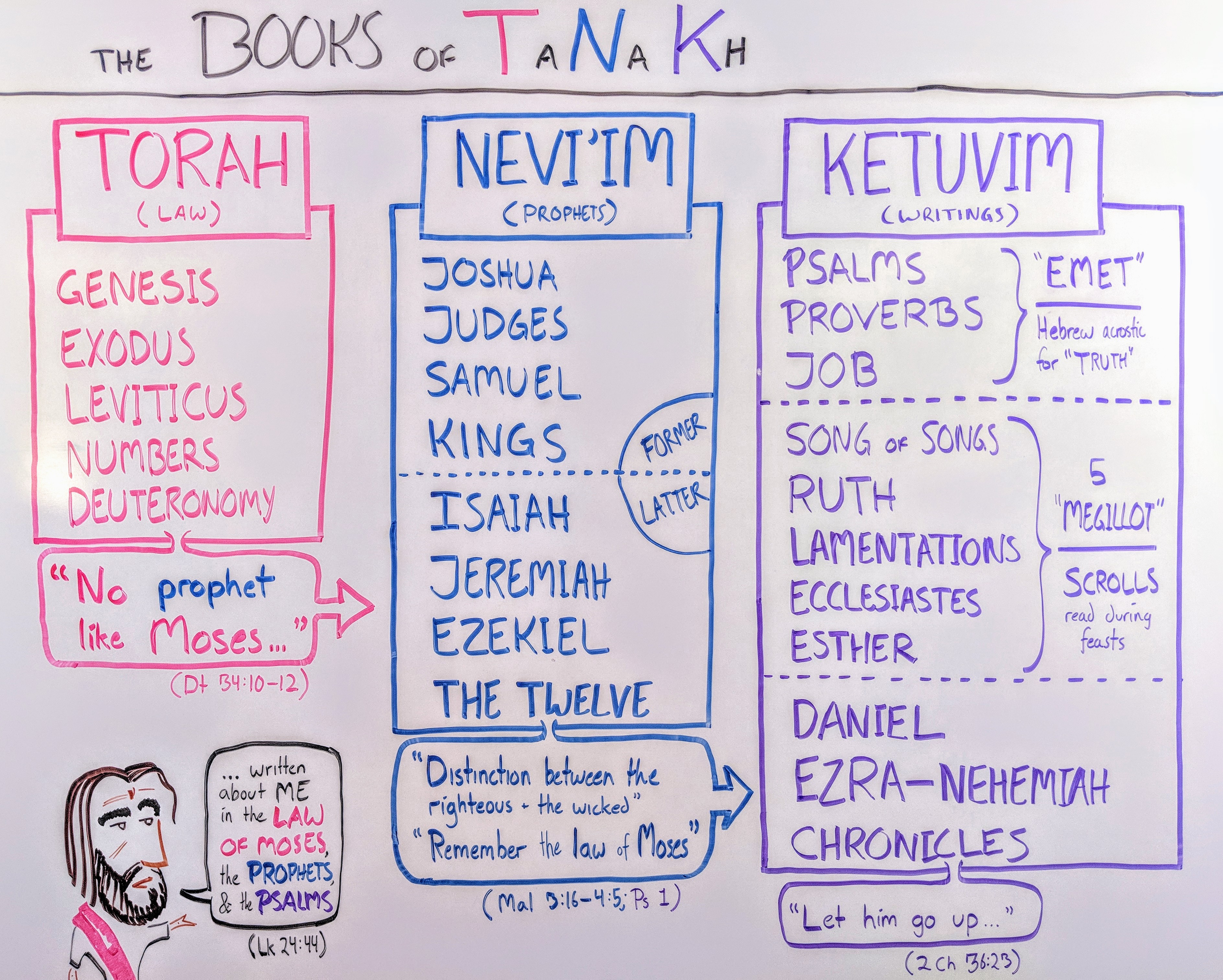
So the Tanakh, what is the Tanakh? Well, just an abbreviation of three words, okay? So the Torah, every single Christian, especially if you guys are doing apologetics or debates, you better know what these words mean.
David Patrick HarryHOST
The Torah, the law, the instruction.
David Patrick HarryHOST
It's the five books, the Pentateuch, right? The Pentateuch, the five books of Moses.

Joseph DumondGUEST
You read the
Ryan NallHOST
whole Tanakh, right? Like, it's not just the Torah.
Ryan NallHOST
Like, from my understanding, my understanding, Simchat Torah, you're just reading the five books of Moses and then starting back over at Genesis 1 after Simchat Torah is over.
Joseph DumondGUEST
Well, it depends.

Jay DyerHOST
But he doesn't tell you that or even explain that.
Jay DyerHOST
Old Testament Hebrew religion, which is proto-Orthodox Christianity, is not the same thing as rabbinic.
Jay DyerHOST
post Talmudic Judaism.
speaker_11SOUNDBITE_SPEAKER
Including our shared patrimony and the scriptural heritage from which both our traditions draw.
1,262 more episodes mention Hebrew Bible.
Create an account to see the whole feed, search across every transcript, and follow the entities you care about.