Heat recovery ventilation
21
MENTIONS
12
EPISODES
12
PODCASTS
Search complete. 21 mentions across 12 episodes found for "Heat recovery ventilation".
Sep 18, 2026

Tim DeStasioGUEST
We have media filtration.
Tim DeStasioGUEST
Humidity control, we have ventilating dehumidifiers, we have ERVs, HRVs.
Tim DeStasioGUEST
That's kind of the list when it comes to those four pillars of indoor air quality.
Tim DeStasioGUEST
Telling people to stop storing paint in their crawl space, take it out to the shed, or find a better place for it.

John TaylorGUEST
And actually, that's really valuable because that can inform the level of tightness techniques that you employ and also the ventilation system as well.
John TaylorGUEST
And you may find on a house, on a retrofit, that actually you've already got really good air tightness and that just the activities that you're going to do, wall insulation, for example, could significantly improve, make the air tightness better to the point where the air tightness is so good that you will need a mechanical, like MVHR, heat recovery ventilation, or kind of some whole house ventilation system.
John TaylorGUEST
So yeah, it's worth getting that understanding up front if you can.
Claire BrownHOST
Yeah, brilliant.

Norman GarciaGUEST
On speaking of that humidity, about the HRV or the energy recovery ventilator.
Norman GarciaGUEST
I- in the Philippines, one of the challenges, ERV has been existing in the Philippines, but only for commercial For residential use, it's com- not being practiced.
James TurnerHOST
Right.
Norman GarciaGUEST
And, yeah, we've been communicating ERV, it will control your humidity, and so on.
Norman GarciaGUEST
So yeah.
Norman GarciaGUEST
So that's what of...

Jason RichardsGUEST
That is one of the best, easiest, freest ways that we can start to kind of take back a little bit of control over our environment, or at least temp- ha- provide temporary relief.
Jason RichardsGUEST
Um, but, um, a- as far as a solution to that, one of the things I recommend to people is an ERV system a lot of times can be really helpful.
Jason RichardsGUEST
Uh, it brings in a little bit of air from the outside, filters it, dehumidifies it, and then blends it with the HVAC air so you have this kinda nice, uh, cycle of fresh air into the system.
Jason RichardsGUEST
I've seen it tamp down and lower CO2 levels for a lot of folks.

Tom KingGUEST
So we can deliver heating, cooling, balanced energy recovery ventilation, heat pump, domestic hot water, And we've also integrated and developed our own cloud-based control and monitoring system over the top of all of that.
Tom KingGUEST
So we take and incorporate and translate the data from each of those individual products, the heat pump, the ERV, hot water, et cetera, and have tied them all into a... control and monitoring system that can be viewed from anywhere that has Wi-Fi or internet access.
Tom KingGUEST
This helps particularly with the long-term performance, monitoring maintenance, and also automated and manual control options for changing from heating to cooling or adjusting temperature settings, maintenance reminders, fault detection.
Tom KingGUEST
All of those is now incorporated into this single package as well.

Daniel WaglerGUEST
That's something that's set up front.
Daniel WaglerGUEST
So back to asking the questions, I use ERV systems in almost all of my builds, but that means they have to have power.
Daniel WaglerGUEST
Okay.
Daniel WaglerGUEST
So is this in a place where you may lose power for a week at a time in a winter storm? Do you need a battery backup? I build with very cool solar systems.

Paul BrarenPANELIST
Industry just ready for complete disruption, Stephen.
Paul BrarenPANELIST
There's nothing turnkey about a whole house HVAC system that handles all new duct work, heating, cooling, dehumidification, ERV, fresh air in the middle of winter when you've got Canadian wildfires in the summer that are brutal now.
Paul BrarenPANELIST
Again, no regrets the last three years.
Paul BrarenPANELIST
It just keeps reminding me again and again how thankful I am I got all this done when I did four years ago.

Amelia LeeHOST
So this is where active ventilation comes into play through mechanical means.
Amelia LeeHOST
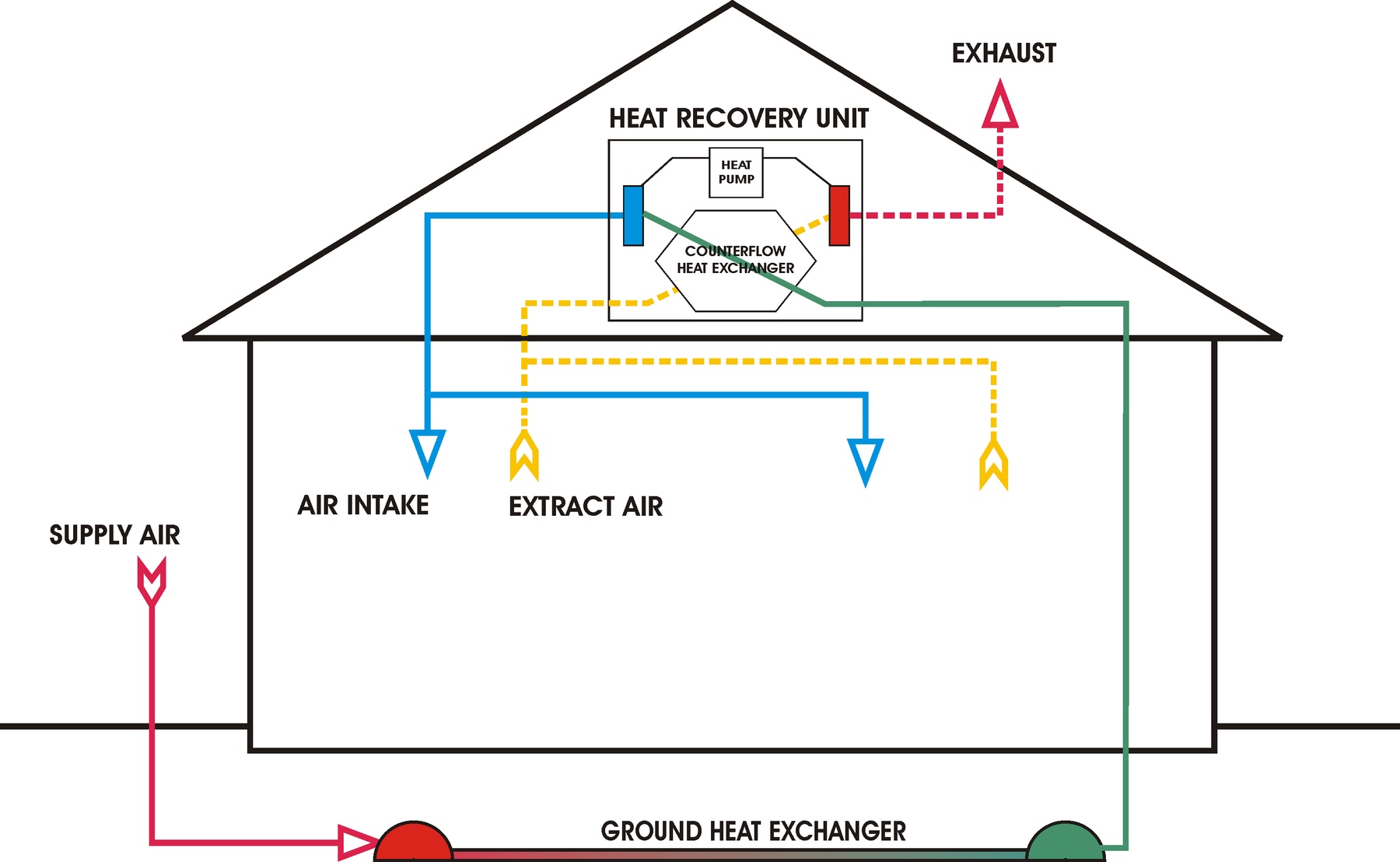
Now when it comes to mechanical ventilation, you'll often hear this acronym MVHR.
Amelia LeeHOST
So what is it and how does it work? Well, MVHR is mechanical ventilation with heat recovery.
Amelia LeeHOST
Sometimes it's also called HRV for heat recovery ventilation.
Amelia LeeHOST
And to quote the fantastic resource renew.org.au, they say mechanical ventilation with heat recovery or MVHR is used to deliver reliable ventilation to maintain excellent indoor air quality in occupied buildings.
Amelia LeeHOST
It supplies fresh filtered air into the building and simultaneously extracts damp, stale or contaminated air without the energy, comfort or noise issues that can arise with open windows.
Amelia LeeHOST
Mechanical ventilation can be thought of as providing continuous fresh air in a controlled manner.
Amelia LeeHOST
That is, you can know exactly how much fresh air you're getting with mechanical ventilation, unlike when relying upon opening windows.

AdamGUEST
So we're basically a plumbing here, renewable company covering all aspects of anything from plumbing, heating in terms of air source heat pumps, gas boilers, oil boilers.
AdamGUEST
And then we do the likes of air conditioning, MVHR and such like.
Cathy MorganCORRESPONDENT
So how does that tally in with the eco?
AdamGUEST
Renewable technology.

Dom FrancksGUEST
You can also use fans to accelerate the air transfer into or out of that window.
Dom FrancksGUEST
If it's really cold or really hot outside, that becomes more difficult, so you can use a system called an energy recovery ventilator or an ERV, and most of those right now are whole home systems that involve renovation, which is not the direction that a lot of people wanna go.
Dom FrancksGUEST
However, there are some interesting new products out there that I've been aware of and have been testing that are the equivalent of a window air conditioner but for energy recovery ventilation that could make it accessible for folks to have better ventilation that's better suited for particularly cold months or particularly hot months without needing to do a full renovation.
Dom FrancksGUEST
But right now, uh, your best bet is if you can open a window, that's the simplest.
Dom FrancksGUEST
If you can use a bathroom fan, that is also fairly effective.
Dom FrancksGUEST
And then the gold standard if you really want a comprehensive ventilation solution for your home is an ERV system.
Chris HutchinsHOST
Do I need to open two windows for airflow reasons, or is it just one window's enough?
Dom FrancksGUEST
Two is preferable, but one is usually sufficient.
2 more episodes mention Heat recovery ventilation.
Create an account to see the whole feed, search across every transcript, and follow the entities you care about.