Haumea
Dwarf planetWikipedia
361
MENTIONS
32
EPISODES
23
PODCASTS
Search complete. 361 mentions across 32 episodes found for "Haumea".
Nov 18, 2026

Lance MartinHOST
Aphelion is near 49.
Lance MartinHOST
The orbit sits near a weak mean motion resonance with Neptune, similar in broad character to the resonance that influences Haumea, though ED-138 is not part of Haumea's collision family.
Lance MartinHOST
What made the object stand out was its intrinsic brightness.
Lance MartinHOST
Absolute magnitude is a measure of how bright an object would appear at a standard distance.
Lance MartinHOST
Additional measurements refine that picture without yet confirming dwarf planet status.
Lance MartinHOST
Near-infrared colors place ED-138 in the intermediate red taxonomic class.
Lance MartinHOST
It is redder than the Haumea family and lacks the strong water-ice absorption signature associated with that family, so it is not a fragment from that collision.
Lance MartinHOST
Z-band photometry limits any aris-like methane frost to roughly a quarter of the surface or less.

speaker_3NARRATOR
Welcome to this journey into one of the strangest worlds in our solar system.
speaker_3NARRATOR
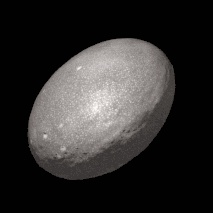
Haumea spins faster than nearly every other large object in space, yet its frantic rotation tears it into a shape that defies the normal rules of gravity.
speaker_3NARRATOR
most worlds settle into spheres comfortable and round pulled inward by their own weight but haumea refuses it stretches and elongates pushed outward by its dizzying spin into a form unlike anything else we have discovered so far what makes this distant world so peculiar is not just what it is but how it came to be the way it is Its shape tells a story written in ice and motion, in ancient collisions and the simple physics of rotation.
speaker_3NARRATOR
To understand Haumea is to witness a fundamental conflict playing out across billions of miles, where the force of gravity meets the unstoppable momentum of a world that spins too fast to stay round.
speaker_3NARRATOR
This world challenges everything we thought we knew about how distant objects should behave when they settle into the darkness of space.
speaker_3NARRATOR
When we look to the heavens and examine distant worlds, we expect to find order and stability.
speaker_3NARRATOR
objects that have reached equilibrium and remain unchanged across the eons.
speaker_3NARRATOR
Haumea defies this expectation, embodying a cosmic anomaly that forces us to reconsider our understanding of planetary physics and the forces that shape worlds across the universe.

Matt HolmanGUEST
And this one is close to the 12 to 7, and it's not alone.
Matt HolmanGUEST
Haumea is a dwarf planet that's in that resonance too, which I don't think they are related in the sense of like, I don't think they are... chips off the same larger block.
Matt HolmanGUEST
But it is curious that they're both there.
Matt HolmanGUEST
So to turn this from a candidate dwarf planet to a dwarf planet, we need to figure out just how big it is and to see if it's large enough to be spherical under its own gravity.

Heather EnsworthHOST
and transmutation.
Heather EnsworthHOST
As we know from that ongoing square between Pluto and Haumea, it's a time of releasing the patterns from the past to be in a time of regeneration, rebirth into new ways of being.
Heather EnsworthHOST
This is the metamorphosis of the caterpillar going through the chrysalis to become the butterfly But the liminal time is the turbulent time, the time in the chrysalis, the time of being in the mystery, in the not knowing.
Heather EnsworthHOST
And Sedna can guide us in how to navigate this rite of passage.
Heather EnsworthHOST
And part of what's significant about this planet, as we've been able to begin to identify it, it's large in size it's somewhere between 370 and 930 miles in diameter and it's very bright so it's carrying an illumination that's significant for a trans-neptunian object or planet that far out in our solar system Its orbit is approximately 283 years.
Heather EnsworthHOST
And what's interesting is it's got a lot of similarities in its orbit with Haumea, which I think is significant.
Heather EnsworthHOST
So part of its meaning may be associated with that energy and meaning of Haumea.
Heather EnsworthHOST
This ED-138 has an orbit of 283 years, as I just said.
Heather EnsworthHOST
Haumea has an orbit of 284 years.
Heather EnsworthHOST
They both have an orbit that's in a resonance with that of Neptune with the... with a ratio of seven to 12.
Heather EnsworthHOST
So in other words, seven orbits of these trans-Neptunian objects, ED-138 and Haumea, is equivalent to 12 cycles of orbit of Neptune.
Heather EnsworthHOST
So it's interesting, there's a resonance with Neptune and a very strong connection with Haumea, both also have a similar tilt off the ecliptic plane in terms of their inclination.

Val LaheyGUEST
The astrology is telling me that the nukes thing is, unfortunately, what I'll say is that the danger is extremely high.
Val LaheyGUEST
And while I'll explain it to you very quickly, is that Haumea, which is a new planet, I mean, it doesn't mean that it wasn't there, but it was discovered in 2004.
Val LaheyGUEST
Okay, and then it... was conjunct with Pluto and the Sun when the atom bombs were dropped at the end of World War II.
Val LaheyGUEST
Okay, so that means that the Sun and Pluto and Haumea all were lined up in the same place, basically, when the bombs were dropped.
Val LaheyGUEST
if you take the two bombs, Hiroshima and Nagasaki together, and you average them, which is you make a composite, which you can do with two different charts.
Val LaheyGUEST
And then you average the two things together.
Val LaheyGUEST
So Pluto is all about, uh, quantum physics is a thing that came to us when, when Pluto was discovered around that time was when, when quantum physics became the dominant, uh, You know, the standard model of physics, which is a quantum physics based thing, became the model of reality when Pluto was discovered.
Val LaheyGUEST
So that whole thing of human beings learning how to split the atom and get the energy out of it was a Pluto thing.

Audrey MartinPANELIST
Come on.
Audrey MartinPANELIST
So it now joins its brethren, Pluto, Eris, Haumea, Makemake, and Ceres, which is not out in the Kuiper Belt, but still a dwarf planet, and is further away.
Audrey MartinPANELIST
Actually, I don't know how far away it is.
Audrey MartinPANELIST
I don't think that it says anything.

Lisa Marie HaleyHOST
And in this chart, we have four celestial bodies in Scorpio.
Lisa Marie HaleyHOST
We have the sun and the moon, but we also have Mercury and Haumea.
Lisa Marie HaleyHOST
And so I think the emphasis on the depths, regeneration, are especially pronounced in But I also want to say, as we're talking about transformation and planting these seeds, I don't necessarily at all think that Scorpio is asking us to destroy what exists.
Lisa Marie HaleyHOST
I think instead it might be asking us to understand reality.
7 MINS LATER
Lisa Marie HaleyHOST
And then those two planets are actually quincunxing the planet at the apex.
Lisa Marie HaleyHOST
And the apex is especially important because it becomes the focal point through which the configuration is really seeking expression and expansion.
Lisa Marie HaleyHOST
And here that focal point is Mercury, which is still retrograde conjunct Haumea in the sign of Scorpio.
Lisa Marie HaleyHOST
So we're still in the Scorpionic beneath the surface transformational regenerative investigative energy, excuse me.

Benjamin BosterHOST
The
Benjamin BosterHOST
dwarf planets Haumea and Quawar also have rings.
Benjamin BosterHOST
The idea of planets has evolved over the history
Benjamin BosterHOST
of astronomy, from the divine lights of antiquity to the earthly objects of the scientific age.

Allison AlethaHOST
And Eris.
Allison AlethaHOST
Makemake and Hamea.
Allison AlethaHOST
There's also unconfirmed candidates that are waiting to get like officialized, like Sedna, Orcus, Kiar, and Gongong.
Allison AlethaHOST
Sorry if I messed up any of those names.
22 more episodes mention Haumea.
Create an account to see the whole feed, search across every transcript, and follow the entities you care about.