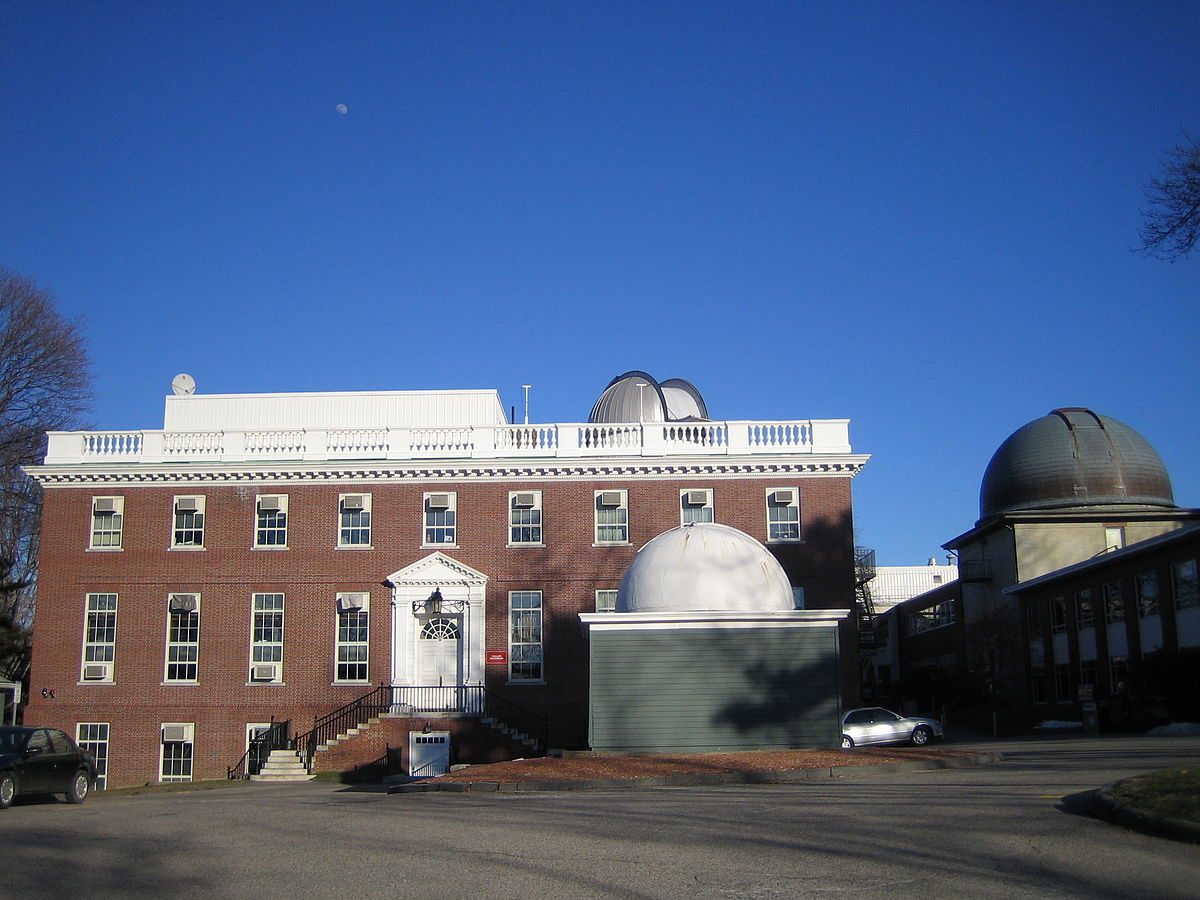
Harvard–Smithsonian Center for Astrophysics
Observatory in Cambridge, MassachusettsWikipedia
29
MENTIONS
26
EPISODES
16
PODCASTS
Search complete. 29 mentions across 26 episodes found for "Harvard–Smithsonian Center for Astrophysics".
Sep 30, 2026

Michael BeckwithHOST
I don't like it when people don't activate their potential, and so we're always speaking about that at some level.
Michael BeckwithHOST
Her lifelong interest in consciousness and the mechanics of the universe led her to develop meditation methodologies and collaborate on research with scientists affiliated with institutions including Harvard Medical School, the Harvard Smithsonian Center for Astrophysics, the Institute of Noetic Sciences, and Stanford University.
Michael BeckwithHOST
So she's one of the people taking woo woo to wow, the world of wonder.
Michael BeckwithHOST
In 2010, she founded the Omnium Media, creating films that bring scientific investigation to subjects often considered outside conventional inquiry.

Daniel WhitesonHOST
And so people started doing this seriously in the '70s.
Daniel WhitesonHOST
Uh, the Center for Astrophysics at Harvard and the Smithsonian started to do this with the Tillinghast Telescope, and they were surprised.
Daniel WhitesonHOST
They surveyed, like, 2,200 galaxies, and they saw that things were not smooth, right? It didn't look like galaxies were distributed randomly across the universe.
Daniel WhitesonHOST
They were clustered together into these bubbles.

speaker_2HOST
When you factor in the sheer volume of chaotic noise radiating throughout the universe, tuning into one specific rhythmic frequency from that far away, it requires, uh, just an astronomical feat of engineering.
speaker_5HOST
Which brings us to September 2026 and this massive breakthrough led by Kevin Ortiz Ceballos at the Center for Astrophysics, you know, the collaboration between Harvard and the Smithsonian.
speaker_2HOST
You're right, a really historic moment.
speaker_5HOST
Because for the very first time, astronomers detected radio signals coming directly from an exoplanet.

speaker_0NARRATOR
Scientists have detected radio signals directly from an exoplanet for the first time in history.
speaker_0NARRATOR
The International Research Team at the Center for Astrophysics, led by Kevin Ortas, was able to identify recurring radio bursts coming from a massive gas giant located approximately 63 light years away from Earth.
speaker_0NARRATOR
Scientists have confirmed that this is a natural phenomenon.
speaker_0NARRATOR
The planet is emitting a rapid pulse due to its intense magnetic field.

SouhaHOST
Scientists have detected radio signals directly from an exoplanet for the first time in history.
SouhaHOST
The International Research Team at the Center for Astrophysics, led by Kevin Ortas, was able to identify recurring radio bursts coming from a massive gas giant located approximately 63 light years away from Earth.
SouhaHOST
Scientists have confirmed that this is a natural phenomenon.
SouhaHOST
The planet is emitting a rapid pulse due to its intense magnetic field.

speaker_2NARRATOR
Scientists have detected radio signals directly from an exoplanet for the first time in history.
speaker_2NARRATOR
The international research team at the Centry-- at the Center for Astrophysics, led by Kevin Ortas, was able to identify recurring radio bursts coming from a massive gas giant located approximately sixty-three light years away from Earth.
speaker_2NARRATOR
Scientists have confirmed that this is a natural phenomena.
speaker_2NARRATOR
The planet is emitting a rapid pulse due to its intense magnetic field.

Suzanne RossGUEST
And what I would say is this, I'd say, Things come in in a variety of different forms, and I'm happy to share what some of those things are because there's such a wide variety that whatever I'm tapped into, whoever I am, there's a, you know, like all of us, we all have a purpose that we're here, right? I've been able to remote view places in the cosmos.
Suzanne RossGUEST
I've worked with a team of scientists at Harvard, the Harvard Smithsonian Observatory, and was able to basically remote view how A universe can condense and form into a new universe.
Suzanne RossGUEST
That was information that I was given between 10 and 20 years ago.
Suzanne RossGUEST
So I finally was working with a team of scientists and doing that.

Chris PlanteHOST
Oops, our, uh, Chinese-made satellite seems to have malfunctioned.
Chris PlanteHOST
On September fourth, uh, the US Space Force cataloged forty-three debris objects from the breakup of Yaogan-50, uh, according to Jonathan McDowell, former astrophysicist at the Harvard Smithsonian Center for Astrophysics, who tracks space activity.
Chris PlanteHOST
And now the pesky debris, uh, satellite fragments are currently at an altitude, uh, ranging between three hundred and seventy-two miles and six hundred and eighty-three miles.
Chris PlanteHOST
Look what the patriarchy has done.

Georgia TolleyHOST
So how worried should we be here on Earth? Well, here is space analyst Jonathan McDowell.
Georgia TolleyHOST
He's a former astrophysicist at the Harvard-Smithsonian Center for Astrophysics.
Georgia TolleyHOST
I spoke to him a little earlier.
Jonathan McDowellSOUNDBITE_SPEAKER
It is a huge step and a huge escalation of the militarization of space, in my opinion.
8 MINS LATER
Georgia TolleyHOST
My goodness me.
Georgia TolleyHOST
Food for thought there.
Georgia TolleyHOST
Space analyst Jonathan McDowell, former astrophysicist at the Harvard-Smithsonian Center for Astrophysics.
Georgia TolleyHOST
I've got a question for you.

Dennis StoneGUEST
You know, we just didn't have the big funds to do it all at once, so it took about four years.
Dennis StoneGUEST
And in 1977, they sent that data to the Harvard-Smithsonian Center for Astrophysics in Cambridge, Mass.
Dennis StoneGUEST
And the result was they said, well, if your stones were used for astronomical purposes, they would work about 1800 BC plus or minus, about two centuries.
Dennis StoneGUEST
And that kind of agrees with the oldest carbon dating on the main site of 4,000 years old.
16 more episodes mention Harvard–Smithsonian Center for Astrophysics.
Create an account to see the whole feed, search across every transcript, and follow the entities you care about.