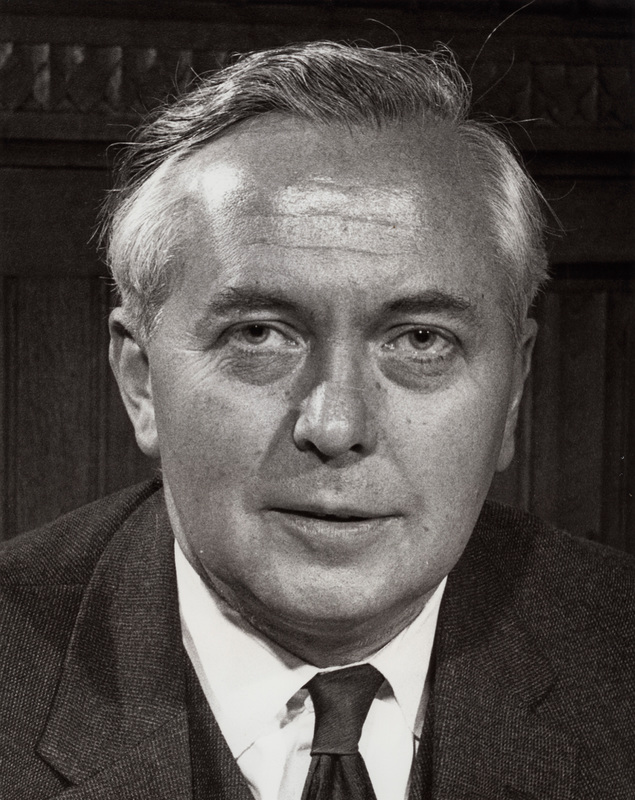
Harold Wilson
Former Prime Minister of the United KingdomWikipedia
179
MENTIONS
105
EPISODES
88
PODCASTS
Search complete. 179 mentions across 105 episodes found for "Harold Wilson".
Oct 27, 2026

Steve RichardsHOST
It's rarely neat.
Steve RichardsHOST
The only neat one, but also arguably, because this goes back to Jenkins, Crossland and Healy, was when Harold Wilson resigned as prime minister voluntarily.
Steve RichardsHOST
In the spring of 1976, his chosen successor, the most experienced, Jim Callaghan, took over after a relatively harmonious leadership contest.
Steve RichardsHOST
But even that, you could argue, was messy because that was the one where all three of those giants, Healy, Jenkins and Crosland, stood.

Bobby CapucciHOST
And the politicians that we elect and the people that have ruled over us for a very long time have straight up been evil, I'm sorry to say.
Bobby CapucciHOST
The Prime Minister, Margaret Thatcher, offered a somewhat solipistic contribution of her own.
Bobby CapucciHOST
Robert Maxwell has never made any secret of the fact that officially he is politically opposed to me.
Bobby CapucciHOST
But to tell the truth, I think he rather liked my approach to politics and government, a sense of direction and decision.
Bobby CapucciHOST
That shit is over.
Bobby CapucciHOST
We are fully engaged now, and you so-called elites, you have our full, unadulterated attention.
Bobby CapucciHOST
At one of their earlier parties in 1986, the speech had been given by a former prime minister, Harold Wilson.
Bobby CapucciHOST
Suffering from the early stages of Alzheimer's, Wilson had begun this speech brightly enough, but then clearly forgot who he was supposed to be talking about.

Robert BucklandHOST
She'd gone as prime minister.
Alun EvansHOST
And when we're talking about historical by-elections, it's worth remembering quite a good story from 1964, when Harold Wilson won the general election and appointed as his foreign secretary a man called Patrick Gordon Walker, who had actually lost the general election.
Alun EvansHOST
But Wilson appointed him nevertheless.
Alun EvansHOST
And they did what parties do.
Robert BucklandHOST
Hull North in 1966.
Robert BucklandHOST
It's about early 66, Labour defending a very small majority.
Robert BucklandHOST
What does Harold Wilson do? In order to win the election, what does he do? He builds the Humber Bridge, or he
Alun EvansHOST
commits to building the Humber Bridge.

Tom HollandHOST
And so in a sense, Dominic, would you not say, in British terms, perhaps, he's like a kind of Yorkshire grammar school boy made good.
Tom HollandHOST
Is he Harold Wilson? A slight hint of Harold Wilson, perhaps.
Tom HollandHOST
don't you think wow i like that yeah so he's he's a man of the people isn't he he's from from northern egypt and he's very internationalizing things so i think that you know there are kind of echoes there and this is a seismic speech it was carried live not just across egypt but across north africa and the whole of the middle east by the cairo radio station the voice of the arabs And to say that it has massive political consequences, well, that would be
Dominic SandbrookHOST
an understatement, wouldn't it? It would be an understatement.

Ben Riley-SmithGUEST
Indeed, he noted that number 10...
Ben Riley-SmithGUEST
I had told him he was the first prime minister to go to Aberfan since Harold Wilson in the wake of the disaster.
Ben Riley-SmithGUEST
He was clearly very moved by that.
Ben Riley-SmithGUEST
He was shown around by a survivor.

David TuckerHOST
You can almost hear John Lennon laughing.
David TuckerHOST
But the Prime Minister, Harold Wilson, saw things differently.
David TuckerHOST
The Beatles were one of Britain's greatest exports.
David TuckerHOST
They were conquering America, bringing millions into the country.

Graham SmithHOST
How cynical of the National Kobol.
Graham SmithHOST
How cynical of the government of the day, which was Harold Wilson's government, by the way.
Vince TracyHOST
Well, again, you know, when you read about the Fabians, I had no idea at the time that Harold Wilson was a Fabian.
Vince TracyHOST
You know, obviously, like most people of our age growing up, you quite like the banter between Wilson and Edward Heath.
Vince TracyHOST
But, you know, going back to this particular event...
Graham SmithHOST
A simple answer there, that was the National Cobalt once again, who should have brought in the rules and regulations capping off the height of the slurry, rather than dipping into the fund after 141 people had died to have it removed.
Graham SmithHOST
But this is the cynicism of national bodies in that day.
Graham SmithHOST
And whether Harold Wilson was a Fabian or whatever, he knew full well what was going on, I'm sure.

Andy RobinsonHOST
What's happening in the world, or in the UK at least in 1974, is Edward Heath, the Prime Minister, has just called a general election.
Andy RobinsonHOST
Harold Wilson is about to become the Prime Minister because that general election was a real mess.
Andy RobinsonHOST
And the BBC have just showed bagpuss for the first time.
James CookHOST
Hey, remember bagpuss? I

BeauHOST
It's funny that the European question has divided the Tory party going all the way back to sort of Ted Heath.
BeauHOST
Well, you could argue, you could argue it was sort of a problem for Harold Wilson, but certainly Ted Heath, certainly Thatcher, and then into sort of the, and John Major massively.
BeauHOST
And it was a downfall of Cameron in the end, wasn't it? Just a massive, massive headache for the Tory party for decades, ripping their party apart in the end, ultimately, kind of, well, not kind of, did.
BeauHOST
And now it's bled out into the Labour Party as well.

Rupert DegasGUEST
Well, yeah, I mean, funnily enough, so when I was growing up in London, my first exposure to political satire was an impressionist called Mike Yarwood back in the late 70s.
Rupert DegasGUEST
And he used to do a Christmas special every year and he did Harold Wilson and Dennis Healy and he had...
Rupert DegasGUEST
June Brown on as Margaret Thatcher, who played her in For Your Eyes Only, the Bond film in 81.
Rupert DegasGUEST
So I was looking at, I was doing impressions.
95 more episodes mention Harold Wilson.
Create an account to see the whole feed, search across every transcript, and follow the entities you care about.