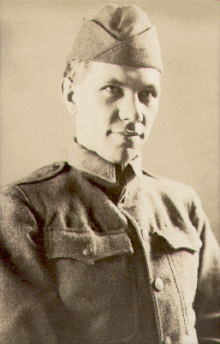
Harold Ross
American journalistWikipedia
7
MENTIONS
4
EPISODES
3
PODCASTS
Search complete. 7 mentions across 4 episodes found for "Harold Ross".
Oct 5, 2026

Sharon McMahonHOST
Making an arrest was a good way to calm the city down.
Sharon McMahonHOST
But why Leo? Remember what journalist Harold Ross had written in the Atlanta Journal? The murder of Mary Fagan must be paid for with blood.
Sharon McMahonHOST
And a Negro's blood would not suffice.
Sharon McMahonHOST
Atlanta newspapers had already framed Mary's murder as Southern womanhood defiled by Northern industrialization.
Sharon McMahonHOST
They did not investigate the notes.
Sharon McMahonHOST
The notes were so unimportant to police, in fact, that Harold Ross, a writer for the Atlanta Journal who was upset about being scooped by a rival journalist that was with the police when they saw Mary's body, took the murder notes from the police station for a story he was working on.
Sharon McMahonHOST
Yes, a journalist just walked off with the notes from the scene of a brutal murder.
Sharon McMahonHOST
And truly, like I said, detectives seemed unconcerned about these notes, maybe because they felt they had already solved Mary's murder.
Sharon McMahonHOST
And he was the night watchman, after all, one of the only people with access to the building after hours.
Sharon McMahonHOST
Police arrested Newtley.
Sharon McMahonHOST
Harold Ross, who would go on to found New Yorker magazine, later wrote, The murder of Mary Fagan was the most brutal crime in the annals of the South.
Sharon McMahonHOST
After the unfolding of the details, the police did what they always do in Georgia.

Donna DingwallCORRESPONDENT
She was also famous as Dorothy Parker by then.
Donna DingwallCORRESPONDENT
In 1925, when Round Tablers Harold Ross and his wife Jane Grant launched a magazine they'd been talking about, Parker was a name they wanted on the masthead.
Donna DingwallCORRESPONDENT
[gentle music] During its first two decades, The New Yorker became the successful humor and literary magazine that its founding editor, Harold Ross, had dreamed of.
Donna DingwallCORRESPONDENT
From its dingy offices on 43rd Street, he published essays that were fizzy and wry, cartoons that were risque and winking.
Donna DingwallCORRESPONDENT
She joined as a founding editor and took over the column Constant Reader, applying the same bite to book reviews as she had to theater.

DianeHOST
James got married and moved to New York, and in 1926, he began his career as a freelance writer.
DianeHOST
There he became friends with E.B. White, who was the author of Stuart Little and Charlotte's Web, and it would be E.B. White who would introduce him to the editor of The New Yorker, Harold Ross.
DianeHOST
Ross hired Thurber.
DianeHOST
Did you read any of the Stuart Little? Of course! I actually never read any of the Stuart Little, but I did read Charlotte's Web.