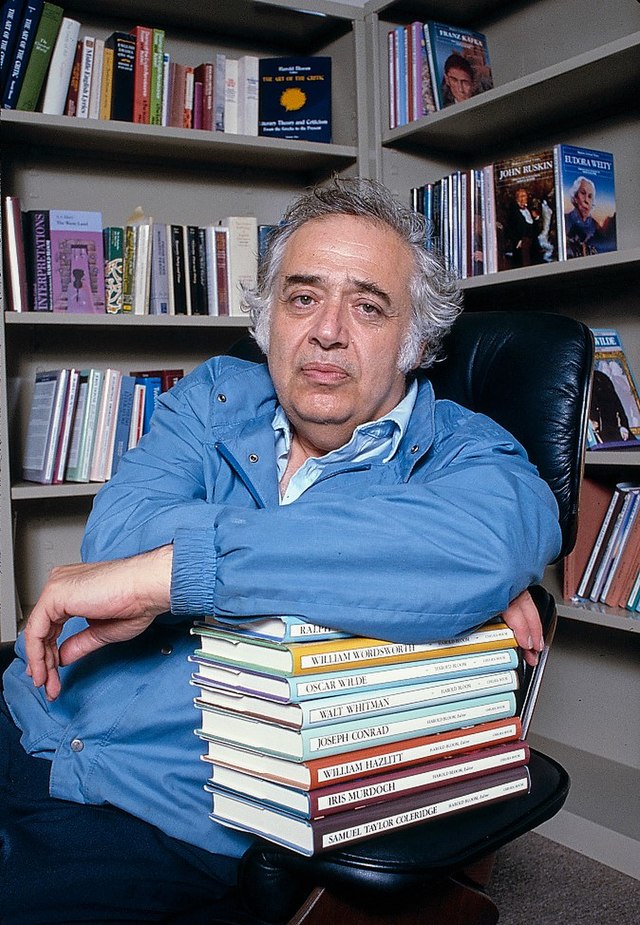
Harold Bloom
American literary criticWikipedia
34
MENTIONS
20
EPISODES
18
PODCASTS
Search complete. 34 mentions across 20 episodes found for "Harold Bloom".
Sep 11, 2026

Taylor CaronGUEST
But it's debated.
Taylor CaronGUEST
So one of the reasons why I wanted to know about Gnosticism is because you guys spoke about Harold Bloom with one of your other guests, Sam, on this channel.
Taylor CaronGUEST
I read about Harold.
Taylor CaronGUEST
I learned how to read American literature with Harold Bloom.
Taylor CaronGUEST
Like I would read his books as I read whatever I was reading.
Taylor CaronGUEST
He's kind of my guide in my teenage years.

Wagner MouraGUEST
For me, it's fascinating because it's...
Wagner MouraGUEST
So, of course, it's a very simple structure, but there is this character... that I have to agree with Harold Bloom is it's more intelligent, more alive than many of us, maybe more intelligent, more alive than most of us.
Wagner MouraGUEST
Did you say
Neil PasrichaHOST
Harold
Wagner MouraGUEST
Bloom? Yeah.
Wagner MouraGUEST
Who's that? Harold Bloom is the guy who is probably the biggest authority on Shakespeare.
Wagner MouraGUEST
He's an American professor who wrote a lot of books.
Wagner MouraGUEST
He has a theory that says that Shakespeare...

Charlotte IversGUEST
Who's your big canon man? His name's completely escaped.
Charlotte IversGUEST
Harold Bloom.
Charlotte IversGUEST
Harold Bloom, et cetera, have basically filtered everything down so I can swan in as a Johnny-come-lately and just go, okay, cool, I'll read the good stuff then.
Charlotte IversGUEST
I've started doing this thing recently where if I go to a country on holiday, I will just read the best book by the best author there.
Charlotte IversGUEST
And I've had an astonishing success rate on that because an entire nation of people have done all the filtering for me.

Marlon JamesGUEST
Yeah, and I enjoyed that.
Marlon JamesGUEST
But one of the reasons why I enjoyed it is I kind of wanted to take the pistol to Harold Bloom.
Marlon JamesGUEST
Yep.
Marlon JamesGUEST
Hey,
Miwa MesserHOST
listen, you got to do the thing
Marlon JamesGUEST
sometimes.
Marlon JamesGUEST
Because one of the things that Harold Bloom, in his very Bloomy way, said was, you know, it took him three reads, and then he realized the violence wasn't gratuitous.
Marlon JamesGUEST
And I was like, homie, you were right on your first read.

Gil RothHOST
I'll tell you, the last show I did was – well, the guest was Heather Cass White.
Gil RothHOST
She edited Harold Bloom's Literary Letters.
Gil RothHOST
It just came out a couple of months ago,
Jonathan AmesGUEST
and
Gil RothHOST
it's that same vibe.
Gil RothHOST
You're reading letters from the 60s and 70s, and yeah, it's Harold Bloom, so there's a whole – extra dimension to it at all but but it was just that sense of oh this is what it was like to keep someone up with what was going on in your life and ask them questions on a typed page or or you know handwritten piece and it was
Jonathan AmesGUEST
just and invariably you always wrote that and i remember reading this like And I saw this in Rilke's letters to a young poet or something, like every one of his letters began, sorry for the delay.
Gil RothHOST
Apologies for...

KozlowskiHOST
And again, there are Blake scholars who will fight tooth and nail for this guy, and they're not just like, you know, Johnny-come-latelys or weirdos or crackpots.
KozlowskiHOST
Several of the greatest scholars in the history of literary criticism, folks like Harold Bloom and Northrop Frye, have made really, really potent arguments.
KozlowskiHOST
Like, they will absolutely die on this hill for William Blake.
KozlowskiHOST
Northrop Frye, even on the back of our textbook, is quoted as saying that, like, he is one of the most, uh, well, it's not in the back of the textbook.

speaker_0HOST
Disappointingly, no literary critic has even really followed him along the path.
speaker_0HOST
His major acolyte, Harold Bloom, basically swerved left, as we shall see.
speaker_0HOST
3.
speaker_0HOST
Harold Bloom's Poetics of Influence or Map of Misreading.
speaker_0HOST
Bloom is the main defender of the Western literary canon in our time, and if he hadn't fallen victim to the culture wars, we'd see his explorations of it in as weird a light as it deserves to be seen.
speaker_0HOST
Early in his career, he was lumped in with the deconstructionists, while in his latter days he was often as not confused with the neoconservative Alan Bloom.
5 MINS LATER
speaker_0HOST
The labyrinth satisfies for complexity and perplexity, but a labyrinth is primarily meant to be escaped.
speaker_0HOST
Even those unicursal versions you find in cathedrals or gardens, which are not prisons but are meant for meditation, one way into the center, one way out to the periphery.

BenHOST
this? I think we can just talk about our favorite bits before we talk about Scandal in the Schoolroom.
BenHOST
I want to note that Plan Mentee gets a lot of Bloomian critiques, like is in Harold Bloom of the late 80s, early 90s academia.
BenHOST
And that's to the extent that Plan Mentee is like, there's no scientific rigor.
BenHOST
People are writing dissertations about random stuff.
BenHOST
Where's the logic? Where's the science? Where's the precision? And I think it's interesting that Das is able to voice this in Plan Mentee, even if he doesn't agree with it entirely.
BenHOST
But Plan Mentee gets the kind of like classical, I don't know, Harold Bloom.
BenHOST
These are all school of resentment people.
BenHOST
But I think it's interesting that it appears in this section, whereas Herschel is more willing to listen to people and to talk about their ideas in a way that's more like empathetic as opposed to like we have standards for academic work, which is what Plan Mentee says.

Jay RuudHOST
It came in as number 64.
Jay RuudHOST
It's highlighted in Harold Bloom's book, The Western Canon.
Jay RuudHOST
And it was on the Union of Russian Writers.
Jay RuudHOST
I love this list.

James Taylor ForemanGUEST
Okay, cool, yeah.
James Taylor ForemanGUEST
My mind was really blown by Harold Bloom's American Religion book.
James Taylor ForemanGUEST
And since I've read that, I'm very convinced that techno-utopianism, New Age thinking, Scientology, all of these branches of seemingly unrelated American religions are really... manifestations of same sort of Gnostic idea of who, of, of who are from whom they it's Joseph Smith is really the most clear avatar.
James Taylor ForemanGUEST
So this is sort of,
Paul AnleitnerHOST
yeah,
James Taylor ForemanGUEST
yeah, yeah.
James Taylor ForemanGUEST
He's Harold Bloom, actually Harold Bloom, who's just self-described as a Jewish Gnostic.
James Taylor ForemanGUEST
So he's not coming at this from, you know, a re-enchantment perspective, but it's still just completely fascinating.
10 more episodes mention Harold Bloom.
Create an account to see the whole feed, search across every transcript, and follow the entities you care about.