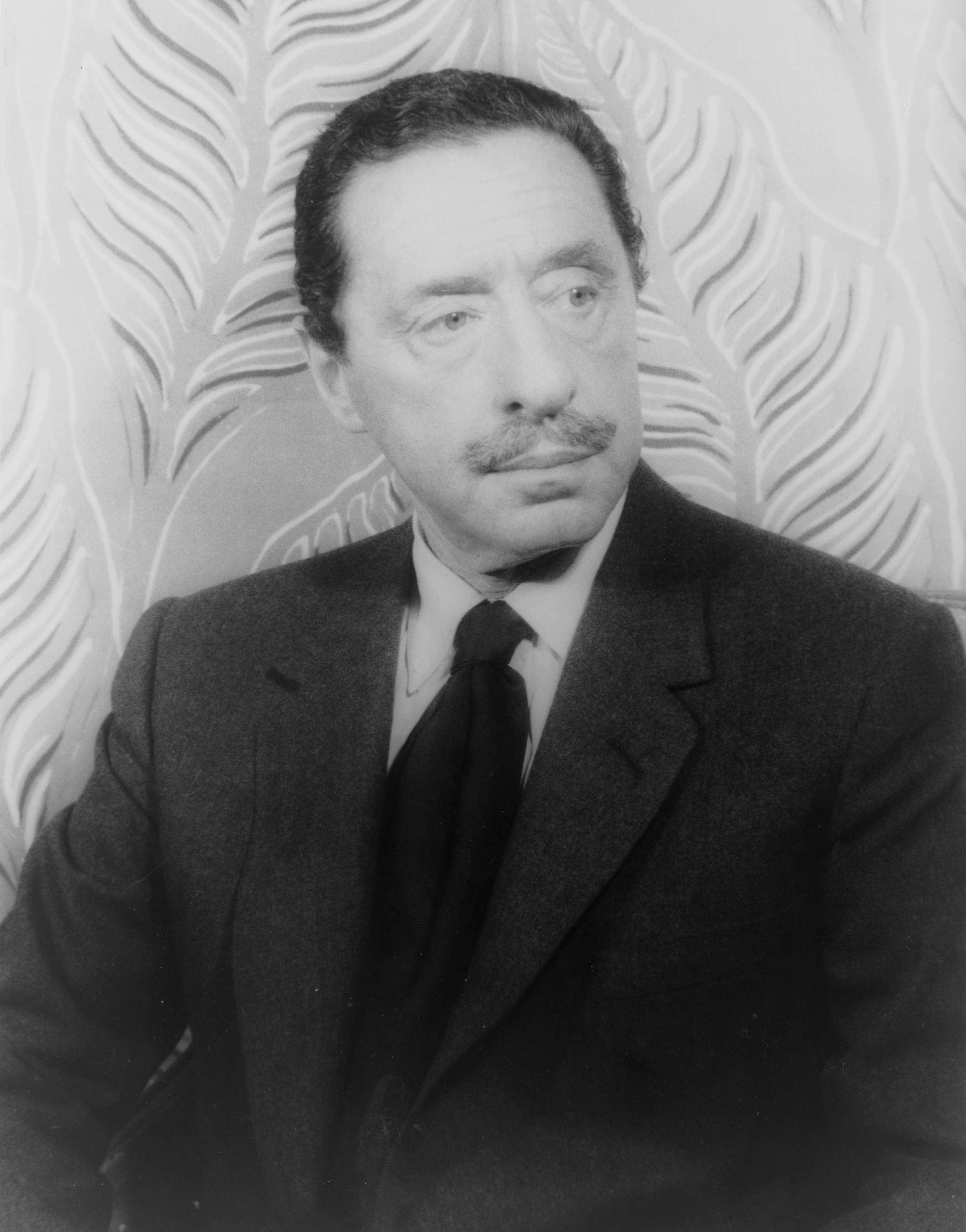
Harold Arlen
American composerWikipedia
20
MENTIONS
13
EPISODES
12
PODCASTS
Search complete. 20 mentions across 13 episodes found for "Harold Arlen".
Sep 18, 2026

Lisa SahulkaHOST
Easy living.
Lisa SahulkaHOST
Elephant's Gerald gave us the Harold Arlen tune, Blues in the Night.
Lisa SahulkaHOST
The lyrics are by the Savannah-based Johnny Mercer.
Ella FitzgeraldSOUNDBITE_SPEAKER
My mama done told me When I was in pigtails My mama done told me Huh A man's gonna sweet talk And give you the big eye But when the sweet talking's done A man is a two-face, a worrisome thing who'll leave you to sing the blues in the night.

John ClarkHOST
We're next gonna hear three more tunes from that period.
John ClarkHOST
We're gonna hear a tune by Jimmy McHugh and Ted Koehler, who was better known for his collaborations with Harold Arlen.
John ClarkHOST
We're gonna hear I've Got My Fingers Crossed, followed by Thanks a Million by Gus Kahn and Arthur Johnston, and then a Duke Ellington tune, Solitude.
John ClarkHOST
So that's our set coming up.

John WingHOST
Let's see, we have two songs left, and this next one... written in 1944, is most likely the most famous drinking song we're doing here today.
John WingHOST
It was composed by Harold Arlen, and it's longer than most songs of the period.
John WingHOST
He gave the melody to Johnny Mercer, and Johnny was hurting after the breakup of his affair with Judy Garland.
John WingHOST
Johnny came up with this most perfect lyric to a difficult length and rhythm song.
John WingHOST
I hope you like my version of that classic.
John WingHOST
Here's a fun fact.
John WingHOST
It's been recorded 359 times, and that ranks it seventh among the most covered Harold Arlen songs.
John WingHOST
His first most covered song is Over the Rainbow with 1,865 recordings.

JohnHOST
The screenplay is by Dorothy Jones and Chuck Jones.
JohnHOST
Music by Harold Arlen.
JohnHOST
Lyrics by E.Y. Harburg.
JohnHOST
It was directed by Abe Levitow.

Frank VaccarelloHOST
Beyond the Blue Horizon, written by Leo Robin, Richard A. Whiting, and W. Frank Harling.
Frank VaccarelloHOST
Before that, we heard I Got a Right to Sing the Blues, written by Harold Arlen and Ted Kohler.
Frank VaccarelloHOST
Now let's learn a little about the artist who had the idea to combine all these blues tunes.
Frank VaccarelloHOST
Joe Bushkin was born in New York City in 1916, and by the time he was still in his teens, he was already making a living behind the piano.
Lisa SahulkaHOST
Going back to the 1963 Civil Rights Anthem, Blowing in the Wind.
Lisa SahulkaHOST
And then Billie Holiday with the Harold Arlen tune, Ill Wind.
Lisa SahulkaHOST
This was recorded originally in the 1930s.
Lisa SahulkaHOST
Billie Holiday gives it a beautiful air of darkness and wind in a way that only she can do it.

Miles EadieHOST
Early flirtations with a broader musical comedy approach, casting names like W.C. Fields or Fanny Brice, were dropped in favour of something closer to a coherent fantasy.
Miles EadieHOST
In the end, Harold Arlen and Yip Harburg were brought in to write an entirely new score built specifically for the film.
Miles EadieHOST
There was also a more practical calculation.
Miles EadieHOST
MGM had little incentive to reuse a score it didn't own.
Miles EadieHOST
But the logic was straightforward.
Miles EadieHOST
The new songs meant new assets to be exploited financially.
Miles EadieHOST
Composer Harold Arlen's big breakthrough was the 1930 song Get Happy, which was later performed on screen by Judy Garland in the movie Summerstock.
Miles EadieHOST
He also wrote the blues-tinged standards Stormy Weather and I've Got the World on a String.

Sid GribetzHOST
From a session of January 1946, we heard all four of the songs, uh, recorded.
Sid GribetzHOST
Harold Arlen's "It's Only a Paper Moon." Then we heard a up-tempo attacking version of an old standby, an old song even in 1946, Creamer and Layton's "After You've Gone." And then he totally deconstructs, even in the initial melody statement, Sigmund Romberg and Oscar Hammerstein's "Lover, Come Back to Me." And finally, original piece called "Jamming with Lester." Willie Smith on alto sax, with Prez on tenor, Howard McGhee trumpet, Vic Dickinson trombone, Leslie Jones piano, Curris Countz on bass, and Johnny Otis at the drums.
Sid GribetzHOST
And then we heard Walter Donaldson's "You're Driving Me Crazy" from an August 1946 session here with Joe Albany at the piano, Irving Ashby guitar, Red Callender bass, and Chico Hamilton on drums backing Prez, Lester Young.
Sid GribetzHOST
And you're hearing this music on radio station WKCR FM New York, 89.9 on the radio dial here in the New York City area and streaming around the world over the internet at wkcr.org.

Pete RussellHOST
Yes.
Pete RussellHOST
Hey Ben, Stormy Weather was written by Harold Arlen and Ted Kohler.
Pete RussellHOST
It's a blues song that uses bad weather as a metaphor for loneliness.
Ben RussellHOST
You're right.

Allison BlackwellGUEST
Yeah, genre.
Allison BlackwellGUEST
I am like a sucker for, you know, older music, Harold Arlen, the Gershwin and stuff.
Allison BlackwellGUEST
And that's kind of where it's leaning toward.
Allison BlackwellGUEST
I have some contemporary stuff, some Sondheim in there and some other things like that.
3 more episodes mention Harold Arlen.
Create an account to see the whole feed, search across every transcript, and follow the entities you care about.