Hanseatic League
97
MENTIONS
53
EPISODES
43
PODCASTS
Search complete. 97 mentions across 53 episodes found for "Hanseatic League".
Nov 25, 2026

OlympiaHOST
Denmark did it for a while and later the Netherlands.
OlympiaHOST
thanks to their salt from Zeeland cities of the Hanseatic League.
OlympiaHOST
This association of trading cities from Northern Europe competed with them buying salt from German and Polish mines.
OlympiaHOST
But depending on the prices, they sometimes sent ships to buy salt in the Netherlands or in France.

Stacie GoddardGUEST
Not to get into the most obscure historical references that I can.
Stacie GoddardGUEST
If we have to return to something to counter, perhaps it's time for a new Hanseatic League.
Stacie GoddardGUEST
That is to say, states that are committed to building trading organizations within these aristocratic, personalist, and violent systems, can they band together, both to cooperate with each other, but when necessary, be able to have mechanisms at hand with which they can resist this type of order.
Stacie GoddardGUEST
So what comes next is ultimately up to us and up in the air.

John MerrimanHOST
What was the kind of impediment to their personal rule? One would be the municipal privileges.
John MerrimanHOST
For example, in the German port towns, Lübeck and Hamburg and the others, they formed this Hanseatic League.
John MerrimanHOST
Germany remains decentralized.
John MerrimanHOST
There are all sorts of states.
John MerrimanHOST
If the middle class in Russia, which I'll talk about on Monday, was just absolutely minuscule, The middle class was extremely small in Prussia.
John MerrimanHOST
Prussia did not include the Hanseatic League cities, such as Bremen and Hamburg and the others.
John MerrimanHOST
So, you have in the Netherlands and in England an astonishingly large middle class.
speaker_3ADVERTISER
Moreover,

Ruth GoldingNARRATOR
But in the year 1169 was founded a trade association which, for wealth, success, and importance, might compare with our East India Company.
Ruth GoldingNARRATOR
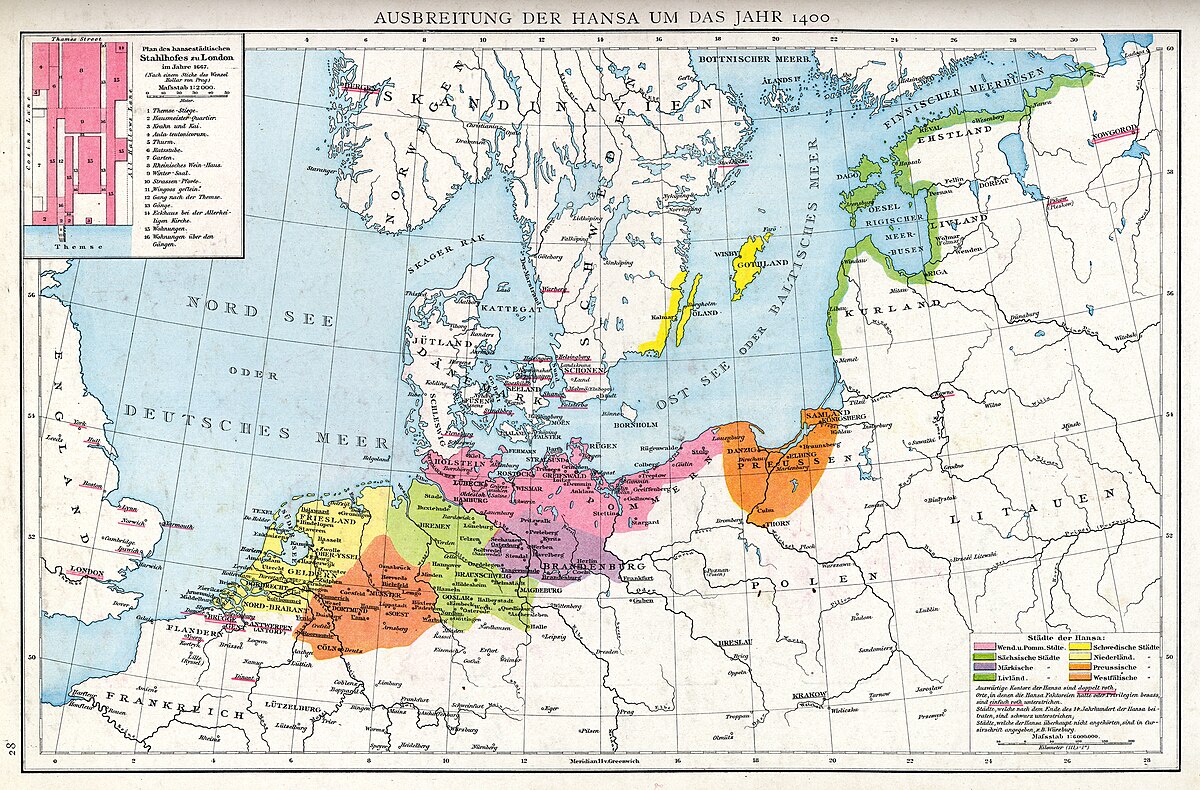
This was the Hanseatic League, so called from the word Hansa, a convention.
Ruth GoldingNARRATOR
In the League were confederated first twelve towns in the Baltic, Lubeck at the head.
Ruth GoldingNARRATOR
Next sixty-four, and even eighty, German towns.
6 MINS LATER
Ruth GoldingNARRATOR
These rivals, with their powerful organisations and their hold over all the northern ports, once out of the way, the English merchants began to push out their enterprises in all directions.
Ruth GoldingNARRATOR
You shall see immediately how they prospered.
Ruth GoldingNARRATOR
Meantime, there remains a monument erected in memory of the Hanseatic League.
Ruth GoldingNARRATOR
In the reign of Queen Anne, the merchants of Hamburg presented to the church where the merchants of the Steelyard had worshipped for 400 years a splendid screen of carved wood.

Ruth GoldingNARRATOR
But in the year 1169 was founded a trade association which, for wealth, success, and importance, might compare with our East India Company.
Ruth GoldingNARRATOR
This was the Hanseatic League, so called from the word Hansa, a convention.
Ruth GoldingNARRATOR
In the League were confederated first twelve towns in the Baltic, Lübeck at the head; next sixty-four, and even eighty, German towns.
Ruth GoldingNARRATOR
They were first associated for protection against pirates.
6 MINS LATER
Ruth GoldingNARRATOR
These rivals, with their powerful organizations and their hold over all the northern ports, once out of the way, the English merchants began to push out their enterprises in all directions.
Ruth GoldingNARRATOR
You shall see immediately how they prospered.
Ruth GoldingNARRATOR
Meantime, there remains a monument erected in memory of the Hanseatic League.
Ruth GoldingNARRATOR
In the reign of Queen Anne, the merchants of Hamburg presented to the church where the merchants of the Steelyard had worshiped for four hundred years a splendid screen of carved wood.

Nick VlahakisNARRATOR
The first five years of the child's life were spent in the country, partly at the Stutthof, which had formerly belonged to Andreas Schopenhauer, but had recently come into the possession of his maternal grandfather.
Nick VlahakisNARRATOR
Five years after the birth of his son, Heinrich Schopenhauer, in consequence of the political crisis which he seems to have taken keenly to heart in the affairs of the Hanseatic town of Danzig, transferred his business and his home to Hamburg, where in 1795 a second child, Adele, was born.
Nick VlahakisNARRATOR
Two years later, Heinrich, who intended to train his son for a business life, took him with this idea to Arles by way of Paris, where they spent a little time and left him there with M. Gregoire, a commercial connection.
Nick VlahakisNARRATOR
Arthur remained at Arles for two years, receiving private instruction with this man's son, Anthime, with whom he struck up a strong friendship, and when he returned to Hamburg it was found that he remembered but few words of his mother tongue.

Jim HedrickNARRATOR
A number of other renunciations and exclusions result from this tendency to rule out death from the calculations of life.
Jim HedrickNARRATOR
And yet, the motto of the Hanseatic League said, It is necessary to sail the seas, but not to live.
Jim HedrickNARRATOR
It is therefore inevitable that we should seek compensation for the loss of life in the world of fiction, in literature, and in the theater.
Jim HedrickNARRATOR
There we still find people who know how to die, who are even quite capable of killing others.

Margaret MacmillanGUEST
No, I think middle powers have pulled together.
Margaret MacmillanGUEST
The Germans had something called the Hanseatic League of City-States, which were very powerful in the Baltic.
Margaret MacmillanGUEST
So I think it is possible for middle powers to work together.
Margaret MacmillanGUEST
But of course, it's more complicated because there's so many of them.

Margaret MacMillanGUEST
No, I think middle powers have pulled together.
Margaret MacMillanGUEST
The Germans had something called the Hanseatic League of City-States, which were very powerful in the Baltic.
Margaret MacMillanGUEST
So I think it is possible for middle powers to work together.
Margaret MacMillanGUEST
But of course, it's more complicated because there's so many of them.
43 more episodes mention Hanseatic League.
Create an account to see the whole feed, search across every transcript, and follow the entities you care about.