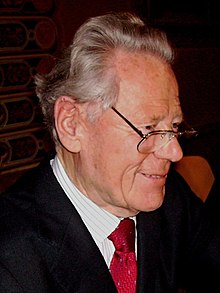
Hans Küng
Swiss priest and theologianWikipedia
17
MENTIONS
11
EPISODES
10
PODCASTS
Search complete. 17 mentions across 11 episodes found for "Hans Küng".
Oct 2, 2026

Mark GilbertGUEST
... post-Vatican II.
Mark GilbertGUEST
So people like, um, Joseph Ratzinger and, uh, Karl, uh, um, uh, Hans von Balthasar.
Mark GilbertGUEST
Um, have I got his name right? Um, von Balthasar.
Camden BuceyHOST
Yeah, Hans Urs von Balthasar-
Mark GilbertGUEST
I can always remember.
Mark GilbertGUEST
Hans, Urs
Camden BuceyHOST
... is another significant-
Mark GilbertGUEST
Yeah, yeah.

Mark GilbertGUEST
There, there was an amazing-
Camden BuceyHOST
Unless you're thinking of Hans Küng-
Mark GilbertGUEST
Yeah
Camden BuceyHOST
... 'cause Hans Küng was certainly-

LauraHOST
However, we are not to interpret this as God's yes only to humans, which is what other theologians have tried to do.
LauraHOST
He cites Hans Kung, a Swiss priest and theologian, who said that God's only concern was with human welfare.
LauraHOST
Again, a very convenient take for a human to have.
LauraHOST
We can interpret the incarnation as simply God coming to earth as a creature, one creature among all the creatures.

Robert BarronGUEST
You know, as you read that, um, you know where I got that idea from? A theologian I, I don't often agree with, but I read him when I was a young man.
Robert BarronGUEST
Um, in Hans Kung's book called On Being a Christian.
Matthew PetrusekHOST
Mm.
Robert BarronGUEST
He makes that observation.

Norman GriggSOUNDBITE_SPEAKER
Some of you might have heard of this.
Norman GriggSOUNDBITE_SPEAKER
It was created by a globalist theologian by the name of Hans Küng, who began his work at a 1991 Paris symposium sponsored by the United Nations Educational, Social, and Cultural Organization.
Norman GriggSOUNDBITE_SPEAKER
This is what Hans Küng has to say about those of us who are so-called fundamentalists.
Norman GriggSOUNDBITE_SPEAKER
Quote, "Any form of church conservatism is to be rejected.
Norman GriggSOUNDBITE_SPEAKER
To put it bluntly, no regressive or repressive religion, whether Christian, Islamic, Jewish, or of whatever provenance, has a long-term future." In other words, history has decreed the immediate abolition of so-called regressive or repressive religion or fundamentalist religion.
Norman GriggSOUNDBITE_SPEAKER
Some of you might have heard of this.
Norman GriggSOUNDBITE_SPEAKER
It was created by a globalist theologian by the name of Hans Küng, who began his work at a nineteen ninety-one Paris symposium sponsored by the United Nations Educational, Social, and Cultural Organization.
Norman GriggSOUNDBITE_SPEAKER
This is what Hans Küng has to say about those of us who are so-called fundamentalists.
Norman GriggSOUNDBITE_SPEAKER
Quote, "Any form of church conservatism is to be rejected.
Norman GriggSOUNDBITE_SPEAKER
To put it bluntly, no regressive or repressive religion, whether Christian, Islamic, Jewish, or of whatever provenance, has a long-term future." In other words, history has decreed the immediate abolition of so-called regressive or repressive religion or fundamentalist religion.

Cornelis van der KooiGUEST
quarrels that he had really enough from that that was even in a psychological sense made him anxious but as a teacher yeah he was what we call erudite erudite and has stimulated me to go to Germany, to Tübingen.
Cornelis van der KooiGUEST
I have studied in the last year of my studies at the Vrije Universiteit in Tübingen in the winter semester 79-80, when Hans Kuhn was there.
Cornelis van der KooiGUEST
And I
Marinus de JongHOST
hear there Heiko Oldman,

PaulogiaHOST
The Lycona footnote and essay lumps them both together as separate ideas from the six minimal facts in final form.
PaulogiaHOST
A quick check of Gary's third volume, see, it has some purpose I guess, shows that Gary himself is aware that critics like Marcus Borg, John Dominic Crossan, Robert Funk, Maurice Casey, Donald Atkinson, Hans Kung, Gregory Riley, and James Robinson argue for spiritual, metaphorical, luminous, or objective vision interpretations where no physical body exited the grave.
PaulogiaHOST
And this is just a sampling of a larger
Frank TurekSOUNDBITE_SPEAKER
pool

Todd WornerSOUNDBITE_SPEAKER
Bishop, how was Jesus' fate different and why did that matter?
Robert BarronSOUNDBITE_SPEAKER
You know, as you read that, you know where I got that idea from? A theologian I don't often agree with, but I read him when I was a young man in Hans Kung's book called On Being a Christian.
Robert BarronSOUNDBITE_SPEAKER
He makes that observation.
Robert BarronSOUNDBITE_SPEAKER
And it's always stayed in my mind that the other great founders, almost without exception, you know, die peacefully and full of years and guaranteed success and all that.

Erwin LutzerHOST
We could take care of the planetary problems of ecology and we could all live happily ever after.
Erwin LutzerHOST
Hans Kung, the great famous German theologian,
Erwin LutzerHOST
said basically that all the religions of the world conflict, but we all agree that we should treat one another as we would like to be treated.
Erwin LutzerHOST
That is the central point, and so he lectured on what that would mean.
1 more episode mentions Hans Küng.
Create an account to see the whole feed, search across every transcript, and follow the entities you care about.