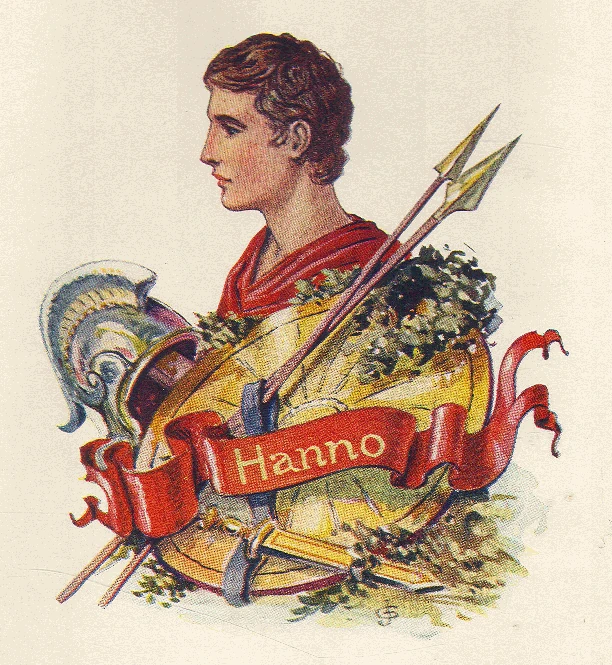
Hanno the Navigator
ExplorerWikipedia
111
MENTIONS
6
EPISODES
5
PODCASTS
Search complete. 111 mentions across 6 episodes found for "Hanno the Navigator".
Sep 26, 2026

JimmyHOST
In the 5th century BC, the seafaring state of Carthage launched one of antiquity's most daring voyages.
JimmyHOST
Hanno the Navigator, a Carthaginian explorer of legendary renown, sailed beyond the Mediterranean into the Atlantic, venturing down the west coast of Africa.
JimmyHOST
His journey is recorded in a logbook attributed to Hanno himself, a rare first-hand account of exploration from the ancient world.
JimmyHOST
This expedition chronicles the founding of new colonies, the establishment of far-flung trade routes, the exploration of unknown lands, and contact with various peoples.
JimmyHOST
But perhaps most importantly of all, it also includes what could potentially be the first written description of gorillas in history.
JimmyHOST
Carthage was founded by Phoenician colonists, and by Hanno's time had become a dominant naval power in the western Mediterranean.
JimmyHOST
The Carthaginians inherited from their Phoenician ancestors a tradition of long-distance sailing and exploration.
JimmyHOST
By 500 BC, they controlled Mediterranean trade routes and were eager to find both new resources and new markets.
JimmyHOST
He said that when Carthage's power was at its height, two expeditions went out at about the same time.
JimmyHOST
Hanno the Navigator sailed south around the coast of Africa and published an account of his voyage, and Himilco, dispatched to explore the outer coasts of Europe, did the same.
JimmyHOST
Scholars still argue over whether the expedition was state policy or a private venture, and no ancient source mentions what Carthage got out of it.
JimmyHOST
Notably, the Romans destroyed the entire body of Carthaginian knowledge when they razed Carthage, which is to say the evidence of what they got may have been lost.
JimmyHOST
That pairing that I mentioned is our anchor to a well-established historical narrative, and takes this from the realm of legend into something more historical.
JimmyHOST
Hanno the Navigator became one of the most famous explorers of antiquity, and the historian Dwayne Roller has argued that both men probably belonged to the Magonids.
JimmyHOST
This is the family that dominated Carthaginian politics in that era, and Roller suggested they may even have been brothers.
JimmyHOST
Ultimately, though, that's just an educated guess, and what matters is that Himilco came home and wrote of his journey.

A. RodrigoNARRATOR
But when the Carthaginians began to be pressed by famine, owing to the number of people cooped up in the city, fifty thousand at least in number, Hannibal, the commander of the besieged forces, found himself in a difficult position, and sent constant messages to Carthage explaining his position and begging for reinforcements.
A. RodrigoNARRATOR
The Carthaginian government shipped the troops they had collected and their elephants and sent them to Sicily to Hanno, their other general.
A. RodrigoNARRATOR
Hanno concentrated his troops and material of war at Heraclea, and in the first place surprised and occupied Herbesus.
A. RodrigoNARRATOR
cutting off the enemy's camps from their provisions and necessary supplies.
A. RodrigoNARRATOR
The result of this was that the Romans were as a fact both besieged and besiegers at the same time, for they were so hard pressed by want of food and scarcity of the necessities of life that they often contemplated raising the siege, and would in the end have done so had not Hero, by using every effort and every device, provided them with a moderate amount of strictly necessary supplies.
A. RodrigoNARRATOR
End of chapter 18 Chapter 19 In the next place, Hanno, perceiving that the Romans were weakened by disease and privation, owing to an epidemic having broken out among them, and thinking that his own troops were in fit fighting condition, took with him all his elephants, about fifty in number, and all the rest of his force, and advanced rapidly from Heraclea.
A. RodrigoNARRATOR
He had ordered the Numidian horse to proceed him, and approached the enemy's fortified camp to provoke him and attempt to draw his cavalry out, after which they were to give way and retire until they rejoined himself.
A. RodrigoNARRATOR
The Numidians, acting on these orders, advanced up to one of the camps, and the Roman cavalry at once issued forth and boldly attacked them.

speaker_0NARRATOR
lived in family groups and was not a chimpanzee.
speaker_0NARRATOR
Around 500 BCE, the Carthaginian explorer Hanno the Navigator sailed down the West African coast on what was likely one of the most ambitious naval expeditions of the ancient world, charting harbours and rivers and coastlines that no Mediterranean sailor had documented before.
speaker_0NARRATOR
His fleet moved south along what is now Morocco, Mauritania, Senegal and beyond, into waters that Carthaginian traders had only heard rumours about.
speaker_0NARRATOR
Somewhere along the coast, the exact location has been debated for centuries and will likely never be settled.
speaker_0NARRATOR
They threw stones.
speaker_0NARRATOR
They were observed in a group.
speaker_0NARRATOR
The account survives only in a Greek translation, and scholars have argued for two and a half millennia about what Hanno actually saw.
speaker_0NARRATOR
Were they apes? Were they humans from an unfamiliar culture? Were they an exaggeration, a tall tale embellished in the retelling, the kind of story that sailors have always told about the edges of the known world? Whatever Hanno saw, the name stuck.

A. RodrigoNARRATOR
But when the Carthaginians began to be pressed by famine, owing to the number of people cooped up in the city, fifty thousand at least in number, Hannibal, the commander of the besieged forces, found himself in a difficult position, and sent constant messages to Carthage explaining his position and begging for reinforcements.
A. RodrigoNARRATOR
The Carthaginian government shipped the troops they had collected and their elephants, and sent them to Sicily, to Hanno, their other general.
A. RodrigoNARRATOR
Hanno concentrated his troops and material of war at Heraclea, and in the first place surprised and occupied Herbesus, cutting off the enemy's camps from their provisions and necessary supplies.
A. RodrigoNARRATOR
The result of this was that the Romans were as a fact both besieged and besiegers at the same time, for they were so hard pressed by want of food and scarcity of the necessities of life, that they often contemplated raising the siege, and would in the end have done so, had not Hiero, by using every effort and every device, provided them with a moderate amount of strictly necessary supplies.
A. RodrigoNARRATOR
End of chapter 18 Chapter 19 In the next place, Hanno, perceiving that the Romans were weakened by disease and privation, owing to an epidemic having broken out among them, and thinking that his own troops were in fit fighting condition, took with him all his elephants, about fifty in number, and all the rest of his force, and advanced rapidly from Heraclea.
A. RodrigoNARRATOR
He had ordered the Numidian horse to precede him and approach the enemy's fortified camp to provoke him and attempt to draw his cavalry out, after which they were to give way and retire until they rejoined himself.
A. RodrigoNARRATOR
The Numidians, acting on these orders, advanced up to one of the camps, and the Roman cavalry at once issued forth and boldly attacked them.
A. RodrigoNARRATOR
The Africans retreated as they had been ordered until they joined Hanno's army, and then, wheeling round and encircling the enemy, they attacked them, killing many and pursuing the rest as far as the camp.

Luke RodgersHOST
But
Dan McCarthyGUEST
... uh, heard of Hanno the Navigator from the 500 BC?
Luke RodgersHOST
Yeah.
Dan McCarthyGUEST
He, he was from Carthage, and he was a great navigator.