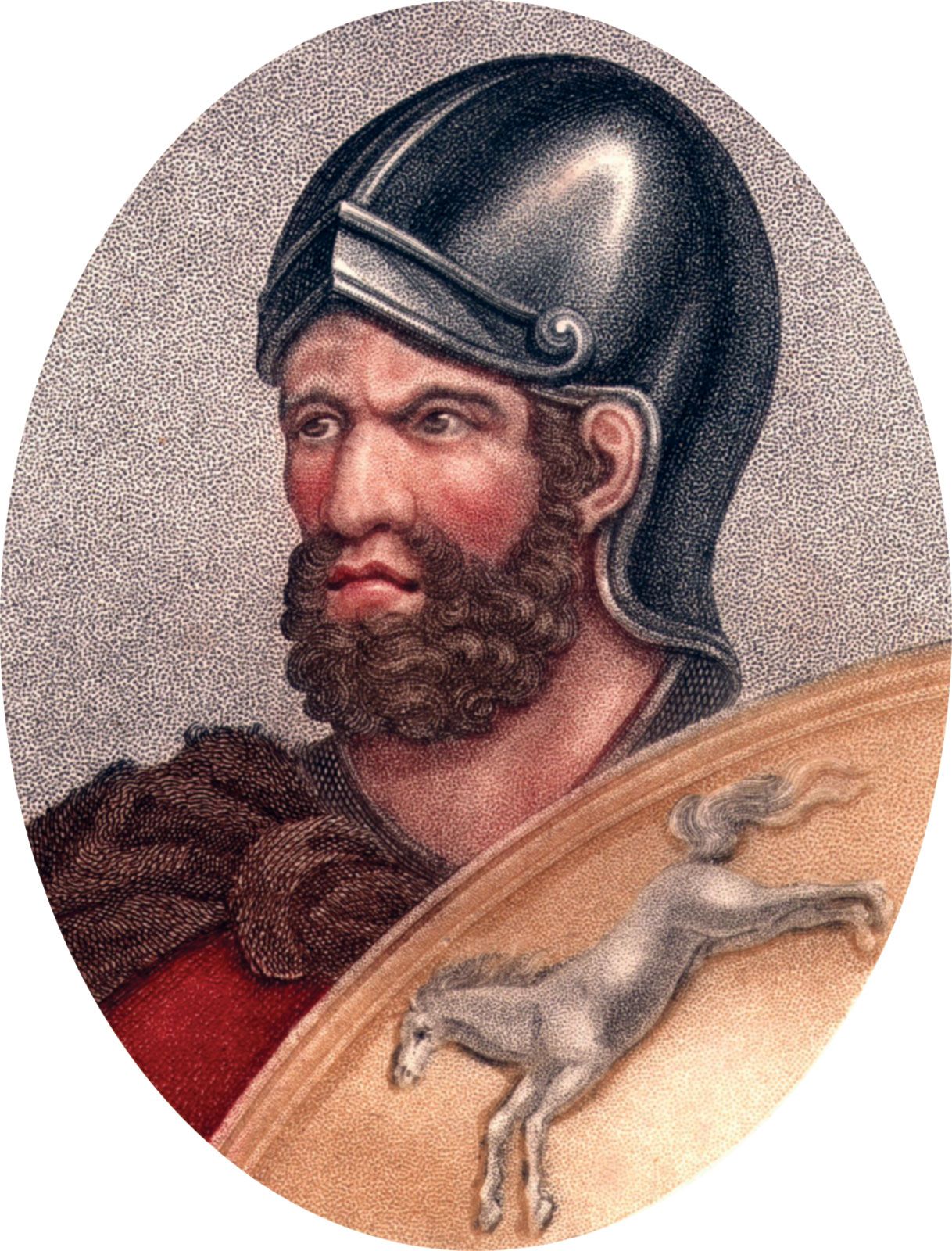
Hannibal
GeneralWikipedia
927
MENTIONS
86
EPISODES
73
PODCASTS
Search complete. 927 mentions across 86 episodes found for "Hannibal".
Sep 25, 2026

Dan SnowNARRATOR
For over a century, the Phoenicians resisted Rome, and the name of their leader is still associated with power and strength.
Glenn MarkoeGUEST
The one Phoenician personality known to us today is Hannibal, great general of the Second Punic War that crossed the Alps with a troop of soldiers mounted on elephants and nearly brought the city of Rome to its knees.
Glenn MarkoeGUEST
Had he done so, the whole history of the Western world as we know it today would have been rewritten by the Carthaginians rather than the Romans.
Dan SnowNARRATOR
But barely 40 years after Hannibal's death, Romans torched and destroyed Carthage.
Dan SnowNARRATOR
Contemporary accounts graphically illustrate the bloody and bitter final struggle.
speaker_5SOUNDBITE_SPEAKER
Some were stabbed, others were hurled alive from the roofs of the buildings.

FinnHOST
Whoa, over 2,000 years ago? What happened?
MiraHOST
A famous general named Hannibal Barca from a city called Carthage in North Africa wanted to march his army to fight the Roman Republic in Italy.
MiraHOST
It was an epic journey of almost a thousand miles.
MiraHOST
But
FinnHOST
Exactly.
MiraHOST
It was a completely crazy plan.
MiraHOST
Hannibal marched tens of thousands of soldiers right up into those freezing, rocky mountains.
MiraHOST
And he brought 37 massive war elephants with him.

speaker_3NARRATOR
Pero quizá el uso más famoso de los elefantes de guerra procedió de un lugar completamente diferente, Cartago.
speaker_3NARRATOR
Aníbal, the Carthaginian general who was close to defeating Rome, understood the power of elephants not only in the battlefield, but also as a symbol of military capacity and determination.
speaker_3NARRATOR
Cuando decidió invadir Italia cruzando los Alpes, no se limitó a hacer marchar a su infantería a través de aquellas montañas.
speaker_3NARRATOR
Llevó elefantes.
speaker_3NARRATOR
Elefantes, criaturas que necesitan enormes cantidades de comida y agua, que se cansan y enferman, y que necesitan cuidados constantes.
speaker_3NARRATOR
transportarlos a través de un paso montañoso en invierno, donde los suministros eran escasos y el terreno hostil.
speaker_3NARRATOR
Muchos de los elefantes murieron durante la travesía, pero los que sobrevivieron llegaron a Italia, y cuando los comandantes romanos supieron que Aníbal había conseguido llevar elefantes a través de los Alpes, el mensaje quedó claro.
speaker_3NARRATOR
Este hombre iba en serio.

speaker_2NARRATOR
But perhaps the most famous use of war elephants came from a completely different place: Carthage.
speaker_2NARRATOR
Hannibal, the Carthaginian general who came close to defeating Rome, understood the power of elephants not only on the battlefield, but also as a symbol of military capability and determination.
speaker_2NARRATOR
When he decided to invade Italy by crossing the Alps, he did not simply march his infantry through those mountains.
speaker_2NARRATOR
He brought elephants.
speaker_2NARRATOR
Transporting them across a mountain pass in winter, where supplies were scarce and the terrain hostile.
speaker_2NARRATOR
Many of the elephants died during the crossing.
speaker_2NARRATOR
But those that survived reached Italy, and when Roman commanders learned that Hannibal had managed to bring elephants across the Alps, the message was clear.
speaker_2NARRATOR
This man was serious.

Rich LowryHOST
And just three months later, they'd build another 250 ships.
Rich LowryHOST
You know, Hannibal comes into Italy, destroys various legions, and they mobilize the way they've never been mobilized before, and they have 10 new legions.
Rich LowryHOST
And they're just a society-wide commitment.
Rich LowryHOST
We are never losing, right? And that's the way we would be if this were an existential conflict, or any of these post-World War II wars had been existential conflicts, but they weren't.

ChandlerHOST
And during the Battle of Cannae in 216 BCE, the Roman Republic was fighting Carthage.
ChandlerHOST
and the Carthaginian general Hannibal wiped out a massive Roman army.
ChandlerHOST
And afterwards, he had his men go and strip the signet gold rings from the dead.
ChandlerHOST
When the news reached Carthage, Hannibal's brother Mago poured the rings out before the Carthaginian senate, and the rings kind of become this grim proxy for the Roman elite Hannibal had killed.
ChandlerHOST
So for each ring, there was a man, and these rings are their proxy within their bodies, and it's showing... every person that he killed.
ChandlerHOST
And not just any people, these are the upper echelons.
ChandlerHOST
then during the same war, we get another demonstration.
ChandlerHOST
So this was in 208 BC, the Roman general Marcus Claudius Marcellus was killed.

Pamela NagamiNARRATOR
Plutarch may have been mistaken, and possibly he was thirty-five.
Pamela NagamiNARRATOR
His father, whose name he bore, had been a magnificent aristocrat, and his mother was Cornelia, daughter of Hannibal's conqueror, the first Scipio Africanus, and one of the comparatively few women whose names are famous in history.
Pamela NagamiNARRATOR
He had much in common with Scipio Aemilianus, whom he resembled in rank and refinement, in valor, in his familiarity with Hellenic culture, and in the style of his speeches.
Pamela NagamiNARRATOR
Diaphanius of Mytilene taught him oratory.
3 HRS 16 MINS LATER
Pamela NagamiNARRATOR
Chapter 8.
Pamela NagamiNARRATOR
The Social War In a previous chapter the relations now existing between Rome and her dependents have been described.
Pamela NagamiNARRATOR
For two centuries the Italians had remained faithful to Rome through repeated temptations, and even through the fiery trial of Hannibal's victorious occupation.
Pamela NagamiNARRATOR
But the loyalty which no external or sudden shock could snap had been slowly eaten away by corrosives which the arrogance or negligence of the government supplied.

Larry WilsonVOICE_ACTOR
That's what I say.
Larry WilsonVOICE_ACTOR
What Hannibal really wants is money.
Larry WilsonVOICE_ACTOR
He's got the men right enough.
Larry WilsonVOICE_ACTOR
The men are splendid.
Tommy HersantNARRATOR
Hanno leaning forward in an earnest way and emphasizing what he says.
ToddVOICE_ACTOR
All you men who get at the head of a department only think of the work of that department.
ToddVOICE_ACTOR
That's why you talk about Hannibals being bound to win.
ToddVOICE_ACTOR
Of course he's bound to win.

Geoffrey EdwardsNARRATOR
The Carthaginians violated treaties.
Geoffrey EdwardsNARRATOR
Hannibal was cruel.
Geoffrey EdwardsNARRATOR
The others were more merciful.
Geoffrey EdwardsNARRATOR
From Pyrrhus we have this famous speech on the exchange of prisoners.
Geoffrey EdwardsNARRATOR
He came, and in the first place it was he that made the motion in the Senate that the prisoners should not be restored.
Geoffrey EdwardsNARRATOR
And in the second place, when his relatives and friends would have kept him back, he chose to return to a death by torture rather than prove false to his promise, though given to an enemy.
Geoffrey EdwardsNARRATOR
And again, in the Second Punic War, after the battle of Cannae, Hannibal sent to Rome ten Roman captives bound by an oath to return to him if they did not succeed in ransoming his prisoners.
Geoffrey EdwardsNARRATOR
And as long as any one of them lived, the censors kept them all degraded and disfranchised because they were guilty of perjury in not returning.

Kathy BarrettNARRATOR
His fame rests on his triumphant success in building up for himself so vast an empire, and the admiration which his career has always excited among mankind is heightened by the consideration of his youth and of the noble and generous impulses which strongly marked his character.
Kathy BarrettNARRATOR
The Carthaginian hero was Hannibal.
Kathy BarrettNARRATOR
We class the Carthaginians among the European nations of antiquity, for in respect to their origin, their civilization, and all their commercial and political relations, they belong to the European race, though it is true that their capital was on the African side of the Mediterranean Sea.
Kathy BarrettNARRATOR
Hannibal was the great Carthaginian hero.
Kathy BarrettNARRATOR
He earned his fame by the energy and implacableness of his hate.
Kathy BarrettNARRATOR
The work of his life was to keep a vast empire in a state of continual anxiety and terror for fifty years, so that his claim to greatness and glory rests on the determination, the perseverance, and the success with which he fulfilled his function of being, while he lived, the terror of the world.
Kathy BarrettNARRATOR
The Roman hero was Caesar.
Kathy BarrettNARRATOR
He was born just one hundred years before the Christian era.
76 more episodes mention Hannibal.
Create an account to see the whole feed, search across every transcript, and follow the entities you care about.