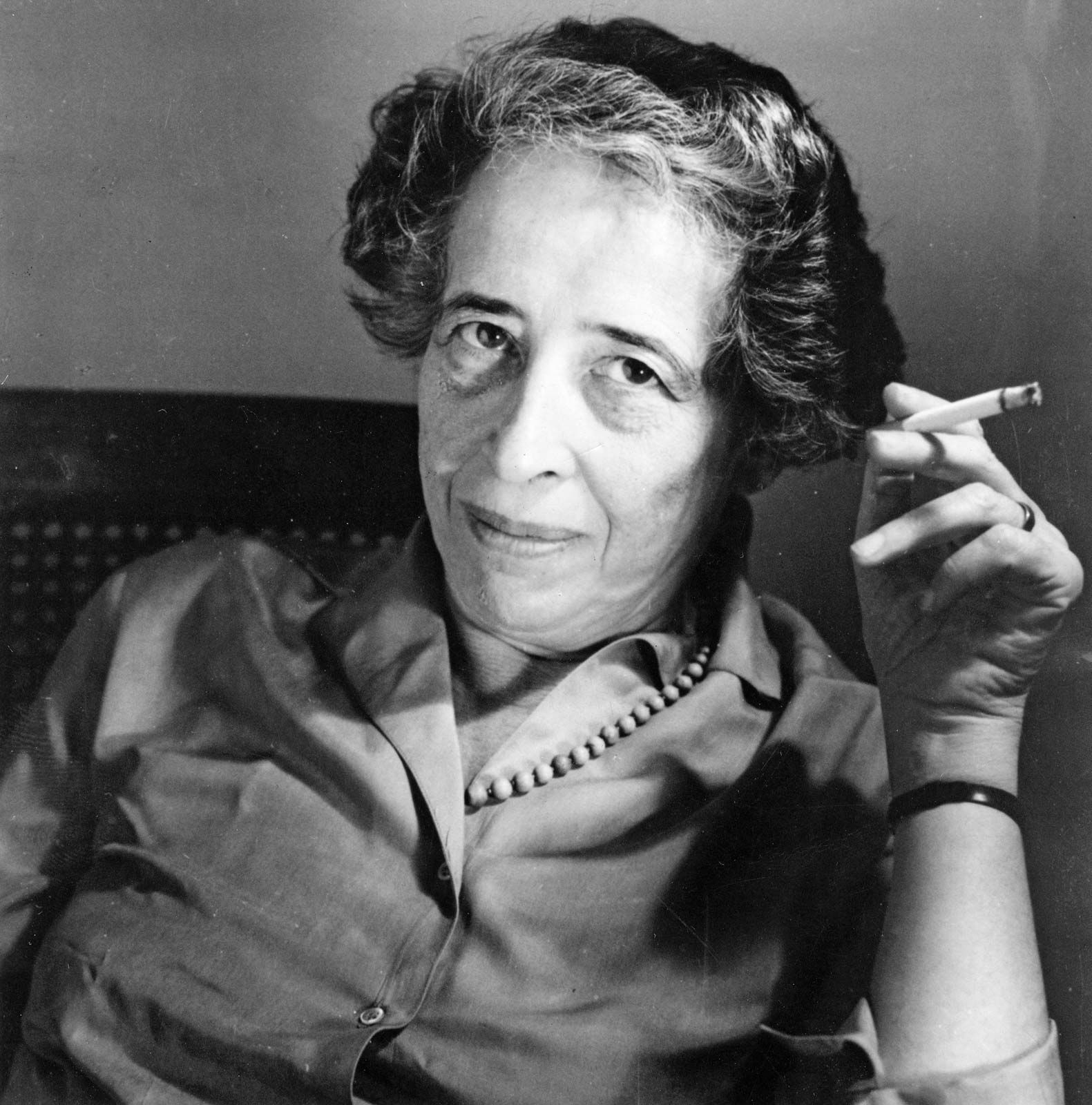
Hannah Arendt
German-American historian and philosopherWikipedia
353
MENTIONS
182
EPISODES
142
PODCASTS
Search complete. 353 mentions across 182 episodes found for "Hannah Arendt".
Sep 13, 2026

David RuncimanHOST
Two more philosophers in this series.
David RuncimanHOST
Next time, I'm gonna be talking to the historian and critic Lindsay Stonebridge about the life of Hannah Arendt, a life lived from Germany to France to the United States to Jerusalem, one of the most interesting lives and most interesting bodies of thought of the entire century.
David RuncimanHOST
That's next time.
David RuncimanHOST
This has been Past Present Future.

Frédéric SamamaGUEST
The conclusion of the book says we see the parallel with m- m- what happened in Europe in the '30s with, with the rise of Nazis, communisms, and so on.
Frédéric SamamaGUEST
And some people have said, "Why did we have these fascisms in Europe?" Hannah Arendt made the case that we had fascisms in Europe in the '30s because the social bonds weakened in the 19th century.
Dan MillerHOST
Mm.
Frédéric SamamaGUEST
And so the people, um, made a kind of pushback against individualism, social bonds weakening, by asking for very strong social structures.
35 MINS LATER
Frédéric SamamaGUEST
I have no interest in having no interest, it triggers some moral sentiments.
Frédéric SamamaGUEST
And with moral sentiments, you can have a group.
Frédéric SamamaGUEST
Hannah Arendt thought that the very
Dan MillerHOST
They're not, they're not really in conflict.

Debarati SanyalGUEST
There's a poignant essentialism to bare life that actually kind of makes a very, uh, radical distinction between bare and political life.
Debarati SanyalGUEST
And, you know, in the book, I, I try to think through it in relation to figures like Arendt and Rancière, and I'm very interested in, um, You know, spaces of re- control that nevertheless still harbor the possibility of resistance and dissent.
Debarati SanyalGUEST
And that's kind of part of a longstanding and perhaps naive investment in, uh, micro poli- political gestures of agency, um, and of, uh, you know, making room for maneuver, as Ross Chambers so powerfully said, even within systems of capture that seemed utterly, uh, you know, absolute.
Debarati SanyalGUEST
Um, that being said, I'm also very aware of and very interested...
Gina StamHOST
And one of the ways that you characterize the border is what you call an interplay of care and coercion.
Debarati SanyalGUEST
Right.
Debarati SanyalGUEST
So coercion and care, I mean, these are, uh, this is a kind of yoking that Hannah Arendt actually pointed out when she talked about how, you know, World War II or the prelude to World War II showed her that, you know, some people were detained out of protection and others, uh, because, uh, uh, the detainees were threatening.
Debarati SanyalGUEST
Um, you know, Miriam Tectin- Tecton's, uh, Casualties of Care also points to the coercions of care.

Dion FanningHOST
Mm
Jill LeporeGUEST
... and I, I was really moved by that, and it, it, it also reminded me of, and, and I start the book with this story about Hannah Arendt writing The Human Condition in the late 1950s.
Jill LeporeGUEST
She had just finished writing The Origins of Totalitarianism, and The Origins of Totalitarianism, which I had forgotten, kind of really ends with automation.
Jill LeporeGUEST
It's sort of like-

Debarati SanyalGUEST
There's a poignant essentialism to bare life that actually kind of makes a very radical distinction between bare and political life.
Debarati SanyalGUEST
And, you know, in the book, I try to think through it in relation to figures like Arendt and Rancière.
Debarati SanyalGUEST
And I'm very interested in... you know, spaces of control that nevertheless still harbor the possibility of resistance and dissent.
Debarati SanyalGUEST
And that's kind of part of a long-standing and perhaps naive investment in micro-political gestures of agency and of, you know, making room for maneuver, as Ross Chambers so powerfully said, even within systems of capture that seemed utterly... you know, absolute.
Debarati SanyalGUEST
Great.
Debarati SanyalGUEST
So coercion and care, I mean, these are...
Debarati SanyalGUEST
This is a kind of yoking that Hannah Arendt actually pointed out when she talked about how, you know, World War II or the prelude to World War II showed her that, you know, some people were detained out of protection and others because the detainees were threatening.
Debarati SanyalGUEST
You know, Miriam Tickton's casualties of care also... points to the coercions of care.

Debarati SanyalGUEST
There's a poignant essentialism to bare life that actually kind of makes a very radical distinction between bare and political life.
Debarati SanyalGUEST
And, you know, in the book, I try to think through it in relation to figures like Arendt and Rancière.
Debarati SanyalGUEST
And I'm very interested in... you know, spaces of control that nevertheless still harbor the possibility of resistance and dissent.
Debarati SanyalGUEST
And that's kind of part of a long-standing and perhaps naive investment in micro-political gestures of agency and of, you know, making room for maneuver, as Ross Chambers so powerfully said, even within systems of capture that seemed utterly... you know, absolute.
Debarati SanyalGUEST
Great.
Debarati SanyalGUEST
So coercion and care, I mean, these are...
Debarati SanyalGUEST
This is a kind of yoking that Hannah Arendt actually pointed out when she talked about how, you know, World War II or the prelude to World War II showed her that, you know, some people were detained out of protection and others because the detainees were threatening.
Debarati SanyalGUEST
You know, Miriam Tickton's casualties of care also... points to the coercions of care.

Debarati SanyalGUEST
There's a poignant essentialism to bare life that actually kind of makes a very radical distinction between bare and political life.
Debarati SanyalGUEST
And, you know, in the book, I try to think through it in relation to figures like Arendt and Rancière.
Debarati SanyalGUEST
And I'm very interested in you know, spaces of control that nevertheless still harbor the possibility of resistance and dissent.
Debarati SanyalGUEST
And that's kind of part of a long-standing and perhaps naive investment in micro-political gestures of agency and of, you know, making room for maneuver, as Ross Chambers so powerfully said, even within systems of capture that seemed utterly... you know, absolute.
Debarati SanyalGUEST
Great.
Debarati SanyalGUEST
So coercion and care, I mean, these are...
Debarati SanyalGUEST
This is a kind of yoking that Hannah Arendt actually pointed out when she talked about how, you know, World War II or the prelude to World War II showed her that, you know, some people were detained out of protection and others because the detainees were threatening.
Debarati SanyalGUEST
You know, Miriam Tickton's casualties of care also... points to the coercions of care.

Debarati SanyalGUEST
There's a poignant essentialism to bare life that actually kind of makes a very radical distinction between bare and political life.
Debarati SanyalGUEST
And, you know, in the book, I try to think through it in relation to figures like Arendt and Rancière.
Debarati SanyalGUEST
And I'm very interested in... you know, spaces of control that nevertheless still harbor the possibility of resistance and dissent.
Debarati SanyalGUEST
And that's kind of part of a long-standing and perhaps naive investment in micro-political gestures of agency and of, you know, making room for maneuver, as Ross Chambers so powerfully said, even within systems of capture that seemed utterly... you know, absolute.
Debarati SanyalGUEST
Great.
Debarati SanyalGUEST
So coercion and care, I mean, these are...
Debarati SanyalGUEST
This is a kind of yoking that Hannah Arendt actually pointed out when she talked about how, you know, World War II or the prelude to World War II showed her that, you know, some people were detained out of protection and others because the detainees were threatening.
Debarati SanyalGUEST
You know, Miriam Tickton's casualties of care also... points to the coercions of care.

Debarati SanyalGUEST
There's a poignant essentialism to bare life that actually kind of makes a very radical distinction between bare and political life.
Debarati SanyalGUEST
And, you know, in the book, I try to think through it in relation to figures like Arendt and Rancière.
Debarati SanyalGUEST
And I'm very interested in... you know, spaces of control that nevertheless still harbor the possibility of resistance and dissent.
Debarati SanyalGUEST
And that's kind of part of a long-standing and perhaps naive investment in micro-political gestures of agency and of, you know, making room for maneuver, as Ross Chambers so powerfully said, even within systems of capture that seemed utterly... you know, absolute.
Debarati SanyalGUEST
Great.
Debarati SanyalGUEST
So coercion and care, I mean, these are...
Debarati SanyalGUEST
This is a kind of yoking that Hannah Arendt actually pointed out when she talked about how, you know, World War II or the prelude to World War II showed her that, you know, some people were detained out of protection and others because the detainees were threatening.
Debarati SanyalGUEST
You know, Miriam Tickton's casualties of care also... points to the coercions of care.

Thomas777GUEST
And he was something of an odd target.
Thomas777GUEST
You know, to be clear, and Hannah Arendt gets into this, her book, Eichmann in Jerusalem, is a mixed bag.
Thomas777GUEST
On the one hand, it's very critical of Israel, and it's blankery of fuel to observe due process.
Thomas777GUEST
But on the other, there's some weak spots of it, and it was very much written for a mass audience.
Thomas777GUEST
The whole point of it was to create a new order whereby Europe became a superpower.
Thomas777GUEST
And that process that gave rise to the establishment of the Third Reich and the Soviet Union that uh you know in historical capacities allowed the united states to marshal its resources into an incredible degree of power projection the side of the scene that was the proximate cause of this horrendous violence um that to be clear emerged from both sides you know between jews and Germans, Jews, and Russians, and ultimately, you know, Zionists turned their violent attentions to Dar al-Islam and the ethnic cleansing of Palestinians.
Thomas777GUEST
And that's actually very much an Ernst Nolte point that Hannah Arendt made.
Thomas777GUEST
And that's no surprise because, you know, she was a heightier acolyte just like Ernst Nolte was.
172 more episodes mention Hannah Arendt.
Create an account to see the whole feed, search across every transcript, and follow the entities you care about.