Hanafi school
ReligionWikipedia
140
MENTIONS
60
EPISODES
42
PODCASTS
Search complete. 140 mentions across 60 episodes found for "Hanafi school".
Sep 15, 2026

speaker_0HOST
Any questions that you have, the WhatsApp number 072786154.
speaker_0HOST
Mufti, the first question that has come through, it says, I'm a Hanafi and I read Salah in page two in Johannesburg when the Shafi'i Adhan went on and I had done so unintentionally.
speaker_0HOST
I was not aware that that was the Shafi'i time.
speaker_0HOST
I would like to know, was my Salah valid?
Yusuf MoosagieGUEST
Yes, so the Salah will be valid.
Yusuf MoosagieGUEST
as what we refer to as the Shafi time for the Asr Salah.
Yusuf MoosagieGUEST
It's also the opinion of the Sahibain, two companions of the Hanafi Madhab.
Yusuf MoosagieGUEST
So it is, there's a difference of opinion in this regard.
Yusuf MoosagieGUEST
And she also said, "Lam yakul Nabi Sallallahu Alaihi Wasallam ala shay'in mina nawafil ashaddun minhu taahudan ala rakatil Fajr." Nabi Sallallahu Alaihi Wasallam was not more particular about any voluntary Salah than the two rakats of Fajr.
Yusuf MoosagieGUEST
So according to the Hanafi school that if a person misses both the Fajr salah, the fard, and the sunnah, and makes up the Fajr salah before Zuhr on the same day, he should make up the two sunnah rakats together with the fard salah.
Yusuf MoosagieGUEST
However, if he performed the Fajr fard on time but missed only the two sunnah rakats, their qada is not obligatory.
Yusuf MoosagieGUEST
Uh, the ulama have nevertheless mentioned that he may perform them after the sunrise.
Yusuf MoosagieGUEST
There's also another noteworthy situation that if a person misses the four rakats before Dhuhr salah, before the congregation for the fard has commenced, then he should join the congregation rather than miss the fard, uh, jama'ah.
Yusuf MoosagieGUEST
Thereafter, according to the Hanafi school, uh, he may perform the missed four sunnah rakats after the fard salah.
Yusuf MoosagieGUEST
So this is not the same as saying that every missed sunnah must always be made up.
Yusuf MoosagieGUEST
Rather, certain emphasized sunnah have specific rulings because of their special importance.

Herman PoppleberryHOST
The
CornHOST
Ottomans had a monopoly on force, but they delegated personal status law to the communities because it was cheaper and more stable than trying to impose Hanafi law on everyone.
Herman PoppleberryHOST
The French tried the opposite in Algeria.
Herman PoppleberryHOST
They refused to recognize Islamic courts and imposed French civil law.

Hatem al-HajHOST
So our scholars said all transactions, but we will not go by this.
Hatem al-HajHOST
And as I said before, don't blame it on the Hanafis alone.
Hatem al-HajHOST
You know, the minor position within the Hanbali Madhab agrees with the Hanafis.
Hatem al-HajHOST
And, you know, Al-Imam Taqaid Deen, took that position, upheld that position.
Hatem al-HajHOST
So he agreed with the Hanafis on that.
Hatem al-HajHOST
So it's not to be blamed on the Hanafis alone.
Hatem al-HajHOST
So we will take some of it, but not all of it.
Hatem al-HajHOST
Take some of it to create some ease for Muslims who are living under non-Islamic jurisdiction, under non-Islamic laws.

speaker_0HOST
Just go look at the Quran, and just look and see where it says very clearly in chapter four verse 89 of the Quran where those who leave the faith, if they leave Islam, they must be put to death.
speaker_0HOST
All four schools of law, the Hanbali, the Hanafi, the Maliki, and the Shafi school, all four schools of law dictate that if anybody leaves Islam, they must be put to death.
speaker_0HOST
The only difference between those schools is when you get put to death, either immediately like the Hanbalis, or you're given three days to repent, or some, in one case, you're given 10 days to repent.
speaker_0HOST
But if you do not repent and come back to Islam, you will ...

speaker_1UNKNOWN
The right one.
Abu Muādh TaqweemHOST
If you're Hanafi protection.
Abu Muādh TaqweemHOST
Anything else?
speaker_1UNKNOWN
[laughing]
Abu Muādh TaqweemHOST
A, a, a, a, a guard dog for your house for protection, that is not mentioned in the hadith.
Abu Muādh TaqweemHOST
So the scholars, they differ over that.
Abu Muādh TaqweemHOST
The Hanafis, they say it's allowed Because they use, you know, like a qiyas.
Abu Muādh TaqweemHOST
They say, "If a dog is allowed to look after your crops and to look after your animals, the bahayim, then of course, min bari awla, you can have a dog to look after you and your family." So they say on this qiyas, jaiz.

Muhammad ibn MuneerGUEST
That's from the 11th century.
Muhammad ibn MuneerGUEST
And then a person just says what? Hanafi or Shafi or Hanbali, etc.
Muhammad ibn MuneerGUEST
Imam Muhammad never said that.
Muhammad ibn MuneerGUEST
Imam Muhammad never allowed that.
53 MINS LATER
Muhammad ibn MuneerGUEST
Both of these books by Al-Zahabi, rahimahullah.
Muhammad ibn MuneerGUEST
And there are many, many other books that talk about tabaqat.
Muhammad ibn MuneerGUEST
Tabaqat of the Shafi'is, the Malikis, the Hanbalis, the Hanafis.
Muhammad ibn MuneerGUEST
The tabaqat al-Huffad, tabaqat of the narrators.
Muhammad ibn MuneerGUEST
There are countless examples of this, right? The madhhab wars, fard, wajib.
Muhammad ibn MuneerGUEST
What do they mean when they say fard, the Hanafis? And what do they mean when they say wajib? You say that it's khilaf, but in reality there's no khilaf.
Muhammad ibn MuneerGUEST
They all agree that the act is obligatory.
Muhammad ibn MuneerGUEST
But they said that it's not fard, meaning established in a certain way through the Quran, through something mutawattin, etc.

speaker_4NARRATOR
For more information or to volunteer, please visit LibriVox.org. the confession of the muslims faith is briefly made in these words there is no deity but god muhammad is god's apostle which imply a belief and observance of everything that muhammad taught to be the word or will of god In the opinion of those who are commonly called orthodox and termed Sunnis, the Muhammadan code is founded upon the Quran, the traditions of the Prophet, the concordance of his principal early disciples, and the decisions which have been framed from analogy or comparison.
speaker_4NARRATOR
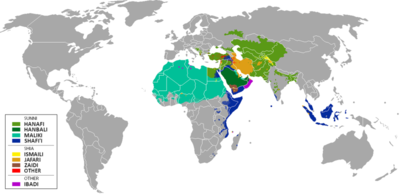
The Sunnis consist of four sects, Hanafis, Shafi'is, Malikis, and Hanbalis, so-called after the names of their respective founders.
speaker_4NARRATOR
The other sects, who are called Shia'is, an appellation particularly given to the Persian sect, but also used to designate generally all who are not Sunnis, are regarded in nearly the same light as those who do not profess al-Islam, the Muhammadan faith, that is, as destined to eternal punishment.
speaker_4NARRATOR
The Muhammadan faith embraces the following points.

Shuaib MalikGUEST
I don't have a problem with that.
Shuaib MalikGUEST
Ibn Abidin, for example, uh, who wrote a well-known fiqh corpus, uh, within the Hanafi madhab.
Shuaib MalikGUEST
He seems a bit more skeptical.
Shuaib MalikGUEST
Maybe this was just a juristic exercise perhaps.
50 more episodes mention Hanafi school.
Create an account to see the whole feed, search across every transcript, and follow the entities you care about.