Hamiltonian
31
MENTIONS
16
EPISODES
13
PODCASTS
Search complete. 31 mentions across 16 episodes found for "Hamiltonian".
Oct 30, 2026

speaker_7HOST
It takes a massive, specific spike in energy to kick that ball completely out of the valley and over the mountain into a new phase.
speaker_6HOST
So two materials are in the same phase if their Hamiltonians can smoothly connect without eliminating that protective energy valley.
speaker_6HOST
It ensures stability.
speaker_7HOST
Exactly.
speaker_7HOST
And when it becomes a mixed state, that deep valley, the Hamiltonian, literally ceases to exist mathematically.
speaker_7HOST
The map is just gone.
speaker_6HOST
So what does this all mean? If pure states are like a perfectly sealed terrarium, but mixed states are like opening the window to a hurricane, and we've just lost our mathematical map because the Hamiltonians are gone, how do scientists even begin to categorize this mess? You're basically blindfolded.
speaker_7HOST
That is the exact wall the field has been slamming into.

Type 3 AudioNARRATOR
The sum from I equals one to N of L of X sub I comma W with the population loss defined via the standard N right arrow infinity limit.
Type 3 AudioNARRATOR
One thing about the loss that sometimes goes underappreciated is that it looks a lot like what we might call a parameterized Hamiltonian.
Type 3 AudioNARRATOR
To see this, note that we can read the empirical loss as a total energy, written as a sum of energies of individual particles in the system.
Type 3 AudioNARRATOR
Each data point is a particle, and L of X sub I comma W is its energy when the model has parameters W.
Christian FerkoGUEST
And the last part, there's this segment right at the end of Sabina's little rant when she talks about a different area, something called loop quantum gravity.
Christian FerkoGUEST
So she says, at the end, seeming to compare this lack of a well-defined Lagrangian in GU, partially due to this undefined Shiab operator, to some other difficulties in this other theory, loop quantum gravity, where there are issues in finding a well-defined Hamiltonian, which is something a bit like a Lagrangian.
Christian FerkoGUEST
So she asks,
Sabine HossenfelderSOUNDBITE_SPEAKER
or how about loop quantum gravity? Do they have a well-defined Hamiltonian? Where is the classical limit?
Christian FerkoGUEST
So here I partly agree.
Christian FerkoGUEST
I agree with Sabina that there are serious problems with loop quantum gravity that have not yet been overcome, which is why personally I don't work on it.
Christian FerkoGUEST
And few people work on it nowadays compared to other areas like string theory.
Christian FerkoGUEST
And the two criticisms that she leveled are essentially correct, that loop quantum gravity, it does have what's called a well-defined kinematical Hilbert space, but they have not yet realized the Hamiltonian constraint in an anomaly-free way.

Hiroshi OoguriGUEST
Well, uh, so the way that we learn quantum field theory in graduate school is, uh, that generaliz- the way that you generalize quantum mechanics to this spatial field.
Hiroshi OoguriGUEST
So in quantum mechanics, as you know, you have classical dynamical system described by Lagrangian or Hamiltonian, and then you apply the, uh, procedure called quantization, and then, uh, formulate time evolution, wave functions, and et cetera.
Hiroshi OoguriGUEST
And the way we learn quantum mechanics in graduate school, and it's the way that, uh, all the textbook of quantum field theory is written, is to apply that to the dynamics of field, like, uh, electromagnetic fields or, uh, fi- fields of quarks and leptons in the case of a standard model.
Hiroshi OoguriGUEST
And, uh, so, so you start with Lagrangian, you apply the methods of quantization, and then the, the theory is a quantum field theory.

Dave FarinaHOST
Essentially, just as F equals ma applies to Newtonian systems, the Schrödinger equation applies to quantum systems by describing the system's three-dimensional wave function, represented by the Greek letter psi.
Dave FarinaHOST
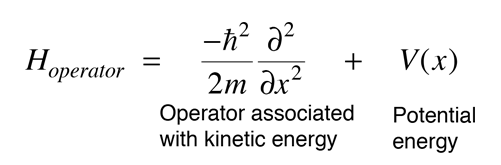
In this equation, this term is called the Hamiltonian operator, which is a set of mathematical operations that describes all the interactions that are affecting the state of the system, which can be interpreted as the total energy of a particle.
Dave FarinaHOST
But while the Schrödinger equation can calculate the wave function of a system, it does not specifically reveal what the wave function is.
Dave FarinaHOST
Max Born proposed that we interpret the wave function as a probability amplitude, where the square of the magnitude of the wave function describes the probability of an electron existing in a particular location.

BrunoGUEST
Okay.
Jason SorokoHOST
So the oracle, the Hamiltonian, the, the black box, you have to really think hard about what you want the quantum computer to do for you.
Jason SorokoHOST
Way harder thinking that you, than you ever had to do.
Jason SorokoHOST
Now, I, we, I wish you had the benefit of being here earlier today.
Jason SorokoHOST
And just before this talk, Bruno, you and I were talking about AI and its role in this.
BrunoGUEST
Yeah.
Jason SorokoHOST
AI is the perfect companion to help to stand up the Hamiltonian, the, the black box, the quantum circuit necessary.
Jason SorokoHOST
I absolutely would never have been able to create a, um, a quantum circuit capable of solving for Grover's algorithm just on my own.

Abhi ChopraGUEST
you bring it to linear that all of that is classical process.
Abhi ChopraGUEST
Once you are ready to put that into quantum, then from there on, you basically have to make it a Hamiltonian system.
Abhi ChopraGUEST
So Hamiltonian can be solved in the NISQ error through like variational circuit and in quantum native error through like HHL type of algorithms.
Abhi ChopraGUEST
But that's how things work.
Abhi ChopraGUEST
Now, when we started doing that, because the approach is how we are linearizing the problem is still your classical method of finite element, finite volume type of methods.

Stephen IbarakiHOST
So you definitely ha- are differentiated for full stack, right? You design the superconducting processors, control architecture, software, cloud and on-premise systems, application services, qubit to cloud.
Stephen IbarakiHOST
You have the coherent analog route, you know, using flux-on-name-based processors to encode a problem in the system Hamiltonian, and then evolve towards a useful low-energy solutions, avoiding the many long gate sequences for targeted, uh, workloads.
Stephen IbarakiHOST
You have a QASIC co-design, so treat the core processor application-specific, uh, chip interactions, algorithm, and use cases are designed together, uh, for optimization, molecular, uh, you know, material simulation, quantum-enhanced AI.
Stephen IbarakiHOST
Um, you have multimodal realism, so r- uh, routes work across analog quantum, digital quantum, CPUs, GPUs, rather than just presenting one architecture as universal.

Daniel J. GuerraHOST
So, valence shell electron pair repulsion, the VSEPR, V-S-E-P-R, is a well-known theory.
Daniel J. GuerraHOST
And according to that theory, where like spin electrons avoid each other and unlike spin electrons form pairs, we have to understand that wave mechanics have to then invoke what's known as Coulomb and exchange integrals of the kinetic and electrostatic terms that ultimately arise in what's called the Hamiltonian.
Daniel J. GuerraHOST
So the purpose of all of this is to bridge that dialectic.
Daniel J. GuerraHOST
In particular, to be able to experimentally, of course, not just theoretically, isolate the influences of electron anti-symmetric spatiotemporal moments that we know must be occurring within biological membrane molecular structures.

WolfmanHOST
Analytical mechanics.
WolfmanHOST
Advanced formulations like Lagrangian mechanics and Hamiltonian mechanics use energy and calculus of variations instead of direct forces to solve complex motion.
WolfmanHOST
Most users agree that rigorous college courses distinguish themselves by moving past basic forces into these advanced mathematical frameworks.
WolfmanHOST
I want to get into Hamiltonian mechanics.
WolfmanHOST
That's one of the ones written down on my list.
WolfmanHOST
We want to know about quantum mechanics.
16 MINS LATER
WolfmanHOST
Hamilton's Principle.
WolfmanHOST
Conserved Quantities, Rigid Bodies and Tops.
6 more episodes mention Hamiltonian.
Create an account to see the whole feed, search across every transcript, and follow the entities you care about.