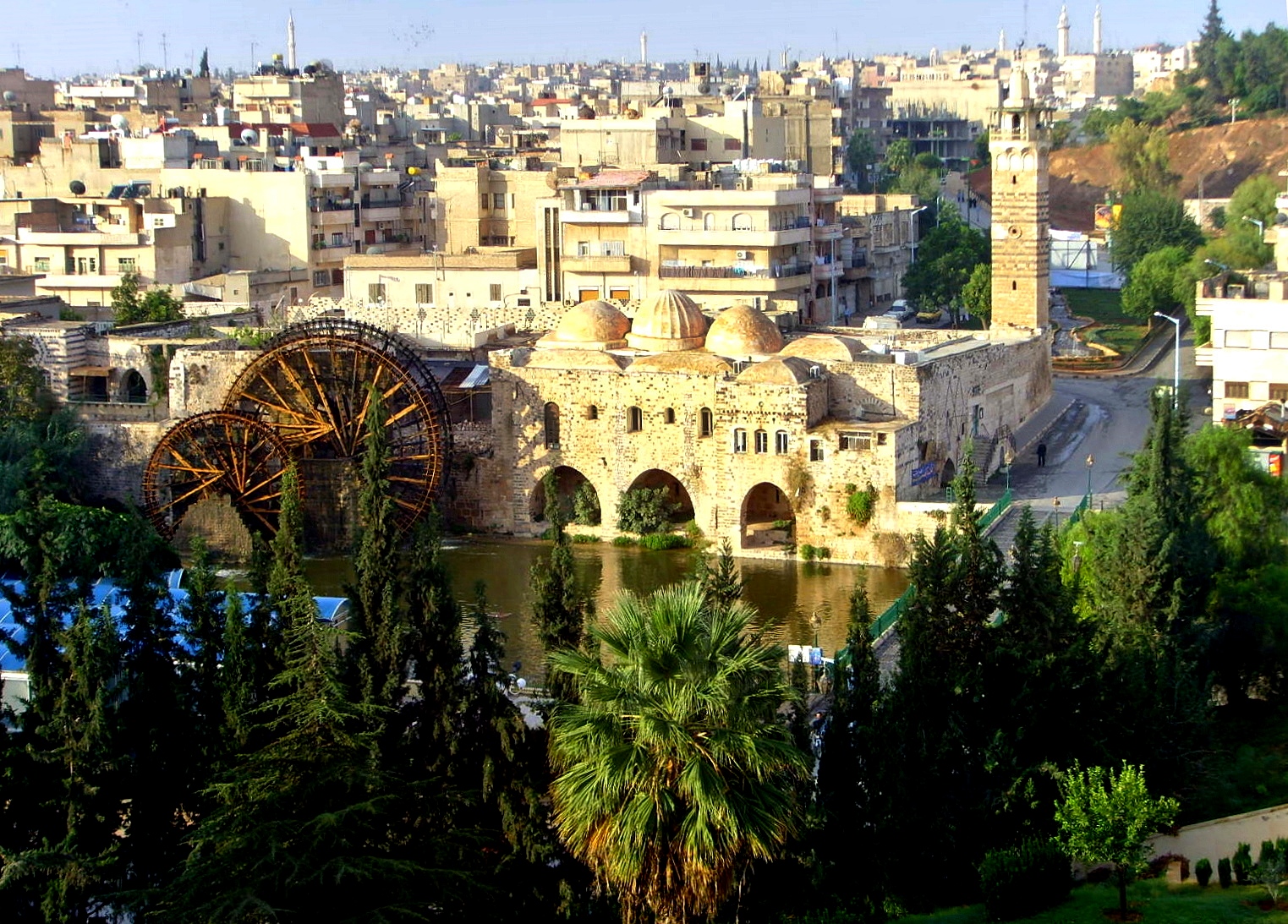
Hama
City in SyriaWikipedia
110
MENTIONS
74
EPISODES
55
PODCASTS
Search complete. 110 mentions across 74 episodes found for "Hama".
Oct 12, 2026

speaker_1NARRATOR
and he did what was evil in the sight of the Lord, according to all that his fathers had done.
speaker_1NARRATOR
And Pharaoh Necho put him in bonds at Riblah in the land of Hamath, that he might not reign in Jerusalem, and laid on the land a tribute of a hundred talents of silver and a talent of gold.
speaker_1NARRATOR
And Pharaoh Necho made Eliakim the son of Josiah king in the place of Josiah his father, and changed his name to Jehoiakim.
speaker_1NARRATOR
But he took Jehoahaz away, and he came to Egypt and died there." And Jehoiakim gave the silver and the gold to Pharaoh, but he taxed the land to give the money according to the command of Pharaoh.
7 MINS LATER
speaker_1NARRATOR
And from the city he took an officer who had been in command of the men of war, and five men of the king's council who were found in the city, and the secretary of the commander of the army who mustered the people of the land, and sixty men of the people of the land who were found in the city.
speaker_1NARRATOR
And Nebuchadnezzar, the captain of the guard, took them and brought them to the king of Babylon at Riblah.
speaker_1NARRATOR
And the king of Babylon struck them down and put them to death at Riblah in the land of Hamath.
speaker_1NARRATOR
So Judah was taken into exile out of its land.

Ekemini UwanHOST
He did evil on the side of the Lord, as his ancestors had done.
Ekemini UwanHOST
Pharaoh Necho imprisoned him in Riblah, in the land of Hamath, and prevented him from ruling in Jerusalem.
Ekemini UwanHOST
He imposed on the land a special tax of 100 talents of silver and a talent of gold.
Ekemini UwanHOST
Pharaoh Necho made Josiah's son Eliakim king in Josiah's place and changed his name to Jehoiakim.

Catherine WilliamsHOST
The first reading is from the Second Book of Kings, beginning at chapter 17, verse 24.
Catherine WilliamsHOST
The King of Assyria brought people from Babylon, Kutha, Avah, Hamath, and Sepharvaim and placed them into the cities of Samaria in place of the people of Israel.
Catherine WilliamsHOST
They took possession of Samaria and settled in its cities.
Catherine WilliamsHOST
When they first settled there, they did not worship the Lord.
Catherine WilliamsHOST
He told them how they should worship the Lord.
Catherine WilliamsHOST
But every nation still made gods of its own and put them in the shrines of the high places that the people of Samaria had made, every nation in the cities in which they lived.
Catherine WilliamsHOST
The people of Babylon made Succoth-benoth, the people of Cuth made Nergal, the people of Hamath made Ashima, the Avites made Nibhaz and Tartak.
Catherine WilliamsHOST
The Sepharvites burned their children in the fire to Adrammelech and Anammelech, the gods of Sepharvaim.
Kevin HarrisonHOST
You've heard what the kings of Assyria have done to all the countries, destroying them completely.
Kevin HarrisonHOST
Will you be delivered? Did the gods of the nations that were destroyed by my predecessors, Gozen, Haran, Rezif, and the people of Eden and Telassar, save them? Where's the king of Hamath or the king of Arpad? Where's the king of Sefervaim, Hena, or Iva? Hezekiah received the letter from the messengers and read it.
Kevin HarrisonHOST
Then he went up to the temple of the Lord and spread it out before him.
Kevin HarrisonHOST
And Hezekiah prayed to the Lord, saying, Lord of heaven's armies, God of Israel, you sit enthroned between the cherubim.

Nathan BrownHOST
the main reason.
Nathan BrownHOST
So, now you've made me curious, because I know you were not just born in Saudi Arabia, you were born in Ta'if, and I'm a political scientist, So I know political places and if I associate with the agreement that essentially brought an end to the Lebanese civil war, but you said your family's from Syria and I understand from the city of Hama, which again, as a political scientist, I associate with the essentially the uprising and the very brutal suppression of the uprising in 1982, in which thousands and thousands of residents were killed.
Nathan BrownHOST
So these are not...
Nathan BrownHOST
These are places with very, very strong associations.
Nathan BrownHOST
So tell us a little bit about your association with these places and how your own individual history maps with this.
Aktham AlwanyGUEST
Exactly.
Aktham AlwanyGUEST
As you said, Nathan, my father's family was from Hama.
Aktham AlwanyGUEST
a city known for its anti-Assad resistance in the early 80s.

Jackie Hill PerryHOST
Behold, you have heard what the kings of Assyria have done to all lands, devoting them to destruction.
Jackie Hill PerryHOST
And shall you be delivered? Have the gods of the nations delivered them, the nations that my fathers destroyed, Gozan, Haran, Rezif, and the people of Eden who were in Telassar? Where is the king of Hamath, the king of Arpat, the king of the city of Sepharvaim, the king of Hena, or the king of Iba? Hezekiah received the letter from the hand of the messengers and read it.
Jackie Hill PerryHOST
And Hezekiah went up to the house of the Lord and spread it before the Lord.
Jackie Hill PerryHOST
And Hezekiah prayed to the Lord, "'O Lord of hosts, God of Israel, enthroned above the cherubim, you are the God, you alone, of all the kingdoms of the earth, you have made heaven and earth.

Kevin HarrisonHOST
Don't let Hezekiah mislead you by saying, The Lord will deliver us.
Kevin HarrisonHOST
Has the God of any nation ever delivered his land from the hand of the king of Assyria? Where are the gods of Hamath and Arpad? Where are the gods of Sepharvaim? Did they rescue Samaria from my hand? Who of all the gods of these countries has been able to save his land from me? How then can the Lord deliver Jerusalem from my hand? But the people remained silent and said nothing in reply, because the king had commanded, Don't answer him.
Kevin HarrisonHOST
Then Eliakim son of Hilkiah, the palace administrator, Shebna the secretary, and Joah son of Asaph the recorder, went to Hezekiah with their clothes torn and told him what the field commander had said.
Kevin HarrisonHOST
Colossians chapter 2 I'm fighting powerfully for you, for those in Laodicea, and for all who haven't had the chance to meet me face to face.

Ray OrtlundHOST
Behold, you have heard what the kings of Assyria have done to all lands, devoting them to destruction.
Ray OrtlundHOST
And shall you be delivered? Have the gods of the nations delivered them, the nations that my fathers destroyed, Gozan, Haran, Rezeph, and the people of Eden who were in Telassar? Where is the king of Hamath, the king of Arpad, the king of the city of Sepharvaim, the king of Hena, or the king of Ivvah?” Hezekiah received the letter from the hand of the messengers and read it.
Ray OrtlundHOST
And Hezekiah went up to the house of the Lord and spread it before the Lord.
Ray OrtlundHOST
And Hezekiah prayed to the Lord, “O Lord of hosts, God of Israel, enthroned above the cherubim, you are the God, you alone, of all the kingdoms of the earth.

Mauryell Smith-ElGUEST
Uh, so politically, again, um, coming from...
Mauryell Smith-ElGUEST
So Egypt is based off of the uniting of the two lands, the uniting of Upper and Lower Egypt, and it was pretty much signified through the rule of Narmer, or Menes, who he's called.
Mauryell Smith-ElGUEST
Now, with that being said, in alignment with putting forth what the prophet laid down, he talks about how the Egyptians are the Hamathites and a direct descendant of Mizraim.
Mauryell Smith-ElGUEST
Um, there's a lot of studies out there that try to align Mizraim with Menes or Narmer, the one who united, um, uh, both Upper and Lower Egypt, and it also, uh, through the Hamathites, Hamath was a city in s- uh, ancient pre-modern Syria, [phone pings] uh, which kind of alludes also to the, uh, period of the Hyksos in Egyptian history.
Mauryell Smith-ElGUEST
Um, but prior to the Hyksos even ruling Egypt, um, there were waves and waves of migrations, generations before then.
Mauryell Smith-ElGUEST
So when I state that the Lower Egypt was, well, had people coming from the Levant and the Eastern Nile Delta, um, it shows through those movements of the Hyksos throughout generations that end up coming to rule Egypt, uh, right before between the Middle and the New Kingdom.
Mauryell Smith-ElGUEST
Not necessarily, you know, genetically, quote unquote, but politically a part of the Amorite movements.
Mauryell Smith-ElGUEST
In fact, um, the migration where Abraham in the Bible goes from Ur to the Chaldees up north, up the Euphrates River to Haran and then down into Canaan, is actually a archeological evidence trade route, or a migration route, of the Amorites.

Abu IbrahimGUEST
Although the surroundings of the masjid are still damaged by the war.
Abu IbrahimGUEST
In Hama, you have the famous Norius water wells and the Orentas River, which is a sight to see.
Abu IbrahimGUEST
And in Aleppo, although Aleppo was greatly affected by the war, it is being rebuilt.
Abu IbrahimGUEST
So the famous citadel of Aleppo was damaged during the war, and it was actually closed for quite some time after the liberation.
Abu IbrahimGUEST
So in Homs, as I mentioned before, we have Masjid Khalid ibn Walid, where Khalid ibn Walid is buried alongside his son Abd al-Rahman.
Abu IbrahimGUEST
And you have Ubaidullah ibn Umar ibn al-Khattab, also buried within the Masjid.
Abu IbrahimGUEST
And in Hama, we take people to the Norse worlds, we take them to a madrasa built by Nur al-Din Zinki.
Abu IbrahimGUEST
In Idlib countryside, there's the resting place of the fifth righteous Khalif, Khalifa of Islam Omar ibn Abdulaziz alongside his wife.
64 more episodes mention Hama.
Create an account to see the whole feed, search across every transcript, and follow the entities you care about.