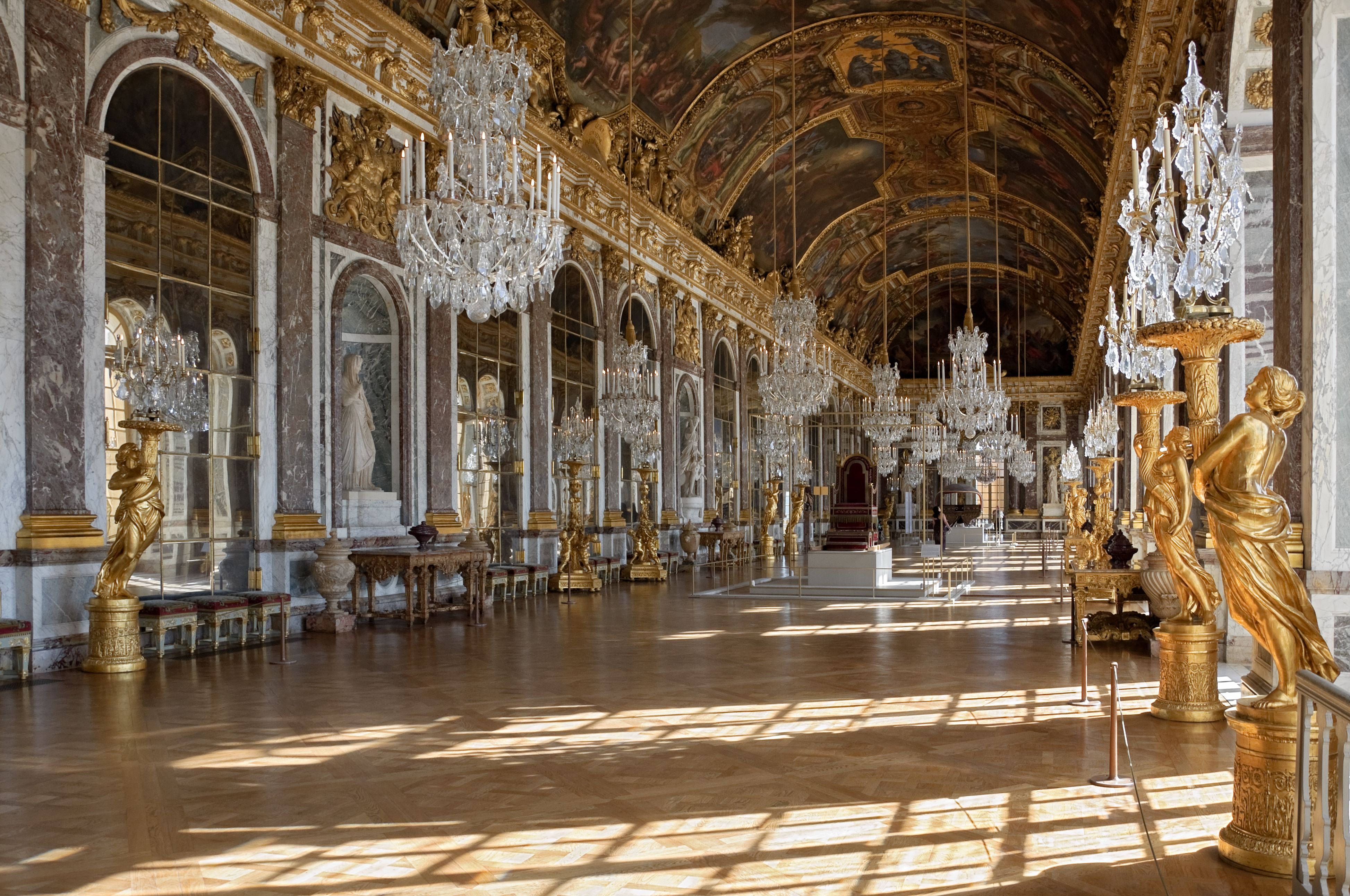
Hall of Mirrors
Castle in Versailles, FranceWikipedia
54
MENTIONS
22
EPISODES
21
PODCASTS
Search complete. 54 mentions across 22 episodes found for "Hall of Mirrors".
Nov 24, 2026

David PawsonHOST
It's marvelous to enter the throne room.
David PawsonHOST
I was walking through the rooms of the Palace of Versailles last Tuesday afternoon, the Hall of Mirrors and those fabulous decorations right through that magnificent building.
David PawsonHOST
But after walking through many rooms, there was one room smaller than the rest, and yet you felt now we have reached the heart of the palace.
David PawsonHOST
It was the throne room.

Lizzie BassettHOST
And also, I mean, there had been very limited access to the palace for previous films.
Lizzie BassettHOST
There had been upwards of 200 movies that had filmed on the grounds, but most of those had been relegated to the gardens, occasionally the famous Hall of Mirrors.
Lizzie BassettHOST
They didn't really give them access to a lot of the rest of Versailles.
Lizzie BassettHOST
And what this movie needed was access to the palace itself.

Oana RinaldiHOST
During the Baroque period, art became more dramatic and grandiose, with mirrors epitomizing opulence and the play of light.
Oana RinaldiHOST
Louis Ziv's Hall of Mirrors at Versailles stands as a testament to this era's extravagance.
Oana RinaldiHOST
Artistic depictions from this period utilize the mirror's ability to enhance the dynamism of light and perspective, symbolizing the grandeur of divine presence and the illusion of space within two-dimensional art.
Oana RinaldiHOST
Chapter 4.

John MerrimanHOST
Germany is not unified until 1871.
John MerrimanHOST
Ironically, unification proclaimed in the Hall of Mirrors at the Chateau of Versailles, which we'll visit for a few seconds later on.
John MerrimanHOST
The fact that German unification was achieved by and that Prussia was dominated by nobles, who were called Junkers, you'll come to them later, and by an army in which the state basically was an appendage of the army, had rather enormous consequences for Europe in the late nineteenth and above all in the twentieth century.
John MerrimanHOST
In the 1960s and 1970s, people paid a lot more attention to social structure and class analysis.

speaker_3SOUNDBITE_SPEAKER
The defeated Germans accepted the Allies' conditions.
speaker_3SOUNDBITE_SPEAKER
And in the Hall of Mirrors, on the 28th of June 1919, the Treaty of Versailles was signed, creating the League of Nations.
speaker_3SOUNDBITE_SPEAKER
But before the ink was dry, the nations were forging a different destiny.
Larry FedorukHOST
Don't want to get too deep into the history here, but the Treaty of Versailles officially ended World War I and placed heavy economic sanctions and reparations on Germany.

Rory SutherlandGUEST
The Buc-ee's approach was, if you make it top quartile, nobody will actually notice, and they just think they got lucky.
Rory SutherlandGUEST
Instead, what Buc-ee's do is the women's restrooms are like the Hall of Mirrors at the Palace of Versailles.
Rory SutherlandGUEST
In other words, they've doubled down on the thing.
Rory SutherlandGUEST
Now, classic example, one of my arguments is that most really significant innovations are psychological as much as they are technological.

Mark ChrislerHOST
Most of them were inspired by, even derivative of, other great structures, but blown up to gargantuan, parodic scales.
Mark ChrislerHOST
Speer's Reich Chancellery, for example, was built to rival Versailles, with a marble gallery specifically twice as long as the Hall of Mirrors.
Mark ChrislerHOST
Hitler gave Speer just a single year to build this enormous palace, a feat Speer accomplished with 48 hours to spare.
Mark ChrislerHOST
He pulled it off thanks to a long list of cheats and shortcuts, along with a bottomless pile of money and the forced labor of tens of thousands of POWs, homosexuals, Roma, and Jews, all working in round-the-clock shifts until they dropped dead.

speaker_3GUEST
Can you imagine? It's quite considerable.
speaker_3GUEST
It's three times the budget of the Hall of Mirrors, for instance.
speaker_3GUEST
The royal chapel has two stories, like any Palatine chapel, but this one took on a dimension which was unheard of.
speaker_3GUEST
On the ground floor was the court, and upstairs, on the same level as his apartments, was the king surrounded by his family.

John GreenHOST
The French were handily defeated, with Napoleon III and an army of 150,000 people captured on September 2nd.
John GreenHOST
The Bavarians, along with smaller states, then had to join Prussia, and in January of 1871, the German Empire was declared in the Hall of Mirrors at the Versailles Palace, and all because of Luxembourg.
John GreenHOST
Although much of the earlier opposition to Bismarck had died down at this point, he still had to forge a nation from these disparate states, one with its own institutions and its own culture.
John GreenHOST
This was a fraught task, which he did in his signature style, more experimentally than sure-footedly.

RosannaHOST
Then Châteauroux died on the 8th of December 1744, which removed the obstacle.
RosannaHOST
On the night of the 25th of February 1745, Versailles held a vast masked ball in the Hall of Mirrors.
RosannaHOST
The occasion was the marriage of the dauphin, the king's son, to the Spanish infanta Maria Teresa Rafaela.
RosannaHOST
The dauphin had married her two days earlier.
12 more episodes mention Hall of Mirrors.
Create an account to see the whole feed, search across every transcript, and follow the entities you care about.