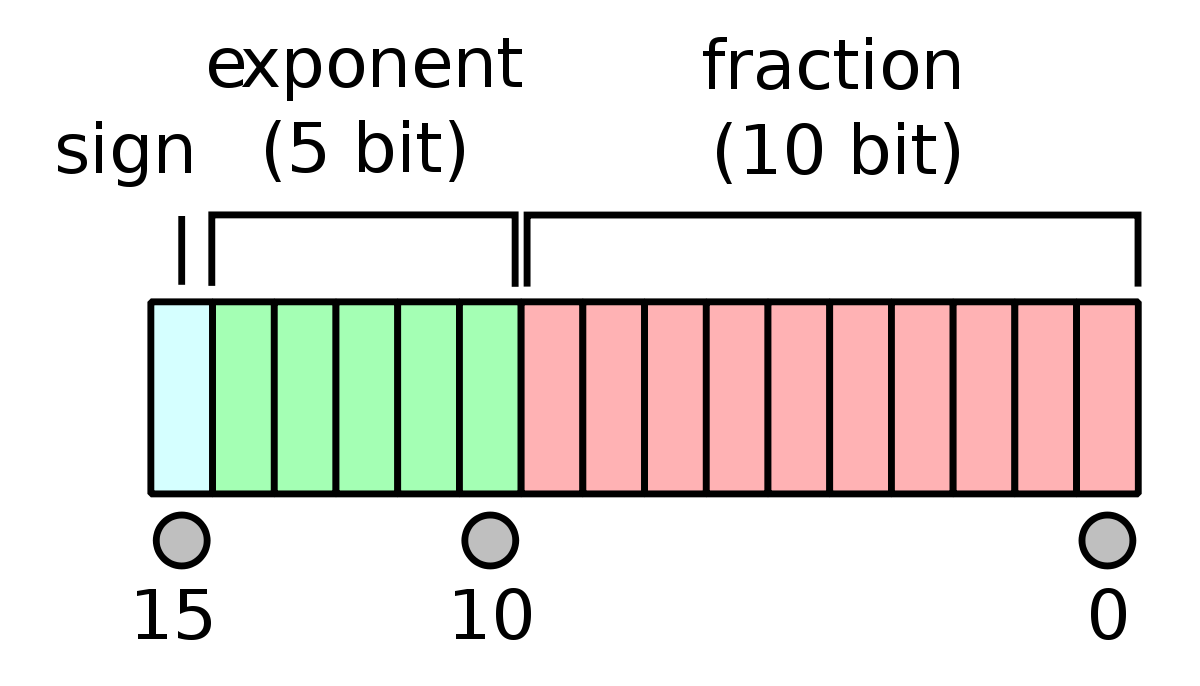
Half-precision floating-point format
22
MENTIONS
9
EPISODES
7
PODCASTS
Search complete. 22 mentions across 9 episodes found for "Half-precision floating-point format".
Oct 17, 2026

Edward OjamboHOST
FP8 support is the newest frontier for high-efficiency AI workflows.
Edward OjamboHOST
It allows models to run, uh, with half the memory or F- FP16.
Edward OjamboHOST
Remember, FP16 is basically also half the memory of [chuckles] floating point 32.
Edward OjamboHOST
Legacy enterprise cards absolutely completely blind to this optimization.
Herman PoppleberryHOST
And the bill is real.
Herman PoppleberryHOST
GPT-3, a hundred and seventy-five billion parameters, two thousand token context, about nine gigabytes of KV cache per request in FP16.
Herman PoppleberryHOST
Ninety-six layers, two thousand and forty-eight tokens, two vectors, twelve thousand two hundred and eighty-eight dimensions, two bytes each.
Herman PoppleberryHOST
Nine gigabytes per conversation before you've stored a single weight in gradient adjacent anything
Herman PoppleberryHOST
The cache became the thing you optimize around, not the model Give me the memory hierarchy part, because I know you've been waiting.
Herman PoppleberryHOST
Standard attention materializes the full score matrix N by N in high bandwidth memory.
Herman PoppleberryHOST
At four thousand and ninety-six tokens in FP16, the scores in the softmax output are thirty-two mebibytes each.
Herman PoppleberryHOST
Four intermediate trips through memory move about a hundred and twenty-eight mebibytes per layer per head, and the actual answer, the output tensor, is one mebibyte So ninety-nine percent of the traffic is scaffolding.

Herman PoppleberryHOST
Memory bandwidth utilization, which is really DRAM activity, is one thousand and five.
Herman PoppleberryHOST
Then the pipe activities, FP64, FP1002, FP16 at one thousand and six, one thousand and seven, one thousand and eight.
Herman PoppleberryHOST
PCIe transmit and receive bytes at one hundred and nine and ten ten.
Herman PoppleberryHOST
NVLink transmit and receive bytes at one one and one twelve.

Neil MisakPANELIST
So by compressing it, it cuts the memory reads in half.
Neil MisakPANELIST
So Blackwell supports FP8, KV natively, Apple stuck at FP16.
Neil MisakPANELIST
I'm gonna give kudos to Matt Kamusi who provided this analogy.
Neil MisakPANELIST
He said, imagine a highway memory bandwidth.

TomHOST
As Sony has been struggling for any good news recently, QSSR came out of nowhere and it is genuinely a pleasant surprise.
TomHOST
Somehow Sony squeezed a PSSR-derived model onto a 2020 GPU just using FP16.
TomHOST
Notably, a similar challenge AMD took on with the promise of releasing FSR 4 and RDNA 2.
TomHOST
I think that's supposed to come out early next year.
TomHOST
...
TomHOST
when they have sign- they do have more teraflops and I believe support, uh, one of the other, um, compute types that PlayStation 5 doesn't.
TomHOST
They wouldn't have to use FP16.
TomHOST
So they'd actually have quite a leg up with an upscaler versus base PS5 and yet Xbox is nowhere.

Rich LeadbetterHOST
I guess we should kick off by talking about, you know, what is QSSR? And it's really interesting, right? Because fundamentally, the PlayStation 5 Pro has got dedicated machine learning instructions, Int8 support, which the base PlayStation 5 doesn't have.
Rich LeadbetterHOST
So instead, what QSSR is, is effectively a version, a refactoring of PSSR streamlined for FP16, which PS5 does support with the benefit of rapid-packed math.
Rich LeadbetterHOST
So we actually had the opportunity to pose some questions to Sony's Daniel Craig, not that one, principal engineer, graphics R&D SIE.
Rich LeadbetterHOST
So basically, he describes it as a drop-in replacement for titles that already support PSSR.
Rich LeadbetterHOST
But we'll talk about performance later.
Rich LeadbetterHOST
Anything to add to that, Oliver?
Oliver MackenziePANELIST
Oh, not too much, just to say that the general approach of basically porting over PSR from INT8 to FP16 is surprising, but that does seem like, you know, obviously that's the way that you have to go here.
Oliver MackenziePANELIST
FP16 is a much more general and more precise data format.

HackerNoon AINARRATOR
Choose Ternary Bonsai 27 BGGUF when it's reported 7.
HackerNoon AINARRATOR
2GB footprint, 95% FP16 intelligence retention claim, or approximately 26 tokens per second on an Apple M5 Pro laptop matches your deployment target.
HackerNoon AINARRATOR
The supplied comparison data does not establish a direct quality or speed test between that model and this crack build.
HackerNoon AINARRATOR
ternary bonsai-8b gguf choose when you need higher model capacity 27b class reasoning vision support and the crack refusal profile choose ternary bonsai-8b gguf when lower memory use and faster local inference matter more than 27b class capability the supplied information identifies the 8b model as a ternary 1 58 bit gguf model bit does not provide its file size or speed here Ternary Bonsai 1.7 BGGUF Choose for quality, reasoning depth, vision, and tool use experiments.
HackerNoon AINARRATOR
Choose Ternary Bonsai 1.7 BGGUF for lightweight edge deployment, quick tests, or workloads where a 27B model is too large.
HackerNoon AINARRATOR
The supplied material does not provide a direct benchmark, file size, or tokens per second comparison.
HackerNoon AINARRATOR
bonsai 27 bgg uf choose when you want the newer bonsai 2 family ternary packaging vision support and explicit refusal circuit removal choose bonsai 27 bgg uf when asmaller approximately 3 9 gigabytes binary model and it's reported approximately 44 tokens per second on an apple m5 pro laptop are more important than the crack model's stated capability preservation target The alternative reports approximately 90% of FP16 intelligence retained, while this model's supplied MMLU comparison is against its ternary base rather than FP16.
HackerNoon AINARRATOR
Technical specifications, has these confirmed properties, task, text-to-text generation, pipeline, parameter scale, 2.7b, architecture, hybrid attention plus SSM using gated delta net, Depth.
CornHOST
Int8 is the sweet spot.
CornHOST
Float16 is workable if you have a TPU.
CornHOST
Float32 is desktop territory.
CornHOST
Int4 is aggressive but works for tiny models.

Thomas SohmersGUEST
Well, it's pretty quickly realized that having 32 bits precision was super overkill for the things that you're wanting to represent and, you know, it's both cost more from a storage and computational perspective than lower precision.
Thomas SohmersGUEST
So we went to FP16, you know, Google developed BF16, you know, a little rejiggering of those bits.
Thomas SohmersGUEST
Went to FP8, now we're at FP4, you know, in popular systems.
Thomas SohmersGUEST
And so we've been reducing the precision quite quickly, but that does lead to, you know, for lack of better word, some brain loss when, when these models run, just because you are now trying to encode the, the same information into fewer bits.
Thomas SohmersGUEST
And so there's been a lot of interesting schemes to say, "Okay, I'm going to take this group of FP16 values or BF16 values, and I'm going to quantize those, so I'm going to, you know, use a truncate and rounding that, that down to, let's say, int4 values." So now you, you actually saved 75% of your total size of that group of values.
Thomas SohmersGUEST
You shrunk that down from 16 bits to 4 bits.
Thomas SohmersGUEST
But just doing that naively will mean that on a lot of benchmark scores, you'll have them get 20, 30% worse.
Thomas SohmersGUEST
So you, you get that 75% savings in, in space, but y- you kind of lobotomize the model.