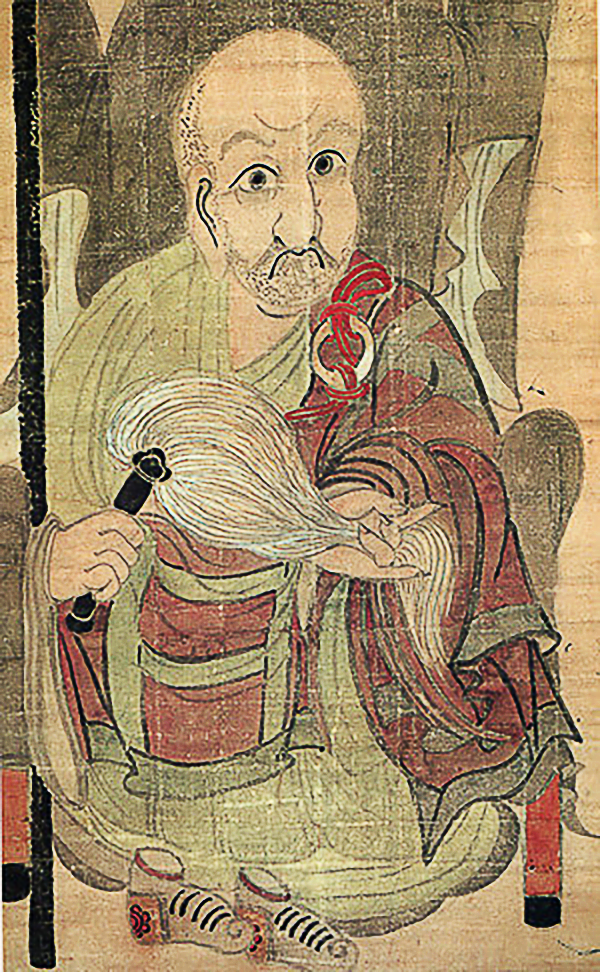
Hakuin Ekaku
Japanese artistWikipedia
27
MENTIONS
12
EPISODES
12
PODCASTS
Search complete. 27 mentions across 12 episodes found for "Hakuin Ekaku".
Oct 28, 2026

Melissa BlackerHOST
The dream of pure land or a lotus land, which is at the center of so many religions, including some types of Buddhism.
Melissa BlackerHOST
And in Zen, we say and There's a line in the beautiful song by Hakuin, a song of Zazen, that the pure land is right here, that we're standing in the middle of it.
Melissa BlackerHOST
This is what it looks like.
Melissa BlackerHOST
Whether it's before so-called awakening or after, we need to not be fooled into thinking that one way is good and the other is bad.

Rafe MartinHOST
I wonder, too, whether Wu Men, in The Gateless Barrier, in saying 500 fox lives, might not have been making sly reference to the Pali Jataka and its 500-plus past-life stories of the Buddha, many in animal form.
Rafe MartinHOST
Zen ancestors like Wan Wu, Lin Chi in China, Dogen and Hakuin in Japan, all refer to Jataka so effortlessly, it's clear they held them in esteem.
Rafe MartinHOST
So why not Wu Men? Because Jatakas in their teaching of karma, lifetimes, and the vow of the Bodhisattva are central to Buddhism, not add-ons, they have been told, carved, painted, performed, and written throughout Buddhist Asia for the last 2,500 years.
Rafe MartinHOST
Two major strands, totaling 600 tales or so, still survive out of what was obviously a larger oral tradition.

KenseiGUEST
And interestingly, Seppo is the slower one to develop in the Dharma, but he ends up with a huge monastery with like 1,500 monks and dozens of successors.
KenseiGUEST
And Ganto also has a monastery, but it gets attacked by the bandits, and he gets speared to death on his seat, and his scream goes out for miles, which later inspires Hakuin in his quest for enlightenment and his search, traveling throughout space and time to our story today here.
KenseiGUEST
Seppo's enlightenment in the snow.
KenseiGUEST
So this story takes place when these two are in their later stages of their training.

Kathie FischerGUEST
Um, how, first of all, how Sōtō Zen tradition differentiated from Rinzai, and that happened gradually, primarily in Japan.
Kathie FischerGUEST
[coughs] So Japanese ancestor Hakuin created undoubt-undoubtedly in collaboration with others, the codified curriculum of koan practice in which students, a student is given successive koans to work with, meets with the teacher repeatedly, uh, to demonstrate her understanding until each koan is mastered according to the requirements of the curriculum.
Kathie FischerGUEST
Hakuin was a beloved and highly acclaimed Japanese Rinzai Zen teacher.
Kathie FischerGUEST
There's a famous story about him in which a young woman accused him of fathering her child.
Kathie FischerGUEST
The young woman and her family go to Hakuin's temple to hand him the baby and confront him with this.
Kathie FischerGUEST
His only response is, "Oh, is that so?" He took in and he cared for the baby.
Kathie FischerGUEST
The young woman felt badly about this, and at some time later, she confessed to her father, to her family, what she had done.
Kathie FischerGUEST
That is, falsely accuse Hakuin of fathering her child.

Sangen SaloHOST
And I believe, I want to believe that this practice is for the sake of all beings.
Sangen SaloHOST
Meaning that we do it so we practice this, we are practitioners of the way so that we can using our body, speech and mind that we could walk through the days without disturbing too much maybe stretching our hands and helping if needed but but also like this like what like what I just said could become again something that I I crap I'm grasping anything could be the thing even nothing so that we we make this thing whatever it is we make it something that then we are we are grasping it and by doing so we maybe accidentally are causing disturbances and unpleasant unpleasant moments we also might ask why should I let go even if I have if I have acquired something if I have worked for something is it is it always so that we have to open our hands is it always so that I have to let go if I have something that I really like and it's mine and I'm grasping is that wrong or right or something in between well I think it's not that kind of question at the end Hakuin Senji I came across this word and it was a sangang probably because it a little bit reminds me my name I was interested in so stupid it was one text that he was giving advice for the monk for a monk and and he said that this monk should investigate sangang and then I got a bit curious what is this sangang and it is threefold contemplation threefold contemplation and I just asked this that should we get open our hands all the time no matter what so not grasping ever and I don't think we can make decision so easily always but then this threefold contemplation for example that Hakuin Senji was suggesting to this monk to discover first of all it's not the Zen typical Zen practice necessarily I mean everything can become one but this is a Tendai sect of Buddhism that are using this method although I don't really see why it is not for example Zen practice as well or in general practice but anyways that is something that they do there it's maybe even one of their main practices and it is about contemplating three different things and one is sunyata emptiness the other one is impermanence and the third one is the middle way but this teaching about sunyata or emptiness mu even oku impermanence was it anika in sanskrit perhaps and the middle way aren't they something that are anyway kind of openly exposed for us all the time but perhaps we just don't notice it them I mean nature itself for example or anything but nature itself like the color of the sky the incense burning candle lights drinking paraffin from the candles all those flowers and trees that we have in a little bit more there in Sanneji than here obviously but the nature is there very much expressing itself in the way that it's not holding back anything So maybe we could say that that is just the way things are.
Sangen SaloHOST
So it's not so much my opinion or how I would like to have it to be.
Sangen SaloHOST
I can try as much as I want to grasp and see how it goes.

Ewan MagieHOST
So there are a number of poems that Hamill presents here.
Ewan MagieHOST
But the one I thought maybe that makes sense to us is the one that's in his essay, Sitting Zen, Working Zen, Feminist Zen, where he presents "10,000 Sutras" after Hakuin's meditation sutra.
Ewan MagieHOST
So I thought I'd read that one.
Ewan MagieHOST
It's on page 115 into 116.
Ewan MagieHOST
Praise our body, even in samsara.
Ewan MagieHOST
Our bodies are the body of the Buddha.
Ewan MagieHOST
Our bodies are the body of the Buddha." So this one here clearly, after Hakuin, feels less like an individual Sam Hamill poem like some of the others later in the collection, and more like Sam's immersion in Zen Buddhist practice.
Ewan MagieHOST
Did anything stand out for you as I read it?

Sunya KjolhedeHOST
So we have to, and in this Active Hope book, they talk about shifting it to a connected self.
Sunya KjolhedeHOST
And the Hakuin chant we just did together talks about this true self that is no self.
Sunya KjolhedeHOST
It's a tricky thing.
Sunya KjolhedeHOST
As soon as you mention self, it seems to reify that there's a self.

speaker_5NARRATOR
And we have to stop doing the destructive thinking that they spend 99% of their time doing.
speaker_5NARRATOR
The 18th century Zen master Hakuin was highly critical of teachers who believed that enlightenment was simply a matter of thinking nothing.
speaker_5NARRATOR
Instead, he wanted his students to think really, really hard.
speaker_5NARRATOR
This is why he assigned them perplexing koans, like what is the sound of one hand clapping? And what did your face look like before you were born? And does the dog have the Buddha nature? These questions defy easy answers, and that's the point.
speaker_5NARRATOR
By taking the time to meditate on them deeply, in some cases for days and weeks or even years, Students put their mind in such a clarified state that deeper truths emerge and enlightenment commences, and even if they don't get all the way there, they are stronger for having tried.
speaker_5NARRATOR
Suddenly, Hakuin promised his students, unexpectedly your teeth sink in, your body will pour with cold sweat.
speaker_5NARRATOR
At the instant, it will all become clear.
speaker_5NARRATOR
The word for this was Satori, an illuminating insight when the inscrutable is revealed.

Ram DassSOUNDBITE_SPEAKER
A lot of people ask about heaven and hell.
Ram DassSOUNDBITE_SPEAKER
A soldier named Nobushige came to Hakuin and asked, do heaven and hell really exist? Who are you? Inquired the master.
Ram DassSOUNDBITE_SPEAKER
I am a samurai, the warrior replied.
Ram DassSOUNDBITE_SPEAKER
You a samurai? Hakuin exclaimed.
Ram DassSOUNDBITE_SPEAKER
What kind of ruler would have you as his guard? You have the face of a beggar.
Ram DassSOUNDBITE_SPEAKER
Nobushige became so angry that he reached for his sword.
Ram DassSOUNDBITE_SPEAKER
But Hakuin continued.
Ram DassSOUNDBITE_SPEAKER
So you have a sword.

Ekai Joel KreisbergHOST
So remember and choose is a very important koan.
Ekai Joel KreisbergHOST
Because how do we remember? What are the obscurations? What are the aspects of self that continue to arise that get in the way? What are the circumstances around us that cause us to forget? So paying attention and reflecting upon our experience matters so it's not just simply a concentration practice anymore and actually it wasn't simply a concentration practice when Hakuin created the koan curriculums that he created but rather than a koan curriculum of stories from 10 centuries ago or 15 or 12 it's the dharmas that are arising in this day and age How do we make sense of this moment in time from an awakened perspective? And that's where we show up with compassion.
Ekai Joel KreisbergHOST
And that's where we learn from how our minds work.
Ekai Joel KreisbergHOST
That's where we learn from noticing how we show up for others.
2 more episodes mention Hakuin Ekaku.
Create an account to see the whole feed, search across every transcript, and follow the entities you care about.