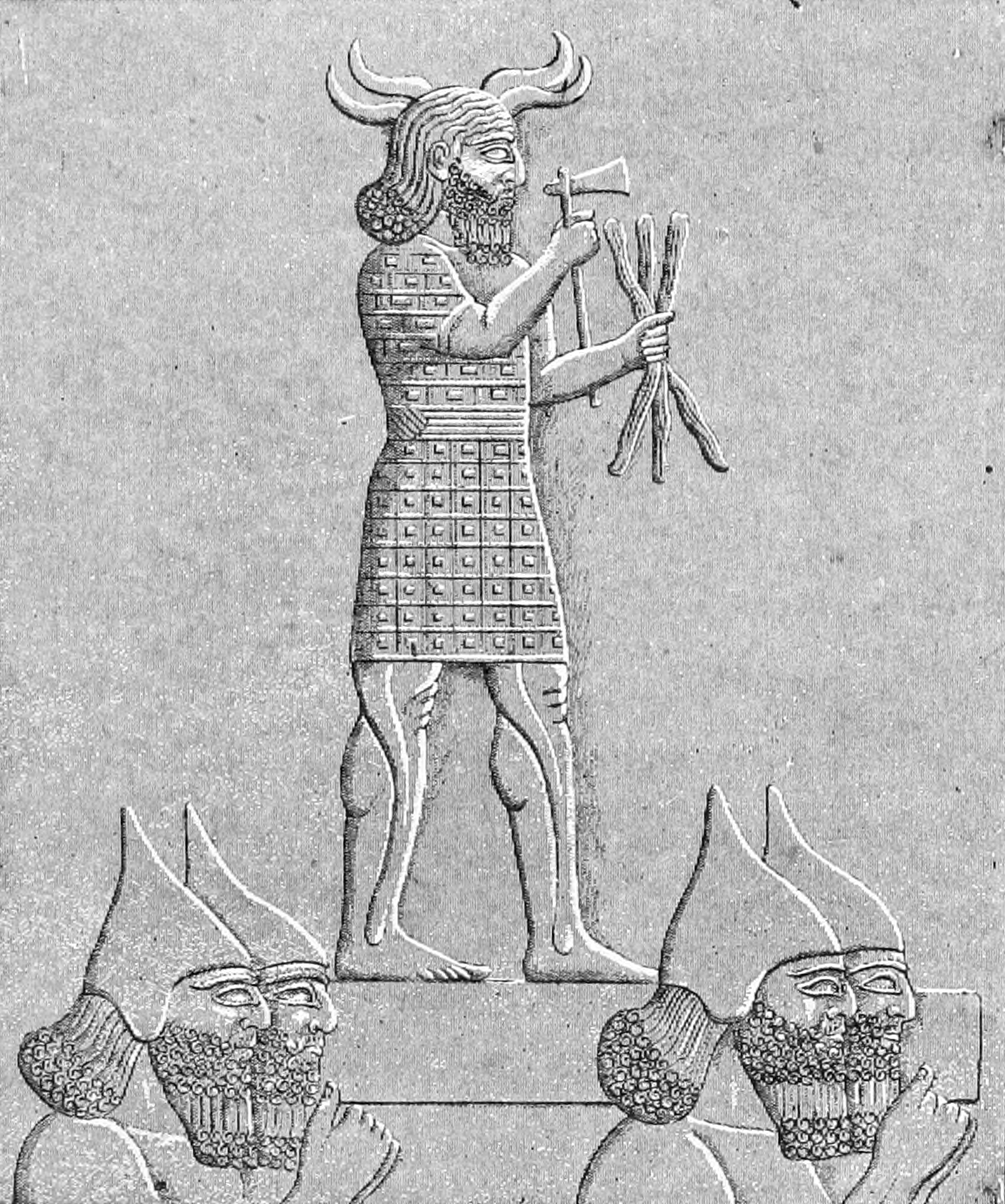
Hadad
GodWikipedia
33
MENTIONS
14
EPISODES
13
PODCASTS
Search complete. 33 mentions across 14 episodes found for "Hadad".
Oct 5, 2026

Heather M. ByeNARRATOR
The older name of the country was Kumusu, and it may be that the language spoken in it was allied to that of the Hittites, since a tablet in hieroglyphics of the Hittite type has been unearthed at Toprak Kala.
Heather M. ByeNARRATOR
One of the newly found inscriptions of Sardurus III shows that the name of the Assyrian god, hitherto read Raman or Riman, was really pronounced Hadad.
Heather M. ByeNARRATOR
It describes a war of the Vanic king against Assur-Nirari, son of Hadad-Nirari, Adadi-Nirari of Assyria, thus revealing not only the true form of the Assyrian name, but also the parentage of the last king of the older Assyrian dynasty.
Heather M. ByeNARRATOR
From another inscription, belonging to Rusas II, the son of Argistus, we learn that campaigns were carried on against Hittites and the Moshi in the later years of Sennacherib's reign, and therefore only just before the eruption of the Cimmerians into the northern regions of Western Asia.
Heather M. ByeNARRATOR
The two German explorers have also discovered the site and even the ruins of Muzazar, called Ardennis by the people of Van.

Heather MbyeNARRATOR
The older name of the country was Kumusu, and it may be that the language spoken in it was allied to that of the Hittites, since a tablet in hieroglyphics of the Hittite type has been unearthed at Toprak Kala.
Heather MbyeNARRATOR
One of the newly found inscriptions of Sardurus III shows that the name of the Assyrian god, hitherto read Raman or Riman, was really pronounced Hadad.
Heather MbyeNARRATOR
It describes a war of the Vanic king against Assur-nirari, son of Hadad-nirari, Adadi-nirari of Assyria, thus revealing not only the true form of the Assyrian name, but also the parentage of the last king of the older Assyrian dynasty.
Heather MbyeNARRATOR
From another inscription, belonging to Rusas II, the son of Argistus, we learn that campaigns were carried on against Hittites and the Moshi in the later years of Sennacherib's reign, and therefore only just before the eruption of the Cimmerians into the northern regions of Western Asia.
Heather MbyeNARRATOR
The two German explorers have also discovered the site and even the ruins of Muzazar, called Ardenis by the people of Van.

Monty MaderHOST
In the Babylonian king list, the seventh king before the flood is Emenduranki of Sippar and the sun god of Shamash.
Monty MaderHOST
A cuneiform text from the library of Ashurbanipal, 7th century BCE, says the gods of Shamash and Adad brought Emenduranki into their assembly, seated him on a golden throne, and taught him the secrets of heaven and earth.
Monty MaderHOST
divination by oil and by the liver, the tablets of the gods.
Monty MaderHOST
Beside him stand the Apaklu, seven sages before the flood who taught humanity the arts of civilization.

JasonHOST
It's a play on the name Baal Zebul, which means prince of the manor.
JasonHOST
This was another name for Baal Hadad, the Canaanite god associated with grain, storms, and national prosperity.
JasonHOST
By changing the name to Baal Zebub, the meaning is changed to the Prince of Flies, and means that he is no longer the Lord of a heavenly manor, but the Lord of excrement.
JasonHOST
Jesus then states that he who is not with him is against him, taken from Mark 9.40, and that who does not gather scatters.

Kyle KempfNARRATOR
Each was dying, rising, savior gods, Osiris, Isis, Zeus, Helios, Cybil, and Attis, Adonis, and Mithra.
Kyle KempfNARRATOR
Some trace the roots of these gods back to the Old Testament period, with Baal-Hadad, a dying, rising god, and Tammuz, who was mourned in Jerusalem.
Kyle KempfNARRATOR
Others believe the mystery religions can be traced back to India or Babylon.
Kyle KempfNARRATOR
A common belief arose in the late 19th century that the Mithra cult or Mithraism was a serious challenge to the early church.

DianaHOST
A black cloud rises on the horizon.
DianaHOST
Inside it is Adad, the storm god.
DianaHOST
Thunder rolls.
DianaHOST
The storm is coming.
DianaHOST
But Adad isn't first.
DianaHOST
Shalott and Hanush are.
DianaHOST
They move ahead of him, crossing the land as his heralds, his vanguard, announcing what is coming before it arrives.
DianaHOST
Different version, different text, same job.

speaker_0NARRATOR
This time he sends drought.
speaker_0NARRATOR
The rain god Adad is commanded to hold back the skies.
speaker_0NARRATOR
Rivers shrink, canals run low, fields dry out under the heat.
speaker_0NARRATOR
Grain does not rise from the earth.

Elsie SelwynNARRATOR
Amianshe himself reigned over the province of Kadima, a word which in Semitic denotes the east.
Elsie SelwynNARRATOR
Finally, the only one of their gods known to us, Hadad, was a Semite deity who presided over the atmosphere, and whom we find later on ruling over the destinies of Damascus.
Elsie SelwynNARRATOR
Peoples of Semitic speech and religion must, indeed, have already occupied the greater part of that region on the shores of the Mediterranean, which we find still in their possession many centuries later, at the time of the Egyptian conquest.
Elsie SelwynNARRATOR
For a time Egypt preferred not to meddle in their affairs.
5 HRS 31 MINS LATER
Elsie SelwynNARRATOR
The Rabbinic Hebrew still employs this plural form in the sense of demons.
Elsie SelwynNARRATOR
The Phoenician inscriptions contain references to several local Rashufs.
Elsie SelwynNARRATOR
The way in which this god is coupled with the goddess Kodshu on the Egyptian stelae leads me to think that at the epoch now under consideration he was specially worshipped by the Amorites, just as his equivalent Hadad was by the inhabitants of Damascus, neighbors of the Amorites, and perhaps themselves Amorites.
Elsie SelwynNARRATOR
End footnote.

Dan McClellanHOST
And that's where our scene is laid at the beginning of Acts 23.1, where he basically is given the floor and he starts off by saying, up to this day, I have lived my life with a clear conscience.
Dan McClellanHOST
before god and then the high priest says hey smack him and uh
Dan BeecherHOST
which is a pretty like that's pretty funny like i mean i guess he just said not guilty really and then they're like oh yeah well what if we hit you now how does that taste yeah i can i
Dan McClellanHOST
can just uh i i would love to see monty python do this and have somebody up there going smite him and uh Or maybe that's more a it's always sunny in Philadelphia kind of vibe.
38 MINS LATER
Dan McClellanHOST
And the king of Israel...
Dan McClellanHOST
Entered previously in my father's land, and Hadad, this is the Aramean storm deity.
Dan McClellanHOST
In the Aramean world, where they speak Aramaic, the storm deity is the head god of the pantheon, and Hadad is that storm deity.
Dan McClellanHOST
Baal Hadad is a conflation of Baal with Hadad.

Joseph OlaHOST
These are their genealogies.
Joseph OlaHOST
The firstborn of Ishmael was Nebajoth, then Kedar, Adbil, Mipsam, Mishma, Duma, Masa, Hadad, Tema, Jethor, Naphish, and Kedema.
Joseph OlaHOST
These were the sons of Ishmael.
Anu OlaHOST
Now the sons born to Keturah, Abraham's concubine, were Zimran, Jokshan, Medan, Midian, Ishbak, and Shua.
Joseph OlaHOST
And when Bela died, Jobab, the son of Zerah of Bozrah, reigned in his place.
Joseph OlaHOST
When Jobab died, Husham of the land of the Temanites reigned in his place.
Joseph OlaHOST
When Husham died, Hadad, the son of Bedad, who attacked Midian in the field of Moab, reigned in his place.
Joseph OlaHOST
The name of his city was Avith.
4 more episodes mention Hadad.
Create an account to see the whole feed, search across every transcript, and follow the entities you care about.